
Capital Flight from Sui to Noomez: A Strategic Shift in Risk-Adjusted Crypto Exposure
Sui's Stagnation: A Case of Technical and Structural Weakness
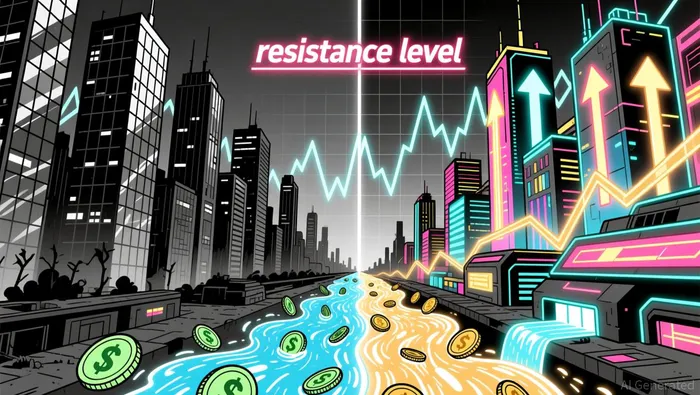
Sui's price action in late 2025 underscores a critical juncture for the protocol. Despite institutional backing and growing DeFi adoption, SUI has been unable to surpass the $1.73 resistance level, instead consolidating within a narrow range of $1.58 to $1.73 in a single day. This indecision has eroded investor confidence, with 24-hour trading volumes spiking to $1.17B-a sign of heightened uncertainty and profit-taking. Technical indicators like the RSI and MACD further reinforce this narrative, suggesting a prolonged consolidation phase rather than a breakout. Meanwhile, the circulating supply of 3.68B SUI (out of a maximum 10B) remains a looming overhang, as future supply unlocks could exacerbate downward pressure.
Noomez's Presale: Liquidity Security as a Hedge
In contrast, Noomez's presale has captured market attention through its deflationary mechanics and liquidity-secured design. The project's 28-stage presale model, governed by audited smart contracts, ensures transparency and predictability. A key feature is the automatic burning of unsold tokens at the end of each stage, which reduces circulating supply and creates scarcity. Additionally, 15% of the total token supply is locked for liquidity, while team allocations are subject to a 6–12 month vesting schedule, aligning incentives with long-term holders. These mechanisms notNOT-- only stabilize the token's value but also provide investors with a clear roadmap for supply reduction, a stark contrast to Sui's opaque supply dynamics.
Noomez's structured approach extends to its incentive systems. Early buyers in Stage 4, for instance, are rewarded with a 4 million $NNZ draw for spending $20, while a 10% referral program amplifies organic growth. The Noom Gauge-a real-time dashboard tracking presale progress-further enhances trust by making token burns and liquidity locks verifiable on-chain. These features collectively create a sense of urgency and credibility, critical in a market where volatility often deters participation.
Strategic Implications: Risk-Adjusted Exposure in a Polarized Market
For investors, the shift from Sui to Noomez represents a strategic recalibration of risk-adjusted returns. While bullish analysts predict Sui could surge by late 2025 if it stabilizes above key support levels, the asset's current volatility and lack of clear catalysts make it a high-risk bet. Noomez, on the other hand, offers a more calculated path: its fixed 280B supply, combined with a 66% APY staking reward, provides both capital appreciation and yield-generating potential. This dual utility-hedge against volatility and income generation-positions Noomez as a versatile tool in diversified crypto portfolios.
Moreover, Noomez's presale acts as a natural hedge against macroeconomic headwinds. As Sui's price consolidates, the token's liquidity security-via locked reserves and burn events-reduces exposure to sudden market shocks. This is particularly relevant in a landscape where large-cap assets are increasingly susceptible to institutional redemptions and regulatory scrutiny.
Conclusion: A Paradigm Shift in Investor Priorities
The capital flight from Sui to Noomez is not merely a short-term trend but a reflection of evolving investor priorities. In an environment where volatility and uncertainty dominate, liquidity-secured presales like Noomez's offer a structured, transparent alternative to traditional large-cap exposure. By prioritizing deflationary mechanics, on-chain accountability, and yield incentives, Noomez addresses the core pain points of crypto investors-liquidity risk, price instability, and opaque governance. As the market continues to mature, such projects may well define the next phase of risk-adjusted crypto investing.






Comentarios
Aún no hay comentarios