
Capital Flight from US Bitcoin ETFs Amid November 2025's $903M Outflow: Investor Sentiment and Macroeconomic Triggers
Investor Sentiment: Fear, Institutional Caution, and Retail Flight
The Fear and Greed Index for cryptocurrencies plummeted to 15 in November 2025-the lowest of the year-highlighting a climate of extreme fear typically associated with market bottoms. This metric aligns with record outflows from U.S. spot Bitcoin ETFs, including a single-day redemption of $903 million on November 21. While institutional investors have not entirely abandoned Bitcoin-cumulative ETF inflows still stand at $57.4 billion-there is a clear trend of position trimming. For example, BlackRock's IBITIBIT-- saw $355.5 million in net outflows during the month, signaling a strategic rebalancing rather than a wholesale exit.
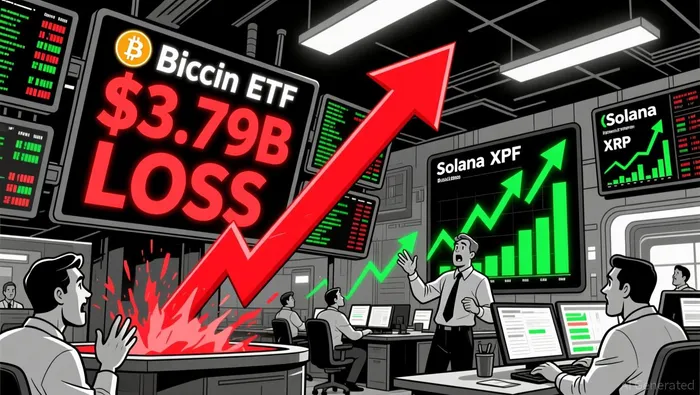
Retail investors, however, have been more reactive. The $3 billion in ETF redemptions reflects capitulation, with many retail participants selling amid Bitcoin's seven-month low of $83,461. This divergence between institutional and retail behavior underscores the market's complexity: while long-term holders like Mubadala Investment Company and the Czech Republic increased Bitcoin holdings, retail demand weakened, creating a tug-of-war between optimism and panic as market participants seek alternatives.
Macroeconomic Triggers: Fed Inaction, Trumpian Uncertainty, and Inflation Fears
The Federal Reserve's decision to maintain interest rates at 5.25% for three consecutive meetings has exacerbated uncertainty. Chair Jerome Powell's emphasis on "economic uncertainty" as a reason for delaying rate cuts has left investors in limbo, with the Fed's reduced odds of a December rate cut (now at 46%) further dampening risk appetite. This inaction has been compounded by political turbulence: President Donald Trump's blistering criticism of Powell-calling him a "FOOL"-and his proposed tariffs have stoked fears of inflation and recession, complicating the Fed's policy calculus.
The interplay between these factors has created a perfect storm for Bitcoin ETFs. Historically, November has been a bullish month for Bitcoin, with an average 41.22% price increase. Yet in 2025, the cryptocurrency's performance has been stifled by macroeconomic headwinds, including a weakening correlation with gold and leveraged position liquidations.
Regulatory Shifts and Market Reallocation
Regulatory ambiguity has also played a role in the outflows. While the U.S. lacks clear guidance on crypto asset classification, investors are increasingly shifting capital to alternative coins with perceived utility. SolanaSOL-- and XRPXRP-- ETFs attracted $289.8 million in inflows during November, as market participants sought assets less correlated to Bitcoin's volatility. This reallocation highlights a broader trend: investors are diversifying their crypto portfolios to mitigate risk amid regulatory and macroeconomic headwinds.
Technical indicators further reinforce bearish sentiment. The fourth "death cross" signal-where short-term momentum dips below long-term trends-has emerged as a red flag for traders. Meanwhile, smart money positions have turned net short on Bitcoin, with cumulative short positions rising by $5.7 million in 24 hours.
Conclusion: A Market at a Crossroads
The November 2025 outflows from U.S. Bitcoin ETFs represent a critical inflection point. While extreme fear metrics and institutional caution suggest a potential market rebound, the macroeconomic and regulatory environment remains fraught. Investors must weigh the Fed's policy trajectory, Trump's economic agenda, and the evolving regulatory landscape when assessing Bitcoin's long-term prospects. For now, the crypto markets are in a holding pattern-waiting for clarity on interest rates, regulatory frameworks, and the broader economic outlook.





Comentarios
Aún no hay comentarios