
Canadian Utilities Ltd.'s Preferred Share Redemption Strategy: A Catalyst for Shareholder Value and Capital Efficiency
Canadian Utilities Ltd. (TSE: CU) has long been a staple for income-focused investors, but its recent moves to redeem preferred shares signal a strategic shift that could reshape its capital structure and unlock value for shareholders. With the upcoming redemption of its Cumulative Redeemable Second Preferred Shares Series FF on December 1, 2025, the company is sending a clear message: it's time to streamline obligations and reinvest in growth. Let's break down what this means for investors.
The Redemption Playbook: Series FF and Beyond
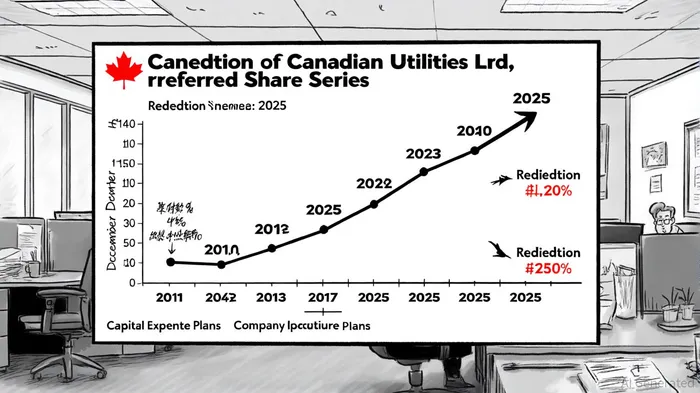
Canadian Utilities announced the redemption of all outstanding Series FF shares at $25.00 per share, totaling $250 million, funded entirely from available cash, according to a company press release. This follows a pattern seen in other preferred share series, such as Series AA and DD, which have redemption prices declining from $26.00 to $25.00 over time, according to a Series AA listing. By systematically retiring higher-cost preferred shares, the company is reducing its fixed obligations while leveraging its strong liquidity position. For example, Q1 2025 cash flow surged 27% year-over-year to $637 million, providing ample firepower for these redemptions without diluting equity, according to the Q1 2025 slides.
Capital Structure Optimization: A Strategic Imperative
The redemption strategy is part of a broader $5.8 billion three-year capital plan focused on expanding electricity and natural gas infrastructure, including projects like the Yellowhead Pipeline and CETO. By retiring preferred shares, Canadian Utilities is simplifying its capital structure, which could lower its weighted average cost of capital (WACC). Analysts note that the company's debt-to-equity ratio of 1.58 already reflects a heavy reliance on debt, but reducing preferred share dividends-currently $0.28125 per quarter for Series FF-could free up cash for reinvestment or debt reduction. This aligns with CEO commentary emphasizing prudence in capital allocation, particularly as Alberta's GDP growth and population trends create tailwinds for utility demand.
Shareholder Value: EPS and Dividend Dynamics
While management hasn't explicitly quantified the EPS impact of the Series FF redemption, the math is straightforward. Preferred dividends are subtracted from net income to calculate EPS. Removing the $250 million redemption cost (funded by cash, not earnings) and the final $0.28125 dividend could boost EPS by narrowing the denominator in the calculation. For context, 2025 EPS estimates stand at $2.39, with revenue projections of $4.12 billion, per analyst estimates. Additionally, the redemption of preferred shares may enhance the common dividend's sustainability. With a current payout ratio of 109.37%, reducing preferred obligations could ease pressure on earnings to fund the 4.71% yield for common shares.
Risks and Considerations
Critics might argue that the high debt load and a 36% year-over-year decline in EPS, according to a Simply Wall St analysis, could strain the company's ability to maintain its dividend. However, the focus on cash flow generation-bolstered by regulated utility operations-mitigates this risk. Moreover, the redemption of preferred shares at a discount to their historical liquidation preferences (e.g., Series 4 trading at a 42.4% discount) suggests undervaluation, as highlighted in a Nasdaq article, offering a safety net for shareholders.
The Bottom Line
Canadian Utilities' preferred share redemptions are more than routine maintenance-they're a calculated move to enhance capital efficiency and position the company for growth. By reducing fixed costs, optimizing leverage, and channeling cash into high-return projects, the company is laying the groundwork for higher EPS and a more resilient dividend. For income investors, this strategy offers a compelling mix of stability and upside, particularly as Alberta's infrastructure needs continue to expand.







Comentarios
Aún no hay comentarios