
Canadian Solar's Strategic Position in the Surging North American Energy Storage Market
A Market Primed for Disruption
The North American energy storage market is expanding at an unprecedented pace, fueled by three key drivers: state-level renewable mandates, falling battery costs, and IRA incentives. For instance, California's SB 100 and New York's 6 GW target by 2030 create clear procurement timelines that reduce capital risk for developers. Simultaneously, lithium iron phosphate (LFP) battery costs have dropped by up to 30% in North American gigafactories, driven by advanced manufacturing credits and economies of scale. The IRA's 30% investment tax credit for standalone storage further amplifies this momentum, incentivizing projects in regions lacking co-located solar generation.
These factors are reshaping the utility sector, where grid stability and renewable integration are now existential priorities. According to a report by Mordor Intelligence, the U.S. remains the largest market for battery energy storage systems (BESS), with Canada and Mexico following suit as supportive policies and infrastructure investments take hold.
Canadian Solar's Strategic Leverage
Canadian Solar has positioned itself at the nexus of these trends through a dual strategy of project development and manufacturing expansion. In Q3 2025, e-STORAGE reported record battery energy storage shipments of 2.7 GWh, far exceeding its guidance range of 2.1–2.3 GWh. This performance underscores the company's ability to scale rapidly, supported by a contracted backlog of $3.1 billion as of October 31, 2025.
The company's North American pipeline is particularly compelling. In Ontario, e-STORAGE is executing the Skyview 2 Energy Storage Project (411 MW / 1,560 MWh) in partnership with Potentia Renewables and the Algonquins of Pikwàkanagàn First Nation. This project, part of Ontario's LT1 procurement process, will deploy 390 units of e-STORAGE's proprietary SolBank 3.0 systems and is slated for commercial operation in Q2 2027. Separately, the Elora and Hedley projects (420 MW / 2,122 MWh) will add critical storage capacity to Ontario's grid under a 20-year Long-Term Service Agreement (LTSA) with performance guarantees as detailed in the company's latest report.
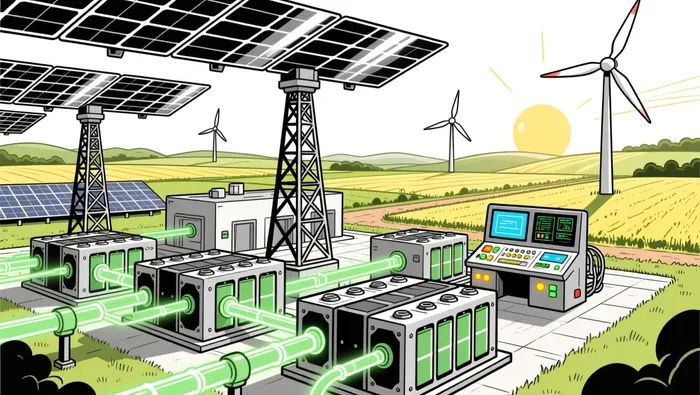
These projects highlight e-STORAGE's full-stack capabilities, from turnkey EPC services to long-term maintenance, which differentiate it in a market increasingly prioritizing reliability and performance. By 2026, Canadian Solar plans to ship 14–17 GWh of energy storage, a leap from its 2025 output, while its North American project pipeline stands at 24.332 GWh as of September 30, 2025.
Policy and Cost Tailwinds Amplify Competitive Advantages
The IRA's standalone storage tax credit is a critical enabler for Canadian Solar's growth. By reducing project costs and improving returns, the credit allows e-STORAGE to target markets previously constrained by financial or regulatory barriers. For example, the Roadrunner Solar and Energy Storage Project in Arizona-a 940 MWh initiative with $340 million in tax equity-demonstrates how IRA incentives can unlock large-scale deployments. Canadian Solar's U.S. manufacturing facilities further insulate it from supply chain risks, aligning with the Biden administration's push for domestic production.
Meanwhile, technological innovation is another pillar of the company's strategy. Graphenix Development Inc.'s work on silicon anode lithium-ion batteries-funded by a $1.9 million XTECH Army contract-signals a shift toward next-generation solutions that could reduce reliance on imported materials. While Canadian Solar has not yet disclosed direct ties to this project, its broader ecosystem of partnerships (e.g., with Aypa Power and Indigenous communities) reflects a commitment to localized, resilient energy systems.
Risks and Long-Term Resilience
Despite its strengths, Canadian Solar faces challenges, including raw material volatility and regulatory uncertainty in some states. However, its vertically integrated model-spanning manufacturing, project development, and long-term service agreements-mitigates these risks. The company's focus on utility-scale projects, which benefit from stable revenue streams and long-term contracts, further insulates it from short-term market fluctuations.
Conclusion: A Prime Position in a High-Growth Sector
Canadian Solar's strategic alignment with North America's energy storage boom is both timely and durable. With a $3.1 billion backlog, a 24 GWh project pipeline, and IRA-driven cost advantages, the company is uniquely positioned to capitalize on the region's $62.1 billion BESS market by 2034. As grid modernization accelerates and renewable mandates tighten, e-STORAGE's full-stack capabilities and manufacturing scale will likely drive sustained outperformance. For investors, this represents a compelling case of a company not just riding a trend, but actively shaping it.







Comentarios
Aún no hay comentarios