
Canadian Pacific Kansas City: A North American Rail Logistical Powerhouse with Resilient Margins and Structural Advantages
Canadian Pacific Kansas City Limited (CP:CA) has emerged as a standout player in the North American rail industry, leveraging its unique continental connectivity, operational discipline, and strategic integration to navigate macroeconomic headwinds while outperforming peers. As the only railroad connecting Canada, the U.S., and Mexico, CPKC's long-term competitive advantages are deeply embedded in its infrastructure and cross-border trade dynamics. With trade policies and nearshoring trends reshaping supply chains, CPKC's margin resilience and growth trajectory present a compelling case for investors seeking exposure to a structurally advantaged industrial asset.
Strategic Positioning: A Continental Land Bridge with Structural Tailwinds
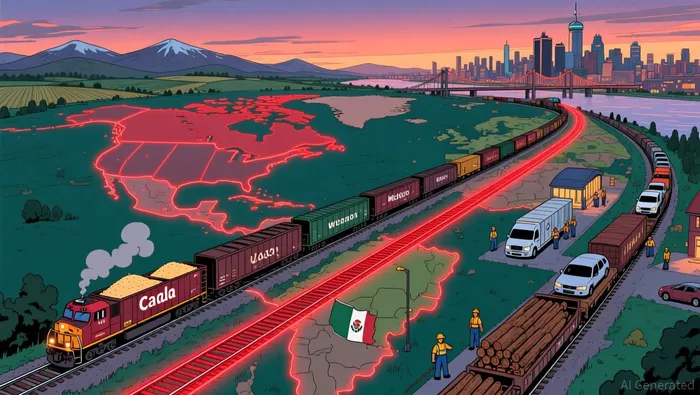
CPKC's merger with Kansas City Southern (KCS) in 2023 created a seamless rail network spanning 22,000 miles, connecting Canadian grain and potash exports to U.S. agricultural hubs and Mexican ports. This integration has positioned CPKC as the critical "land bridge" for North American trade, a role that is becoming increasingly valuable as supply chains shorten and nearshoring accelerates. CEO Keith Creel highlighted at the UBS Global Industrials and Transportation Conference 2025 that CPKC's ability to facilitate cross-border commerce-such as shipping Canadian aluminum and French fries to Mexico-has become a strategic differentiator.
The company's cross-border exposure accounts for 41% of its revenue according to freight data, with key sectors including autos, intermodal, lumber, and energy. While tariffs on steel and other goods have disrupted certain segments (e.g., cross-border steel shipments effectively halted at 50% tariffs), CPKC has offset these challenges by capitalizing on growth in autos and intermodal freight. For instance, the company reported an 85% year-over-year increase in coal revenues and an 11% rise in grain revenues in Q2 2025, underscoring its ability to adapt to shifting demand.
Operational Efficiency: A 180-Point Operating Ratio Improvement and Cost Synergies
CPKC's operational efficiency metrics in 2025 have outpaced peers like Canadian National (CN) and CSX. By mid-2025, its operating ratio had improved 180 basis points to 58.9%, driven by enhanced train velocity (up 1%), reduced terminal dwell time (down 2%), and cost synergies from the KCS integration. This performance reflects disciplined cost control and pricing strength, even amid a weak Canadian economy and global trade headwinds according to industry analysis.
The KCS integration is expected to deliver $1.2 billion in annual cost savings and $1.5 billion in revenue synergies by 2026 according to industry analysis, though execution risks remain. Nonetheless, CPKC's ability to achieve a 60.7% operating ratio in Q2 2025-despite narrowly missing earnings forecasts-demonstrates its margin resilience according to earnings call data. This is further supported by its focus on self-help initiatives, such as optimizing train productivity and leveraging automation.
Trade Policy Dynamics: Navigating Risks and Seizing Opportunities
Trade policies, particularly under the Trump administration, pose both challenges and opportunities for CPKC. Proposed 25% tariffs on goods from Mexico and Canada could disrupt cross-border traffic, though analysts anticipate a short-term volume surge as companies rush to ship before new tariffs take effect. CPKC's CEO has emphasized that the integration of North American markets has never been stronger, with nearshoring trends driving demand for its services.
While tariffs on steel have curtailed certain segments, CPKC's diversified revenue streams-spanning autos, lumber, and energy-have insulated it from sector-specific shocks. For example, the company's coal segment saw a 85% revenue increase in Q2 2025, reflecting robust energy demand. Additionally, CPKC's role in facilitating the movement of Canadian potash to U.S. and Mexican markets positions it to benefit from long-term agricultural demand.
Competitive Advantages: Outperforming Peers and Structural Tailwinds
CPKC's unique tri-national network provides a structural edge over peers like CN and CSX. Its operating ratio improvement of 180 basis points in 2025 outpaces CN's performance, driven by disciplined cost management and early synergy realization from the KCS integration. This efficiency, combined with its cross-border exposure, allows CPKC to generate mid-single-digit revenue ton-mile (RTM) growth and 12–18% year-over-year core adjusted EPS growth in 2025 according to investor reports.
Moreover, CPKC's integration with KCS has created a "continental advantage," enabling it to capture a larger share of North American trade flows. As U.S. manufacturing and Mexico's automotive sector expand, CPKC's role as a logistics enabler becomes increasingly critical. This is further reinforced by its participation in the Gemini partnership, which aims to enhance international grain exports through the Port of Prince Rupert according to earnings call data.
Investment Thesis: Margin Resilience and Growth in a Volatile Landscape
Despite near-term uncertainties from trade policies and global economic volatility, CPKC's margin resilience and operational discipline position it as a defensive growth play. Its ability to improve operating ratios while navigating a freight recession highlights its management's agility. Additionally, the company's focus on cost synergies, pricing power, and cross-border trade dynamics aligns with long-term structural trends like nearshoring and energy transition.
For investors, CPKC offers a rare combination of operational excellence, margin stability, and exposure to North American trade growth. With a 2025 growth plan targeting mid-single-digit RTM growth and 12–18% core adjusted EPS growth according to investor reports, the company is well-positioned to deliver value as it executes its integration roadmap and capitalizes on its continental network.







Comentarios
Aún no hay comentarios