
Canadian Gas Pipelines Near Breaking Point as Gulf Coast LNG Expansion Intensifies Bottleneck Risk
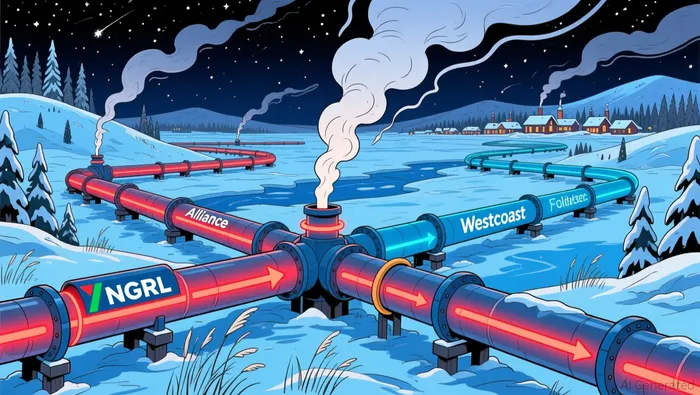
The physical flow of Western Canadian gas to the U.S. market is operating under significant strain, a condition that signals a tight supply-demand balance. Three major pipeline systems-NGTL, Alliance, and Westcoast-form the backbone of this export corridor, and they are consistently running at high utilization rates. This isn't a seasonal peak but a sustained pattern driven by robust production and persistent demand in downstream markets.
The system's vulnerability was starkly exposed in January 2025. During a period of extreme cold weather, throughputs on these pipelines surged, coming within a hair of exceeding available capacity. The data shows that at times, shipments can surpass reported capacity due to factors like colder temperatures packing more gas into the pipes and sudden demand spikes. That near-capacity event was a direct result of continued high production levels in the WCSB and the severe winter conditions that drove up heating demand across the border. It was a clear warning that the system's buffer is thin.
This physical tightness is mirrored in the price signals. In 2024, the price differential between the Western Canadian benchmark, AECO-C, and the U.S. Henry Hub benchmark widened to $1.29/MMBtu. That gap, more than double the previous year's spread, is a classic indicator of a constrained physical market. It reflects the cost of moving gas across the border and, more importantly, the premium buyers are willing to pay for reliable supply when domestic Canadian inventories are low and demand is high. The widening differential in a year of mild weather and regional oversupply suggests that even under normal conditions, the export infrastructure is a bottleneck.
Together, these points paint a picture of a system under pressure. High utilization rates mean there's little room for error or unplanned outages. The January event proved the system can be pushed to its limits. And the persistent price gap confirms that the market values this flow highly, pricing in the risk of disruption. For any new LNG project aiming to tap this supply, the baseline is clear: the existing flow is already tight, making the addition of new export capacity a critical need to avoid future bottlenecks.
The Bottleneck: Pipeline Limits and Storage Vulnerability
The physical constraints on the Canadian gas system are not just about the pipelines themselves; they are about the entire network's ability to absorb and redirect supply. The Canadian pipeline backbone, while not at full tilt, operates with a thin margin for error. Last year, the average utilization rate across the key export systems was 82%. That figure is a critical benchmark. It shows the system is running well below its theoretical 100% capacity, but in a market where demand is surging and weather can spike consumption overnight, that 18% buffer is a vulnerability. It means any disruption-a planned maintenance outage, a mechanical failure, or another cold snap-can quickly push the system toward the limits seen in January 2025.
This vulnerability is compounded by a failing safety net on the U.S. side. U.S. natural gas storage capacity is failing to keep pace with market growth. As the nation's gas market expands, particularly with new export terminals, the buffer designed to smooth out seasonal and daily demand swings is shrinking. For Gulf Coast LNG exporters, this is a direct risk. Storage is their primary tool for managing the volatility of global demand and the timing of ship sailings. A system with less storage flexibility is more exposed to price spikes during demand surges and more likely to face supply shortfalls when production dips. This dynamic makes the market more sensitive to any disruption in the flow of gas, whether from Canada or domestic sources.
The most telling sign of the system's constraints, however, is where new investment is flowing. The massive expansion of U.S. Gulf Coast LNG export capacity is not driving a push to re-route existing Canadian gas. Instead, it is driving demand for offshore feed-gas infrastructure. Projects like Golden Pass and Plaquemines LNG are focused on securing new supply from deepwater Gulf of Mexico fields via subsea pipelines and tiebacks. This strategic pivot indicates that the market sees offshore U.S. gas as a more reliable and scalable source for these new export terminals than trying to reroute constrained Canadian flows. It underscores that the Canadian pipeline system, even with its current capacity, is viewed as a bottleneck that cannot easily be overcome to meet the surging demand from the LNG export boom. The solution for new LNG capacity is not to fix the Canadian pipeline, but to build new supply sources offshore.
The Demand Surge: LNG Export Capacity and Feed Gas Needs
The demand for natural gas to fuel U.S. exports is growing at a pace that is outstripping the pipeline infrastructure needed to deliver it. The scale of the new capacity is staggering. Nearly 18 Bcf/d of new LNG export capacity is under construction or sanctioned along the Gulf Coast. This wave of projects, including the first phase of Golden Pass LNG, is set to dramatically increase the region's ability to ship gas overseas. Yet, the pipelines required to move the necessary feed gas remain a work in progress, creating a clear mismatch between export potential and supply logistics.
This demand is already reshaping the U.S. pipeline network. In 2025, a substantial portion of new pipeline capacity was dedicated to the Gulf Coast. Specifically, 85% of the new capacity added that year, or 5.3 Bcf/d, was dedicated to the South Central region. This region includes Texas and Louisiana, the heart of the LNG export boom. The projects built last year are primarily gathering systems and regional connectors, designed to pull gas from major shale plays like the Haynesville and Eagle Ford to hubs near the coast. While this expansion is critical, it represents a response to existing demand rather than a complete build-out for the new LNG terminals coming online.
The first phase of Golden Pass LNG, expected in late 2026, will be a major stress test for this emerging supply chain. The project's success hinges on a complex web of new and expanded pipelines, including the Louisiana Energy Gateway project and the Gillis Hub expansions. The fact that companies are already in "detailed conversations" about securing pipeline capacity for future LNG projects shows the market is actively trying to close the gap. However, the sheer volume of new demand means more pipeline announcements are likely in the coming years. The bottom line is that while the U.S. is building out its export capacity rapidly, the physical infrastructure to feed it is still catching up, leaving the system vulnerable to delays and bottlenecks.
Catalysts and Risks: What to Watch for the Balance
The tight balance between Canadian gas supply and Gulf Coast export demand is set to be tested by a series of near-term catalysts and risks. The primary catalyst is the startup of new U.S. LNG export terminals, which will directly increase the volume of feed gas required from the Canadian pipeline system. The most immediate test is the first phase of Golden Pass LNG, expected late 2026. This project alone will demand a significant and reliable flow of gas, putting further pressure on the already high-utilization export corridors. Its successful ramp-up will be a key signal of whether the current pipeline infrastructure can handle the combined load of existing exports and new LNG demand.
A major risk to this balance is the potential for another period of extreme cold weather. The system's vulnerability was proven in January 2025, when extremely cold temperatures in export markets drove throughputs to near-capacity levels. A similar event in the future could spike heating demand on both sides of the border, creating a simultaneous surge in need for Canadian gas for export and for domestic use. This would strain the system's thin buffer, potentially leading to price spikes and physical bottlenecks. Recent price action shows the market is sensitive to such events; last week, strong U.S. demand for Canadian gas fueled a bullish undercurrent, with key Canadian hubs seeing sharp price rallies.
The investment case for bridging the gap hinges on a third factor: whether pipeline operators can secure regulatory approval and funding for new capacity expansions. The market is already signaling a need, with the LNG boom driving demand for offshore feed-gas infrastructure. Yet, the solution for Canadian gas requires onshore pipeline projects that must navigate complex permitting and financing. The bottom line is that the system's ability to hold or break depends on this interplay. The catalyst of new LNG demand is coming. The risk of weather disruption is ever-present. And the capacity to respond will be determined by the pace of new pipeline projects, which must clear regulatory hurdles and secure capital to move forward.







Comentarios
Aún no hay comentarios