
Canadian Equities Weather U.S. Political Storm: Strategic Investor Behavior and Market Divergence in 2025
The Canadian equity market has demonstrated remarkable resilience in 2025 amid escalating U.S. political uncertainty, outperforming its U.S. counterpart in key periods and reshaping investor strategies. This divergence reflects a complex interplay of structural advantages, shifting capital flows, and divergent economic narratives.
Structural Advantages: Resources, Valuations, and Sector Mix
Canadian equities have benefited from a resource-driven economy and historically lower valuations compared to U.S. stocks. According to an Edward Jones report, the TSX Composite's 2024 performance-its best year since 2009-was fueled by strong fundamentals in energy, mining, and financials, sectors less exposed to U.S. policy volatility. In Q3 2025, the Morningstar Canada Index surged 8.1%, outpacing the U.S. index's 5.4% gain, driven by banking stocks like Royal Bank of CanadaRY-- and resource plays. Analysts attribute this to Canada's defensive sector mix, which contrasts with the U.S. market's heavier weighting toward cyclical technology stocks vulnerable to regulatory shifts, as noted in the Morningstar analysis.
Meanwhile, Canadian stocks have traded at price-earnings (P/E) ratios 15–20% lower than their U.S. counterparts, offering a valuation cushion as investors recalibrate portfolios amid U.S. policy risks. This discount has made the TSX an attractive haven for global capital seeking stability, particularly as U.S. tariffs and immigration debates create headwinds for multinational corporations, a point highlighted in the Edward Jones report.
Investor Behavior: Diversification and Cross-Border Flows
Despite trade tensions, Canadian investors have paradoxically increased allocations to U.S. markets in 2025. InvestorsHangout data reveal that cross-border investments reached C$59.9 billion between January and May 2025, driven by a preference for U.S. equities' growth potential and bond yields. This trend underscores a strategic balancing act: while domestic equities offer defensive appeal, U.S. assets remain a cornerstone for diversification and higher returns, according to the InvestorsHangout analysis.
This duality is further complicated by geopolitical dynamics. For instance, Canadian Prime Minister Mark Carney's tariff reductions on U.S. goods have eased trade frictions, encouraging capital flows, though consumer boycotts of American products-such as a 60% drop in U.S. liquor exports-highlight the fragility of bilateral relations reported by InvestorsHangout. Investors are thus adopting sector rotation strategies, favoring Canadian energy and financials while hedging with U.S. tech and healthcare plays, a pattern also observed in the Morningstar coverage.
Navigating Uncertainty: A Path Forward
The 2025 market landscape suggests a continuation of this divergence. While both economies are projected to achieve soft landings, U.S. policy risks-ranging from protectionist tariffs to regulatory overhauls-will likely keep volatility elevated, as the Edward Jones report warns. Canadian investors are advised to prioritize domestic opportunities in electrification-driven sectors (e.g., clean energy, critical minerals) while maintaining tactical exposure to U.S. markets for growth, consistent with the Morningstar guidance.
However, challenges persist. The Bank of Canada's rate-cut cycle has compressed fixed-income returns, pushing investors toward equities despite a low-interest-rate environment noted by Morningstar. This dynamic may amplify market swings, particularly if U.S. political developments trigger global risk-off episodes.
Conclusion
Canadian equities have proven their mettle in 2025, leveraging structural advantages and strategic investor behavior to outperform U.S. markets during periods of political turmoil. Yet the interplay between cross-border flows, trade policy shifts, and sector-specific risks ensures that resilience will require ongoing adaptability. For investors, the lesson is clear: in an era of uncertainty, a nuanced approach that balances defensive positioning with selective exposure to high-growth assets will be key to navigating the Canada-U.S. divergence.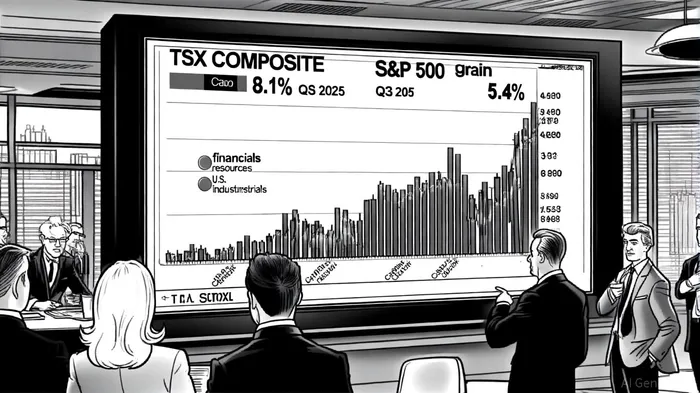





Comentarios
Aún no hay comentarios