
Canadian Dollar and FX Debt in a Shifting Fed Policy Landscape
The U.S. Federal Reserve and Bank of Canada have embarked on divergent monetary policy paths in 2025, creating a pivotal moment for the Canadian dollar (CAD) and FX debt strategies. With the Fed signaling a shift toward rate cuts to address a softening labor market and inflationary pressures[1], while the Bank of Canada has adopted a more aggressive easing stance to counter a weaker domestic economy[3], the implications for currency positioning and debt markets are profound.
Interest Rate Differentials and CAD Positioning
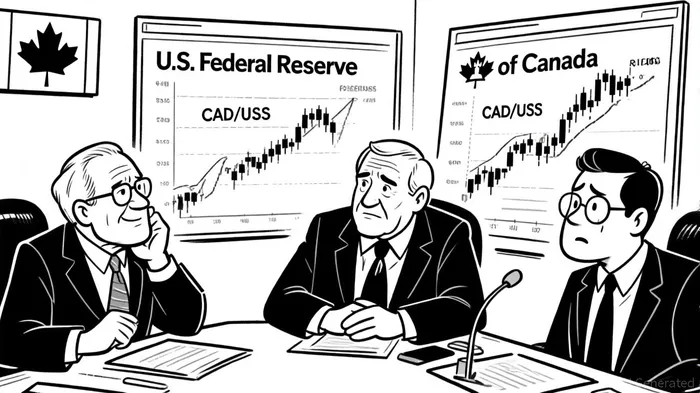
The Fed's September 2025 rate cut-reducing the federal funds rate to 4.00%-4.25%-was accompanied by projections of two additional cuts, targeting a 3.50%-3.75% range by year-end[1]. In contrast, the Bank of Canada slashed its key rate to 2.5% in September 2025, with forecasts suggesting further reductions to 2.25% by year-end[3]. This 1.25-percentage-point interest rate differential has exacerbated CAD's depreciation against the U.S. dollar, with the loonie trading at 1.25 as of September 2025[1].
According to a report by the Bank of Canada, the widening rate gap has driven capital flows toward U.S. assets, reducing demand for CAD and amplifying exchange rate volatility[1]. This dynamic is compounded by divergent economic fundamentals: the U.S. economy is projected to grow at 1.6% in 2025, with unemployment rising to 4.5%[1], while Canada's GDP contracted 1.6% in Q2 2025, driven by job losses and weak manufacturing output[3].
FX Debt and Hedging Strategies
Investors and financial institutions are recalibrating FX debt strategies to navigate the shifting rate landscape. A key concern is the impact of U.S. rate cuts on Canadian borrowing costs. As the Fed eases policy, U.S. bond yields are expected to decline, potentially easing fixed-rate mortgage rates in Canada[2]. However, this comes with risks: a weaker CAD increases the cost of dollar-denominated debt for Canadian corporations and households, while exchange rate volatility complicates hedging efforts[1].
Canadian banks and asset managers have responded by increasing short positions in currency futures and raising hedging costs for options contracts[1]. For instance, the cost of hedging CAD depreciation against the USD has surged, reflecting heightened uncertainty about the pace of BoC rate cuts and the Fed's response to inflation[1]. This environment favors investors with long USD positions or exposure to U.S. Treasuries, while CAD holders face elevated risks unless hedged effectively[2].
Economic Fundamentals and Forward Outlook
The Fed's rate cuts are framed as a move toward "neutral" policy, with officials emphasizing the need to balance labor market softness and inflation, currently at 3% for 2025[1]. Meanwhile, the Bank of Canada's aggressive easing reflects a more urgent response to a real-time output gap of -1.5% and core inflation near 2%[3]. This divergence suggests the CAD may remain under pressure in the near term, particularly if U.S. rate cuts outpace Canada's reductions.
Looking ahead, the Bank of Canada faces a delicate balancing act. While further rate cuts are likely, excessive easing could exacerbate CAD depreciation, harming exporters by making Canadian goods more expensive in global markets[2]. Conversely, delaying cuts risks deepening economic slack. The Fed, meanwhile, is expected to continue its gradualist approach, with rate cuts in October and December 2025[1], but inflation above its 2% target remains a constraint[3].
Strategic Considerations for Investors
For investors, the key takeaway is to prioritize flexibility in currency and debt strategies. Short-term positions in USD or U.S. dollar-denominated assets may offer yield advantages, but long-term exposure to CAD could benefit if the BoC's rate cuts outpace the Fed's, narrowing the differential. FX hedging should be dynamic, leveraging options and futures to manage volatility while avoiding overexposure to CAD weakness.
In FX debt markets, Canadian borrowers with USD liabilities should monitor hedging costs and consider locking in rates if the CAD's depreciation trajectory stabilizes. Conversely, U.S. investors with CAD exposure may find opportunities in Canadian bonds, where yields are now more competitive relative to U.S. Treasuries.
As central banks navigate divergent economic realities, the CAD's trajectory will hinge on the interplay of rate differentials, growth prospects, and global risk sentiment. Investors who align their strategies with these dynamics will be better positioned to capitalize on the evolving landscape.







Comentarios
Aún no hay comentarios