
Canadian Automotive Industry Volatility: Navigating Supply Chain Reconfiguration and Workforce Shifts
The Canadian automotive industry is at a crossroads, grappling with the dual forces of electric vehicle (EV) adoption and trade-driven supply chain volatility. As manufacturers pivot toward electrification and contend with geopolitical tensions, investors must weigh the sector's resilience against its vulnerabilities. This analysis examines how supply chain reconfiguration and workforce transitions are reshaping Canada's automotive landscape-and what this means for future investment opportunities.
Supply Chain Reconfiguration: A Double-Edged Sword
The transition to EVs has spurred significant reconfiguration in Canada's automotive supply chains. According to the government's Future of Canadian Vehicles report, the industry is investing heavily in battery manufacturing and critical mineral processing, with projects like Umicore's battery material plant and Northvolt's Quebec facility positioning Canada as a potential global leader in EV production. However, these efforts are being tested by trade disruptions. The imposition of 25% U.S. tariffs on non-CUSMA-compliant vehicles in April 2025, coupled with Canadian retaliatory tariffs on $30 billion of U.S. goods, has created a volatile environment. Nearly 64.5% of Canadian exporters to the U.S. now face tariffs, forcing companies to delay investments, diversify supplier networks, and adopt nearshoring strategies, according to a Statistics Canada analysis.
The impact is evident in production decisions. For example, General Motors' Ingersoll, Ontario, plant-initially projected to produce 50,000 electric vans annually-has idled operations due to sluggish demand and trade uncertainties, resulting in 600 job losses, a development reported by Global News. Similarly, automakers like HondaHMC-- and StellantisSTLA-- have delayed EV projects, citing affordability challenges and infrastructure gaps, Global News reported. While green procurement strategies and 3D printing are helping small-scale suppliers adapt, the sector's reliance on cross-border trade remains a critical risk, as noted by SCMR.
Workforce Transitions: Opportunities and Challenges
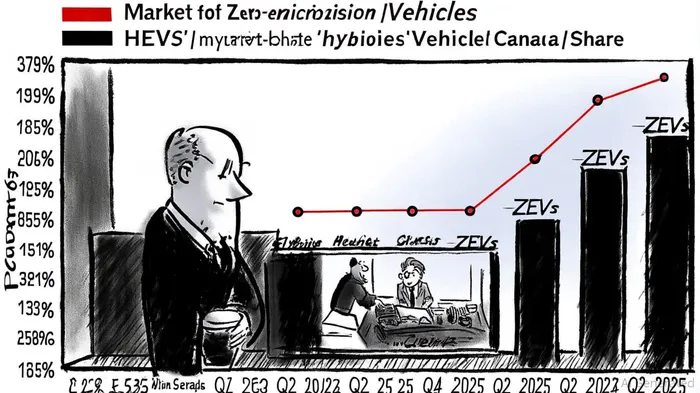
The EV transition is reshaping Canada's automotive workforce, creating new roles while displacing traditional jobs. Electric Mobility Canada projects that e-mobility employment could nearly triple by 2035, with sectors like battery manufacturing and power electronics engineering driving growth, according to Electric Autonomy. Training initiatives, such as Ford and GM's partnerships with educational institutions, are addressing skill gaps in EV-specific expertise, Electric Autonomy reports. However, the shift is uneven. In Q2 2025, zero-emission vehicle (ZEV) market share fell to 9.2%, while hybrids captured 12.9% of sales, reflecting consumer preferences for affordability and range flexibility, according to S&P Global.
Trade disruptions have compounded these challenges. The phase-out of federal EV incentives and the 100% tariff on Chinese BEVs have further strained adoption, pushing automakers to prioritize hybrids, S&P Global notes. Meanwhile, U.S. tariffs on steel and aluminum have hit domestic manufacturers hard, with April 2025 exports down 23% year-on-year, according to CBC. In response, the federal government, via Finance Canada, has proposed a $2 billion strategic response fund to support workforce training and supply chain resilience, alongside policies like the EV Supply Chain investment tax credit.
Investment Implications: Balancing Risk and Resilience
For investors, the Canadian automotive sector presents a paradox: long-term growth potential in EVs and critical minerals, juxtaposed with near-term volatility from trade tensions and workforce shifts. The industry's reliance on U.S. exports (85% of vehicles produced in Canada are exported to the U.S.) makes it particularly sensitive to policy changes, per Made in Canada. Yet, opportunities exist for companies that can navigate these challenges.
- Supply Chain Diversification: Firms leveraging nearshoring and green procurement strategies-such as those adopting 3D printing to reduce offshore dependency-are better positioned to withstand disruptions, as SCMR reported.
- Workforce Adaptability: Companies investing in retraining programs, like those supported by the Future of Canada's Automotive Labourforce (FOCAL) initiative, could benefit from a net gain of up to 100,000 jobs by 2040, according to Jobber Nation.
- Policy Alignment: Aligning with government incentives, such as the EV Supply Chain tax credit, may enhance competitiveness while supporting national net-zero goals; Finance Canada has outlined consultations and measures in this area.
However, risks remain. The expiry of federal EV rebates and the rise of hybrid dominance suggest that achieving Canada's 2035 ZEV targets will require policy adjustments and infrastructure investments, S&P Global warns. Investors should also monitor geopolitical developments, as retaliatory tariffs from China on Canadian agricultural products—such as canola oil—highlight the sector's interconnected vulnerabilities, as reported by The Globe and Mail.
Conclusion
Canada's automotive industry is undergoing a transformative phase, driven by electrification and trade dynamics. While supply chain reconfiguration and workforce transitions pose significant challenges, they also create opportunities for innovation and resilience. Investors who prioritize adaptability-whether through supply chain diversification, workforce training, or policy alignment-may find themselves well-positioned to capitalize on the sector's long-term potential. However, the path forward will require navigating a complex interplay of market forces, regulatory shifts, and global uncertainties.





Comentarios
Aún no hay comentarios