
Canada's Trans Mountain: A Tariff-Proof Pipeline
Generado por agente de IACyrus Cole
martes, 4 de febrero de 2025, 3:50 pm ET2 min de lectura
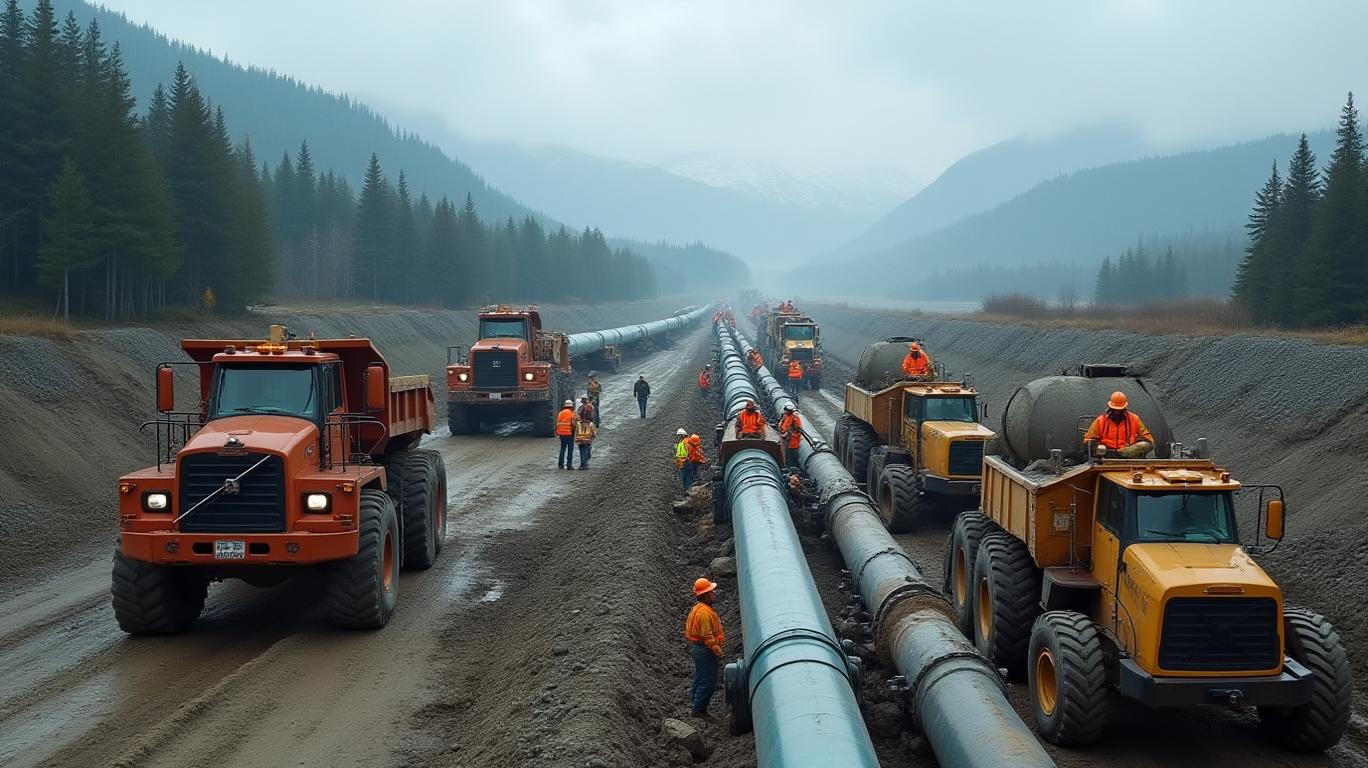
The Trans Mountain pipeline expansion, completed in May 2024, has become a critical asset for Canada's energy sector, particularly in the face of potential U.S. tariffs on Canadian oil and energy products. The $34 billion project, which nearly tripled the pipeline's capacity to 890,000 barrels per day (bpd), has opened up new markets for Canadian crude, allowing producers to diversify their customer base and mitigate the risks associated with U.S. tariffs.
The pipeline's strategic importance has been underscored by the threat of U.S. tariffs, which could significantly impact the demand for the Trans Mountain pipeline system. If imposed, U.S. tariffs would make it more cost-effective for Canadian producers to export their oil to other countries, avoiding the additional 25% tariff. This increased interest in the pipeline can be attributed to several specific factors:
1. Market diversification: The Trans Mountain pipeline expansion has opened up new markets for Canadian oil, particularly in Asia. With the threat of U.S. tariffs, Canadian producers would be more inclined to explore these alternative markets to avoid the additional costs (Source: Calgary Herald and Financial Post, May 1, 2024).
2. Price differential: Historically, Canadian crude oil has sold at a discount to U.S. crude due to limited pipeline capacity and transportation costs. The Trans Mountain pipeline expansion has helped to narrow this price differential, and with the threat of U.S. tariffs, producers would be motivated to maintain this advantage by shipping their oil through the pipeline to avoid the 10% tariff (Source: Calgary Herald and Financial Post, May 1, 2024).
3. Spot capacity: The Trans Mountain pipeline has long-term contracts taking up about 80% of its capacity, with the remaining 20% available on an uncommitted, spot basis. If U.S. tariffs are imposed, producers may find it more cost-effective to use this spot capacity to export their oil to other countries, avoiding the 25% tariff (Source: The Globe and Mail, January 13, 2025).
4. Increased demand for Canadian oil in Asia: The TMX project has already helped to diversify markets for Canadian oil, with about 50% of cargoes destined for customers in China, South Korea, India, and Brunei since the expansion began operating last spring. This trend is likely to continue or even increase if U.S. tariffs are imposed, as producers seek to avoid the additional costs (Source: The Globe and Mail, January 13, 2025).
The Trans Mountain pipeline expansion project aligns with Canada's long-term energy strategy by increasing the country's ability to reach new markets and diversify its customer base, thereby enhancing energy security and economic resilience. The project has already led to a narrowing of the price differential between Western Canada Select (WCS) and West Texas Intermediate (WTI) by about $10 in Q4 2024 compared to Q4 2023, indicating a significant price uplift. Analysts estimate this price uplift increased oil revenues by $10 billion since the startup of the expanded system (Source: Calgary Herald and Financial Post, May 1, 2024).
In conclusion, the Trans Mountain pipeline expansion project has become a critical asset for Canada's energy sector, providing an alternative route for Canadian producers to access international markets without facing the additional costs associated with U.S. tariffs. The project aligns with Canada's long-term energy strategy by enhancing energy security and economic resilience, and its strategic importance has been underscored by the threat of U.S. tariffs. As Canada continues to explore new markets, it may identify additional opportunities for diversifying its oil exports, further enhancing its energy security and economic resilience.



Divulgación editorial y transparencia de la IA: Ainvest News utiliza tecnología avanzada de Modelos de Lenguaje Largo (LLM) para sintetizar y analizar datos de mercado en tiempo real. Para garantizar los más altos estándares de integridad, cada artículo se somete a un riguroso proceso de verificación con participación humana.
Mientras la IA asiste en el procesamiento de datos y la redacción inicial, un miembro editorial profesional de Ainvest revisa, verifica y aprueba de forma independiente todo el contenido para garantizar su precisión y cumplimiento con los estándares editoriales de Ainvest Fintech Inc. Esta supervisión humana está diseñada para mitigar las alucinaciones de la IA y garantizar el contexto financiero.
Advertencia sobre inversiones: Este contenido se proporciona únicamente con fines informativos y no constituye asesoramiento profesional de inversión, legal o financiero. Los mercados conllevan riesgos inherentes. Se recomienda a los usuarios que realicen una investigación independiente o consulten a un asesor financiero certificado antes de tomar cualquier decisión. Ainvest Fintech Inc. se exime de toda responsabilidad por las acciones tomadas con base en esta información. ¿Encontró un error? Reportar un problema




Comentarios
Aún no hay comentarios