
Canada's Climate Ambitions Clash with U.S. Trade Tensions: Navigating the Investment Crossroads
The geopolitical and economic tectonicTECX-- plates are shifting in North America. Canadian Prime Minister Mark Carney’s defiant declaration—“Canada is not for sale”—collides with Donald Trump’s characteristically blunt rejoinder: “Never say never.” This clash of rhetoric underscores a pivotal moment for investors: Is Canada’s economy a fortress of climate-driven growth, or a vulnerable frontier in a escalating trade war?
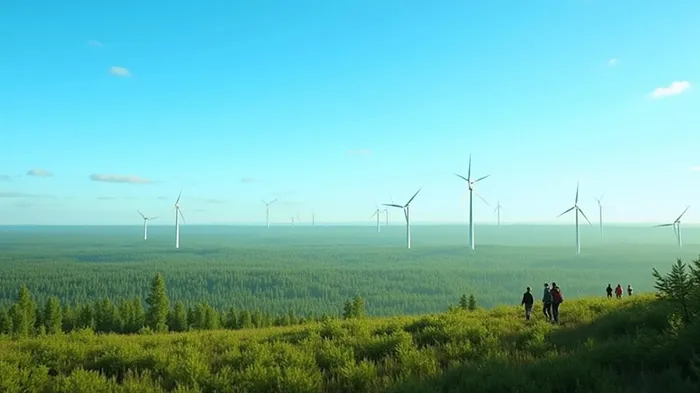
Carney’s Climate Play: Positioning Canada as a Clean Energy Superpower
Carney’s government is doubling down on a vision of Canada as a global leader in the energy transition. By integrating climate action into economic strategy, his policies aim to attract $200 billion in private capital over five years through tax incentives for clean tech, carbon capture, and EV infrastructure. Key levers include:
- Carbon Contracts for Difference: Guaranteeing stable returns for low-carbon projects, even if market carbon prices dip.
- Mandatory Climate Risk Disclosures: Aligning with global standards to guide capital toward sustainable sectors.
- Transition Bonds: A proposed $10 billion/year fund to finance high-emission industries’ shift to green technologies.
The East-West electricity grid, a flagship infrastructure project, exemplifies this strategy. Connecting Quebec’s hydroelectricity to fossil fuel-reliant regions, it promises to reduce reliance on U.S. energy imports—a direct counter to Trump’s trade threats.
Yet Carney faces headwinds. The OECD slashed Canada’s 2025 GDP forecast to 0.7%, citing U.S. trade tensions and sluggish domestic demand. Critics also question whether his scrapping of the consumer carbon tax—a bid to ease cost-of-living pressures—will undermine emissions targets.
Trump’s Trade Wars: A Double-Edged Sword for Canadian Markets
Donald Trump’s tariffs on Canadian goods—notably a 25% levy on non-USMCA-covered products and a 10% tax on energy—have triggered retaliation. Canada’s counter-tariffs on $22 billion of U.S. imports, including agricultural goods and autos, have disrupted supply chains.
The fallout is measurable. General Motors, for instance, faces $4–5 billion in annual costs due to tariffs, while smaller firms report skyrocketing logistics expenses. The Federal Reserve’s Beige Book notes reduced cross-border tourism and Canadian consumer shifts toward European imports (e.g., Italian tomatoes over California’s).
Yet Trump’s tactics may inadvertently boost Canada’s climate agenda. The trade war has accelerated efforts to diversify supply chains and strengthen domestic industries. For instance, Canadian firms are now exploring European partnerships for critical minerals—a cornerstone of EV production—while Carney’s First and Last Mile Fund seeks to secure local control over these resources.
The Investment Crossroads: Risks and Opportunities
For investors, Canada presents a paradox of peril and promise.
Risks:
1. Geopolitical Volatility: Trump’s unpredictable rhetoric—such as his annexation musings—creates reputational risks.
2. Economic Stagnation: A 0.7% GDP growth rate signals weak demand, potentially delaying returns on infrastructure projects.
3. Trade Uncertainty: Retaliatory tariffs could escalate further, disrupting industries like automotive and agriculture.
Opportunities:
1. Clean Tech Boom: Carney’s policies make Canada a hub for EVs, hydrogen, and carbon capture. The Clean Electricity Investment Tax Credit alone could unlock $200 billion in private capital.
2. Resource Resilience: Demand for critical minerals (lithium, nickel) and renewable energy infrastructure is surging globally. Canada’s abundant reserves position it as a supplier of choice.
3. Dollar-Cost Averaging: The Canadian dollar’s decline against the U.S. dollar (down 8% in 2025) lowers entry costs for foreign investors.
The Bottom Line: Climate Resilience vs. Geopolitical Risk
Canada’s investment climate hinges on its ability to balance climate ambition with economic pragmatism—and withstand U.S. trade pressures.
- Climate-Driven Sectors: Renewable energy, EV supply chains, and carbon capture projects are likely winners. The TCFD-aligned transparency Carney mandates will attract institutional investors seeking ESG-compliant opportunities.
- Defensive Plays: Canadian equities in materials (up 19.9% in Q1 2025) and gold (33.9%) have already shown resilience. These sectors may outperform as global stagflation fears grow.
Conclusion: Betting on Canada’s Transition
Despite the risks, Canada’s long-term trajectory remains compelling. Its $10 billion/year transition bond program, 75% methane reduction target by 2030, and $200 billion clean tech pipeline offer a roadmap for sustainable growth.
Even as Trump’s tariffs bite, Carney’s strategy to diversify trade partners—strengthening ties with the EU and U.K.—buffers against U.S. unpredictability. The East-West grid and hydropower investments position Canada to export clean energy, reducing reliance on fossil fuels and geopolitical whims.
For investors, the calculus is clear: Short-term volatility is inevitable, but Canada’s pivot to climate leadership could deliver asymmetric returns as the world transitions to net-zero. As Carney himself put it, “This is not just about fighting climate change—it’s about building a more competitive Canada.” In an era of economic fragmentation, that vision may prove decisive.





Comentarios
Aún no hay comentarios