
Campbell's Q3 Earnings Outperformance and Strategic Divisions Analysis: Assessing Long-Term Investment Potential Amid Mixed Segment Performance and Cautious Guidance
Campbell Soup Company's Q3 2025 earnings report revealed a tale of two segments: robust growth in its Meals & Beverages division and persistent challenges in the Snacks business. While the company's net sales rose 4% year-over-year to $2.5 billion, driven by the Sovos Brands acquisition, its adjusted EPS declined 3% to $0.73, reflecting inflationary pressures and tariff headwinds. This mixed performance underscores the critical question for investors: Can Campbell'sCPB-- strategic initiatives and long-term growth algorithm sustain value creation amid uneven segment dynamics?
Meals & Beverages: A Pillar of Resilience
The Meals & Beverages segment delivered a standout performance, with organic net sales climbing 6% in Q3, fueled by strong demand for U.S. soup, Rao's pasta sauces, and growth in the Canadian market. 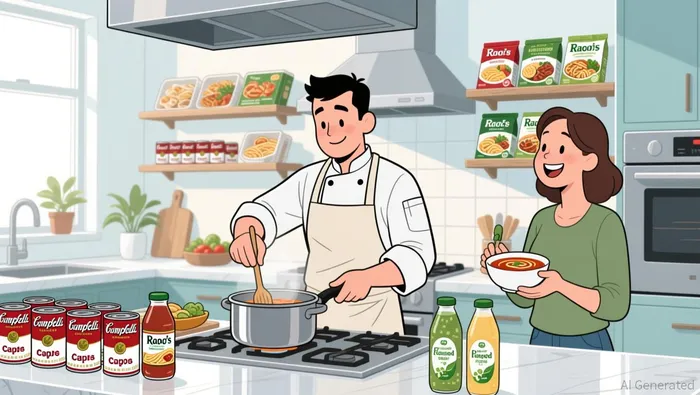 This segment's success aligns with Campbell's strategic focus on quality, convenience, and value, bolstered by the Sovos Brands acquisition. Rao's, now a key growth driver, is on track to become the company's fourth $1 billion brand. Analysts highlight that the segment's alignment with consumer trends-such as the shift toward home cooking and healthier meal solutions-positions it as a long-term growth engine.
Campbell's innovation pipeline further strengthens this segment. Modernized soup offerings and flavor-forward products cater to evolving preferences, while the company's emphasis on plant-based beverages and quick-scratch cooking solutions taps into emerging demand. These initiatives, combined with the Sovos acquisition's synergies, suggest a durable competitive advantage in a category expected to outpace broader food industry growth.
Snacks: A Rocky Road to Recovery
In contrast, the Snacks division faced headwinds, with organic net sales declining 5% in Q3 due to lower volume and mix, particularly in Goldfish crackers and third-party partner brands. Full-year guidance for adjusted EPS now anticipates performance at the low end of its range, reflecting slower-than-expected recovery in this segment. The fourth quarter of 2025 saw a 3% organic sales decline, with in-market consumption falling 2%.
However, Campbell's leadership remains optimistic. The company has outlined a multi-pronged turnaround strategy, including incremental marketing investments, consumer-led innovation, and cost savings initiatives. Limited-time offerings (LTOs), such as the popular Milano chai latte flavor, and new Goldfish flavors aim to reignite growth in stagnant categories. Additionally, the Snacks division's direct store delivery model and margin expansion roadmap-targeting a 17% margin by the end of the planning period-offer a framework for long-term profitability.
Industry experts caution that shifting consumer preferences toward protein-rich and healthier alternatives pose a challenge. Yet Campbell's pivot toward better-for-you snack formats and seasonal white chocolate product lines signals adaptability. If these strategies gain traction, the Snacks division could stabilize by late 2026, as management projects modest sequential improvement in the fourth quarter of 2025.
Strategic Framework and Long-Term Prospects
Campbell's broader growth algorithm-targeting 2–3% organic sales growth, 4–6% adjusted EBIT growth, and 7–9% adjusted EPS growth-reflects a balanced approach to topline and margin expansion. The company's $250 million cost savings program, already generating $110 million in savings, further insulates margins against inflation and tariffs. Meanwhile, its focus on innovation and portfolio modernization aligns with macro trends, such as the rise of convenience-driven meals and plant-based diets.
Analysts remain cautiously optimistic. While the Snacks division's recovery is uncertain, the Meals & Beverages segment's momentum and Sovos Brands' integration provide a strong foundation. The key risk lies in the pace of Snacks' turnaround and the company's ability to navigate macroeconomic headwinds. However, Campbell's disciplined capital allocation and strategic agility-evidenced by its recent investor day roadmap-suggest a resilient long-term outlook.
Conclusion
Campbell's Q3 results highlight both strengths and vulnerabilities. The Meals & Beverages division's outperformance and strategic alignment with consumer trends offer a compelling case for long-term investment. Meanwhile, the Snacks division's challenges, though concerning, are not insurmountable given the company's innovation pipeline and cost discipline. Investors should monitor the Snacks turnaround's progress in 2026 and the broader impact of tariffs and inflation. For now, Campbell's balanced approach to growth and its focus on value creation position it as a cautiously optimistic play in the packaged food sector.







Comentarios
Aún no hay comentarios