
Is Campbell's (CPB) Q1 Earnings Report a Buying Opportunity Amid Persistent Headwinds?
Campbell Soup Company (CPB) has long been a staple in the U.S. packaged food sector, but its recent performance has been a mixed bag of resilience and headwinds. The Q1 2024 earnings report, released in April 2024, offers a critical lens through which to assess whether the stock is a compelling buy amid macroeconomic challenges. This analysis evaluates Campbell'sCPB-- financial health, strategic moves, and valuation realism to determine if the company's current trajectory justifies investor optimism.
Earnings Performance: A Mixed Signal
Campbell's Q1 2024 results showed modest top-line resilience despite a 1% decline in organic net sales to $2.5 billion, a slowdown from the 15% growth in Q1 2023. While the company's adjusted EPS of $0.91 exceeded expectations of $0.87, adjusted EBIT and EPS fell 9% and 11%, respectively, compared to the prior year. These declines reflect broader industry pressures, including inflationary costs and shifting consumer preferences. However, CEO Mark Clouse emphasized "strong execution in supply chain operations" and a renewed focus on affordability and innovation to counter these trends according to company statements.
The company's guidance for fiscal 2024 remains intact, with management expressing confidence in sequential improvement, particularly in the second half of the year. This optimism is tied to the pending acquisition of Sovos Brands, which closed in March 2024 and is expected to drive growth in premium and health-conscious categories according to management guidance.
Strategic Resilience: Sovos Acquisition and Portfolio Refinement
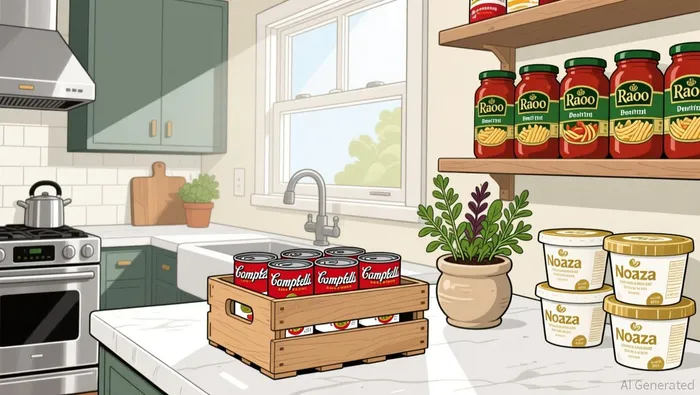
Campbell's acquisition of Sovos Brands for $2.7 billion is a cornerstone of its strategic resilience. Sovos, owner of premium brands like Rao's, Michael Angelo's, and noosa, added $1 billion in annual sales to Campbell's portfolio, with Rao's alone generating $775 million in revenue in 2023 according to company press release. The acquisition expanded Campbell's reach into high-growth segments such as premium pasta sauces, frozen entrées, and yogurts, aligning with consumer trends toward health-conscious and premiumized products.
The integration of Sovos has already shown early traction. In Q3 2024, the acquisition contributed to a 6% increase in net sales, with adjusted EBIT rising 13% to $354 million and adjusted EPS climbing 10% to $0.75 per share. However, the deal came at a cost: total debt surged to $7.54 billion in FY2024, pushing the net debt-to-EBITDA ratio to 4.9x according to financial analysis. While this elevated leverage raises concerns about financial risk, CampbellCPB-- anticipates $50 million in annualized cost synergies over two years, which could offset some of the debt burden according to company statements.
Complementing the Sovos acquisition, Campbell has also streamlined its portfolio by divesting non-core assets. The sale of the Pop Secret popcorn business in August 2024 underscores a strategic shift toward focusing on core Snacks division brands. This "concentrated approach" aims to enhance operational efficiency and allocate capital to higher-growth opportunities.
Valuation Realism: Undervalued or Overlooked?
Campbell's valuation appears to reflect skepticism about its ability to navigate headwinds. As of December 2024, the stock traded at a trailing P/E ratio of 22.6, significantly below its estimated fair value of $63.48 (compared to a current price of $30.04) according to valuation analysis. This discount suggests the market is pricing in continued margin pressures and uncertainty around the Sovos integration. However, the company's long-term growth prospects-driven by premium brand expansion and cost synergies-could justify a re-rating if execution meets expectations.
The P/B ratio, though not explicitly cited, is implied to be low given the valuation gap. This could indicate undervaluation if the company's intangible assets (e.g., Sovos's premium brand equity) are not fully reflected in book value. Conversely, the elevated debt load and declining organic sales in core categories according to financial analysis highlight risks that could weigh on earnings power.
Conclusion: A Calculated Buy?
Campbell's Q1 2024 earnings report reveals a company navigating a challenging environment with a mix of caution and ambition. While organic sales declines and rising debt are concerning, the Sovos acquisition and portfolio rationalization demonstrate a strategic commitment to long-term growth. The stock's current valuation, trading well below estimated fair value, suggests the market is discounting future potential.
For investors, the key question is whether Campbell can execute its integration playbook effectively and deliver the promised synergies. If the company can stabilize core categories while leveraging Sovos's premium brands to drive margin expansion, the current discount could present a compelling entry point. However, those wary of elevated leverage and macroeconomic risks may prefer to wait for clearer signs of momentum.
In the end, Campbell's story is one of transformation. Whether it succeeds depends on its ability to balance short-term pain with long-term gain-a test that will define its resilience in the years ahead.





Comentarios
Aún no hay comentarios