
Is Campbell's (CPB) Current Stock Weakness a Mispriced Opportunity or a Sign of Structural Decline?
The CampbellCPB-- Soup Company (CPB) has long been a bellwether for the U.S. packaged food industry, but its recent stock performance-down 31.93% over the past 12 months-has sparked debate about whether this reflects a temporary valuation dislocation or a deeper structural decline. To answer this, we must dissect the interplay between Campbell'sCPB-- financial resilience, evolving consumer preferences, and competitive dynamics in a market increasingly defined by health-consciousness and premiumization.
Valuation Dislocation: A Tale of Two Metrics
Campbell's financials reveal a nuanced picture. While net sales in 2025 rose 6% to $10.3 billion, driven by the Sovos Brands acquisition, organic sales declined by 1%, signaling underlying demand challenges. Adjusted EBIT increased by 2% to $1.5 billion, and operating margins held steady at 30.4%-a slight improvement from prior years-despite cost inflation and supply chain pressures. However, the stock's underperformance relative to the S&P 500 and the broader food industry's 8.1% annual earnings growth suggests a disconnect between fundamentals and market sentiment.
This dislocation may stem from two factors. First, Campbell's snacks division, which accounts for a significant portion of its revenue, has seen organic net sales decline by 5.1% in Q1 2026, driven by a 3% volume drop. The segment is grappling with shifting consumer priorities: indulgent snacks like Cape Cod crackers are losing ground, while premium, better-for-you options such as Late July chips and Snack Factory products are gaining traction. Second, the market may be overestimating the risks of structural decline in the snacks category, which is still expected to grow as consumers seek convenient, fiber-rich, and globally inspired options.
Margin Resilience: A Shield Against Headwinds
Campbell's ability to maintain operating margins amid cost pressures underscores its operational discipline. In Q4 2025, the company reported an 8.41% operating margin, and while adjusted EBIT dipped by 2% in that quarter, it fell further by 11% in Q1 2026 due to weaker sales volumes. These declines, however, were partially offset by productivity gains and favorable net pricing. The company's focus on premiumization-evidenced by the success of brands like Snack Factory and Late July- has helped stabilize margins in a segment otherwise plagued by volume declines.
Yet, margin resilience alone cannot mask structural vulnerabilities. The snacks division's 4% revenue drop in fiscal 2025 to $4.2 billion reflects a broader industry trend: consumers are trading down to essentials and prioritizing health over indulgence. While Campbell's has managed to hold share in four of its eight leadership snack brands, the long-term sustainability of this strategy depends on its ability to innovate in a market increasingly dominated by fiber-rich, plant-based, and clean-label products.
Structural Decline or Cyclical Adjustment?
The key question is whether Campbell's challenges are cyclical or structural. The U.S. canned foods market, which includes Campbell's core soup and ready-meal categories, is projected to grow at a 4.3% CAGR through 2035, driven by convenience and affordability. This suggests that the company's core business remains resilient in a macroeconomic environment where cost-conscious consumers favor shelf-stable products. However, the snacks segment's struggles may reflect a more permanent shift in consumer behavior.
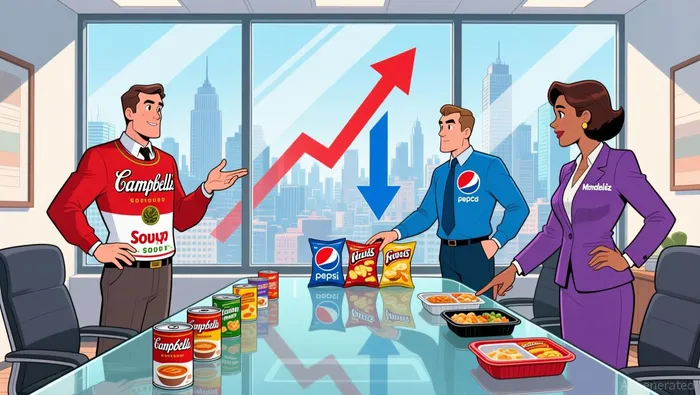
Competitors like PepsiCo and Mondelēz are also reporting volume declines in traditional snacks, indicating that Campbell's is not alone in navigating this transition. Yet, its reliance on premiumization and limited-time offerings (LTOs)-such as Pumpkin Spice Milano cookies- highlights the fragility of demand for premium snacks in a cost-conscious climate. Meanwhile, the rise of GLP-1 medications for weight management could further suppress demand for indulgent snacks, adding a new layer of uncertainty.
The Investment Case: Balancing Risks and Opportunities
Campbell's current valuation appears to discount a worst-case scenario for its snacks division while underestimating the potential of its core canned foods business. The company's 6.17% year-over-year net income growth in 2025 and its strategic pivot toward premiumization and innovation suggest that it is adapting to the new consumer landscape. However, the stock's underperformance- despite a 4.9% increase in net income over the past 12 months-reflects skepticism about its ability to reverse long-term trends in the snacks segment.
For investors, the critical question is whether Campbell's margin resilience and market share retention in key categories justify a re-rating. The company's focus on clean-label formulations, sustainability, and omnichannel distribution aligns with industry-wide trends, but its success will depend on execution. If Campbell can stabilize its snacks division while leveraging growth in the canned foods market, the current discount may represent a mispriced opportunity. Conversely, if structural shifts in snacking preferences persist, the discount could be a rational reflection of long-term risks.
Conclusion
Campbell's stock weakness is best viewed as a partial dislocation rather than a sign of terminal decline. The company's financial discipline and strategic agility in premiumization offer a buffer against near-term headwinds, but its long-term prospects hinge on its ability to navigate the structural transformation of the U.S. snack market. For investors with a medium-term horizon, the current valuation may warrant a cautious bet on resilience, provided the company continues to innovate and adapt to the evolving consumer landscape.





Comentarios
Aún no hay comentarios