
Calumet, Inc. (CLMT): Strategic Positioning in Sustainable Aviation Fuel and Alignment with U.S. Decarbonization Goals
Calumet, Inc. (CLMT) has emerged as a pivotal player in the U.S. decarbonization landscape, leveraging its Montana Renewables (MRL) division to scale sustainable aviation fuel (SAF) production. While the company's recent H.C. Wainwright presentation did not explicitly address rare earths or critical minerals—a sector often tied to industrial policy—the strategic initiatives outlined underscore a robust alignment with U.S. climate goals and the Inflation Reduction Act (IRA) of 2024. This analysis evaluates Calumet's investment potential through the lens of its SAF expansion, federal loan structure, and policy-driven demand tailwinds.
Strategic Expansion of SAF Production
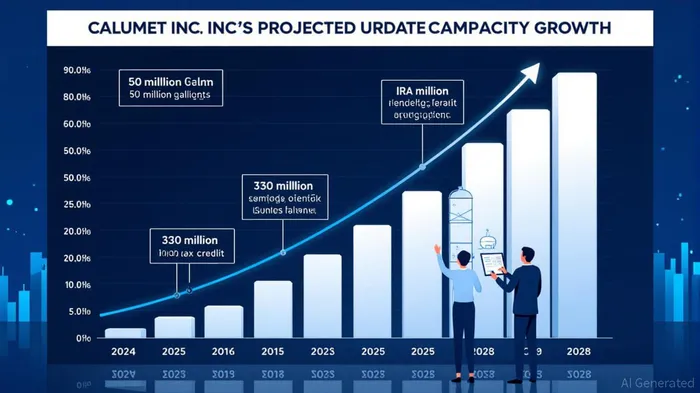
Calumet's MRL division is projected to increase SAF output from 50 million gallons in 2024 to 330 million gallons by 2028, a sixfold growth driven by its MAX SAF expansion project[1]. This trajectory positions the company to capitalize on regulatory mandates such as California's requirement for 20% SAF blending by 2030[1]. The Department of Energy (DOE) has allocated a $1.44 billion loan to support this scale-up, with $778 million earmarked for refinancing and growth[1]. Notably, the loan structure avoids equity dilution, preserving shareholder value while enabling debt reduction and reinvestment.
Policy-Driven Cost Advantages
Federal incentives under the IRA further bolster Calumet's profitability. SAF producers qualify for tax credits worth $1.25–$1.75 per gallon through 2027[1], directly reducing production costs during a critical scaling phase. These credits, combined with state-level mandates, create a predictable demand environment, mitigating market risks for investors. As stated by Damien Cleusix in a recent analysis, “The IRA's tax credits are a game-changer for SAF economics, and Calumet's production scale ensures it captures a disproportionate share of these benefits”[1].
Alignment with U.S. Industrial Policy
While Calumet's focus remains on SAF rather than rare earths or critical minerals, its operations align with broader U.S. decarbonization priorities. The Biden administration's emphasis on reducing aviation emissions—accounting for 2.5% of global CO₂ emissions—has made SAF a cornerstone of climate strategy[3]. By securing federal financing and leveraging IRA incentives, CalumetCLMT-- exemplifies how private-sector innovation can dovetail with national objectives. This alignment not only enhances the company's regulatory resilience but also opens avenues for future partnerships with agencies prioritizing clean energy transitions.
Investment Implications
From an investor perspective, Calumet's strategic initiatives present a compelling case. The non-dilutive DOE loan ensures capital efficiency, while IRA tax credits improve margin visibility. With SAF demand projected to grow at a 20% CAGR through 2030[1], Calumet's 2028 capacity target positions it to dominate regional markets, particularly in California. However, risks include potential delays in loan disbursement—recent reports noted White House delays in approving the Montana biofuel loan[2]—and competition from emerging SAF producers.
Conclusion
Calumet, Inc. (CLMT) may not be directly involved in rare earths or critical minerals, but its strategic focus on SAF places it at the forefront of U.S. decarbonization efforts. The company's alignment with IRA incentives, federal loan support, and regulatory mandates creates a strong foundation for scalable growth. For investors seeking exposure to policy-driven clean energy transitions, Calumet's MRL division offers a high-conviction opportunity, albeit with careful monitoring of execution risks.





Comentarios
Aún no hay comentarios