
California Resources Corporation: Pioneering a Sustainable Energy Transition with ESG-Driven Resilience
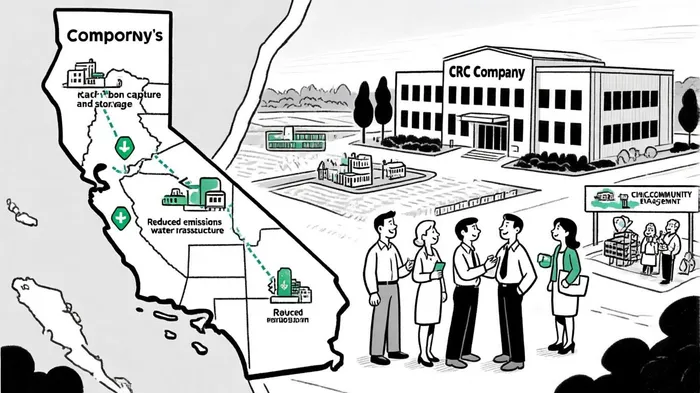
In an era where energy markets are increasingly defined by regulatory scrutiny, climate risks, and investor demand for sustainability, California Resources CorporationCRC-- (CRC) has emerged as a case study in strategic reinvention. The release of its 2024 Sustainability Report[1] underscores a deliberate pivot toward decarbonization, water stewardship, and community resilience—initiatives that align with both the United Nations Sustainable Development Goals (SDGs) and the evolving expectations of capital markets. For investors, the question is no longer whether energy companies can adapt to a low-carbon future but how effectively they can integrate sustainability into their core operations while maintaining profitability.
A Strategic Shift: From Fossil Fuels to Responsible Net Zero
CRC's merger with Aera Energy in 2024[2] marked a pivotal moment, consolidating its position as California's largest oil and gas producer while accelerating its transition to a net-zero framework. The company's Responsible Net Zero (RNZ) strategy[1] is notNOT-- merely a compliance exercise but a recalibration of its business model to address climate challenges head-on. By securing California's first EPA permits for underground CO₂ injection and storage[1], CRCCRC-- is laying the groundwork for the state's first commercial-scale carbon capture and storage (CCS) project—a move that positions it as a leader in a sector where carbon management is becoming a critical competitive advantage.
This strategic pivot is not without precedent. As BloombergNEF notes, carbon capture technologies could account for 15% of global emissions reductions by 2050[3]. CRC's early-mover status in California—a state with aggressive climate targets—suggests a forward-looking approach that could yield both regulatory and market rewards.
ESG Metrics: Quantifying Progress in a High-Stakes Landscape
CRC's 2024 report highlights measurable progress in reducing its environmental footprint. The company achieved a 27% reduction in Scope 1 and 2 greenhouse gas emissions and a 32% decline in legacy methane emissions compared to its 2020 baseline[1]. These figures are particularly significant given California's stringent regulations, which mandate a 40% reduction in methane emissions by 2035[4]. By exceeding early benchmarks, CRC demonstrates operational agility and a commitment to transparency—a trait that ESG-focused investors increasingly prioritize.
Water management further illustrates this alignment. CRC's initiative to recycle 75% of produced water and deliver 4.7 billion gallons of treated reclaimed water to local districts[1] addresses a critical challenge in drought-prone California. Such efforts not only mitigate environmental risks but also enhance community relations, a key component of social license to operate.
Regulatory and Market Alignment: Navigating a Dual Transition
CRC's success hinges on its ability to navigate a dual transition: decarbonizing its operations while adapting to a regulatory environment that is tightening rapidly. California's cap-and-trade program, Low Carbon Fuel Standard (LCFS), and upcoming methane fee mechanisms[5] create both costs and opportunities. By investing in CCS and methane reduction technologies, CRC is transforming compliance obligations into revenue streams. For instance, the LCFS alone generated $1.2 billion in proceeds for clean energy projects in 2023[6], a trend CRC is poised to leverage through its carbon management initiatives.
From a market perspective, the company's focus on ESG metrics resonates with a growing cohort of institutional investors. BlackRock's 2024 Global Investor Study found that 85% of investors view climate risk as a material factor in their decision-making[7]. CRC's alignment with these priorities—evidenced by its $5.7 million in community donations[1] and transparent reporting—enhances its appeal in a capital market increasingly skeptical of greenwashing.
The Investment Thesis: Resilience Through Innovation
While critics may argue that oil and gas companies are inherently misaligned with a net-zero future, CRC's approach challenges this narrative. By leveraging its deep expertise in California's geology and regulatory landscape, the company is transforming from a traditional energy producer into a diversified decarbonization enabler. Its CCS project, for example, could generate carbon credits or offset fees under California's methane regulations, creating new revenue lines.
Moreover, CRC's focus on water recycling and community engagement mitigates operational risks that have plagued peers in other regions. As the International Energy Agency (IEA) notes, water scarcity could reduce global oil production by 10% by 2040[8]. CRC's proactive management of this issue ensures its long-term viability in a resource-constrained world.
Conclusion: A Model for the Energy Transition
California Resources Corporation's 2024 Sustainability Report[1] is more than a document—it is a blueprint for how traditional energy firms can evolve in a world demanding both energy security and environmental stewardship. By embedding ESG principles into its operations, securing regulatory first-mover advantages, and delivering measurable decarbonization results, CRC is positioning itself as a resilient, forward-looking investment. For those who dismiss the energy transition as a zero-sum game, CRC's strategy offers a compelling counterpoint: that long-term value creation and sustainability are not mutually exclusive but mutually reinforcing.





Comentarios
Aún no hay comentarios