
California's High-Speed Rail: A Bullet Train to Nowhere—or a Strategic Gamble?
The California High-Speed Rail project, once a visionary $33 billion effort to connect San Francisco and Los Angeles in under three hours, now stands at a crossroads. With federal funding evaporating under the Trump administration and costs tripling to an estimated $88 billion–$128 billion, the project’s future hinges on political will, financial acumenABOS--, and the willingness of state leaders to double down on a gamble many call a fiscal black hole.
The Funding Crisis
The project’s trajectory has been marked by escalating costs and dwindling federal support. As of 2025, federal grants account for just 23% of the project’s total funding, with the state of California shouldering $22.5 billion—25% of which comes from its cap-and-trade program. This funding mechanism is now under siege from Republican lawmakers like Rep. Kevin Kiley, who argue that scarce transportation dollars should go to road projects and regional transit instead of a “$100 billion train to nowhere.”
The federal government’s retreat is stark. President Trump has refused to allocate further funds, calling the project “the worst cost overrun I’ve ever seen” and jokingly dubging Governor Gavin Newsom “Gavin Newscum.” The Biden administration’s $3.1 billion grant and a $1 billion prior commitment remain under threat of rescission, leaving California to foot most of the bill.
Investors in infrastructure stocks might find the rail project’s struggles reflected in broader market sentiment. The INFRA ETF, which tracks infrastructure-related equities, has seen volatile swings amid political and economic uncertainty, dipping 15% in late 2024—a period coinciding with renewed attacks on the rail project.
Political Battles and Economic Arguments
Governor Newsom defends the project as an economic linchpin, citing 15,000 construction jobs created to date and the strategic imperative to avoid ceding high-speed rail technology to China. “This is not just a train—it’s a generational infrastructure advantage,” he argues. Yet critics, including Sen. Tony Strickland, dismiss it as a “hole” that will never turn a profit, pointing to legal challenges and delays that now push passenger service to 2030–2033 at the earliest.
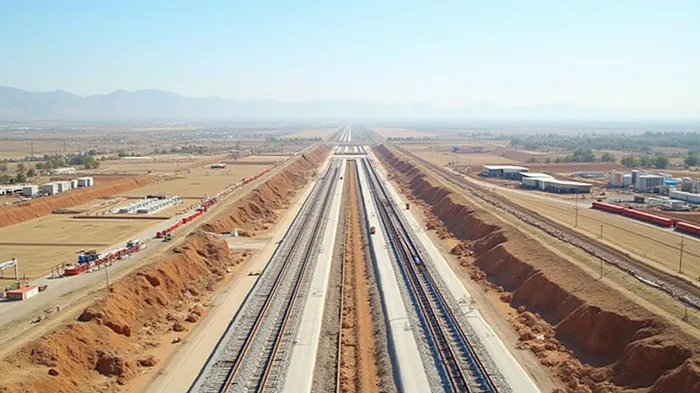
The project’s current progress is uneven. Fifty major structures are completed in the 119-mile Merced-to-Bakersfield segment, with 22 miles of guideway ready for track-laying. But only 50% of this segment is under construction, and securing an additional $7 billion by summer 2025 is critical to keep it alive.
Risks and Rewards
The project’s survival hinges on three factors: federal cooperation, legal resolution, and fiscal creativity. Four active lawsuits under the California Environmental Quality Act threaten to further delay timelines, while the state’s reliance on cap-and-trade revenues—a politically contentious source—adds uncertainty.
Proponents argue that abandoning the project would waste $6.8 billion in federal funds and $22.5 billion in state investments. Detractors counter that the costs far outweigh the benefits: even if completed, ticket prices would likely exceed $100, and ridership projections remain speculative.
Conclusion: A Gamble with High Stakes
The California High-Speed Rail project is a classic case of sunk-cost fallacy meets geopolitical ambition. With $30 billion already invested and timelines stretching into the next decade, the state faces a choice: double down on a project that could redefine transportation in the U.S. or cut losses and pivot to road projects.
The numbers are grim: the project’s costs have surged 230%, and its completion date has been pushed back a decade. Yet the 15,000 jobs already created and the tangible infrastructure built—50% of the Central Valley segment—suggest that walking away would be a colossal waste.
Investors and policymakers must weigh these realities. If California secures the $7 billion needed by summer 2025 and resolves legal hurdles, the project could inch toward completion—a testament to long-term infrastructure vision. If not, it may join the ranks of other grandiose projects, like Boston’s Big Dig, as a cautionary tale of ambition outpacing practicality. For now, the verdict remains on the tracks.







Comentarios
Aún no hay comentarios