
California's Green Renaissance: Strategic Investment in Legislative Innovation and Infrastructure
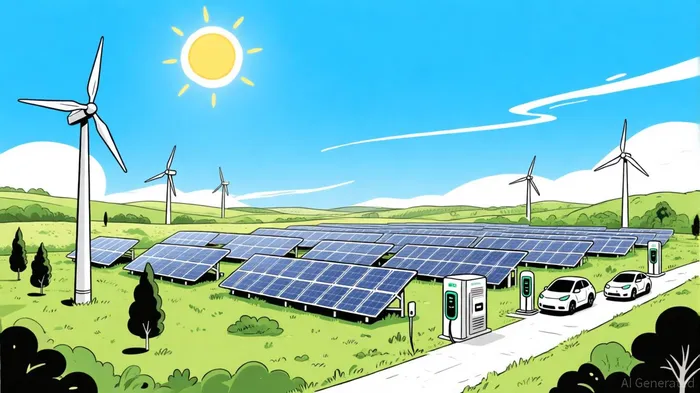
California's 2025 legislative session has cemented its position as a global leader in climate innovation, with a suite of policies designed to accelerate green infrastructure development while addressing economic equity. For investors, this represents a unique confluence of regulatory momentum, market scalability, and long-term returns. By dissecting the state's legislative trends and their economic implications, we uncover actionable insights for capitalizing on California's green renaissance.
Legislative Trends: Resilience, Equity, and Long-Term Commitment
The 2025 legislative agenda prioritizes disaster resilience and equitable climate action. Bills like AB 239 and AB 818 streamline post-disaster rebuilding, ensuring communities recover faster from wildfires and other climate-related crises [1]. These measures are paired with AB 1, which mandates periodic updates to wildfire risk reduction strategies, creating a dynamic policy framework that adapts to evolving threats [1].
Equally significant is the reauthorization of California's cap-and-trade program through 2045, a decision that has sparked debate but ensures sustained funding for climate initiatives. Critics argue it risks entrenching systemic inequalities, while proponents highlight its role in balancing affordability and decarbonization [2]. Meanwhile, the Greenlining Institute's advocacy for equity-focused policies—such as the Roads to Resilience Act (AB 1132) and the California Community Reinvestment Act (AB 801)—demonstrates a deliberate effort to integrate social justice into infrastructure projects [3].
Economic Impact: Jobs, Growth, and Market Dynamics
The economic returns of these policies are substantial. A 2025 study by Greenline Insights projects that California's green infrastructure investments will generate 287,000 jobs and deliver $55 billion in economic growth between 2031 and 2045, assuming cap-and-trade remains intact [1]. These figures are bolstered by the state's renewable energy boom: cleantech investment hit a record $71 billion in Q3 2024, driven by the Inflation Reduction Act's (IRA) $27 billion Greenhouse Gas Reduction Fund [4].
The IRA's Solar for All and Empowering Rural America programs are already catalyzing large-scale renewable deployment, with over 36 GW of renewables and storage expected by 2030 [4]. Meanwhile, the rise of data centers—projected to drive 44 GW of clean energy demand by 2030—highlights the symbiotic relationship between digital infrastructure and decarbonization [4].
However, challenges persist. Despite a 23% reduction in per capita emissions since 2006, California's renewable energy share stagnated at 36.9% in 2023, missing the SB 100 target of 44% [5]. Emissions from substitutes for ozone-depleting substances (SODs) are now the fastest-growing source of GHG emissions, rising 0.6% annually [5]. These gaps underscore the need for targeted investments in emerging technologies like direct air capture (DAC) and advanced battery storage.
Strategic Investment Opportunities
- Cleantech Manufacturing and Innovation: With falling interest rates and subsiding inflation, renewables are becoming cost-competitive. Investors should prioritize firms developing modular solar systems, green hydrogen, and DAC technologies.
- Equity-Linked Infrastructure: AB 801 and AB 1132 create opportunities for impact investors to fund projects in historically underserved communities, aligning financial returns with social value.
- Energy Storage and Grid Modernization: California's 44% share of U.S. battery storage additions in 2023 [5] signals a growing market for grid resilience solutions, particularly as heat waves strain power systems.
Challenges and the Path Forward
Meeting California's 2030 emissions targets requires accelerating the current 2.5% annual reduction rate to 4.2% [5]. This necessitates scaling public-private partnerships, such as the Transformative Climate Communities program, which leverages state funds to attract private capital [6]. The Climate Policy Initiative's analysis reveals that California needs $60 billion annually in climate finance by 2045—up from $39 billion today—highlighting the urgency of innovative financing mechanisms [6].
For investors, the key lies in aligning with policies that combine regulatory durability (e.g., cap-and-trade extensions) with market scalability. The state's commitment to net-zero by 2045 is not just an environmental imperative but a $600 billion economic opportunity.
Conclusion
California's legislative trends reflect a strategic pivot toward resilient, equitable, and economically viable green infrastructure. While challenges in renewable adoption and emissions from SODs persist, the state's policy framework and market dynamics position it as a bellwether for global climate action. Investors who align with these trends—whether through cleantech innovation, equity-focused infrastructure, or grid modernization—stand to benefit from a future where sustainability and profitability are inextricably linked.







Comentarios
Aún no hay comentarios