
CAF's $2.5 Billion Marine Ecosystem Investment: A Blue Economy Blueprint for Sustainable Returns
The Development Bank of Latin America and the Caribbean, CAF, has positioned itself at the forefront of global sustainability efforts with its $2.5 billion marine ecosystem investment initiative—a doubling of its 2022–2025 commitment. This bold pledge, announced ahead of the UN Ocean Conference 2025, underscores a strategic shift toward blue economy financing, where biodiversity preservation and economic resilience converge. For investors, this presents a rare opportunity to align capital with planetary stewardship while targeting risk-adjusted returns through innovative instruments like blue bonds and habitat banks.
Blue Economy Financing: Aligning Capital with Ocean Health
CAF's strategy is anchored in the Sea Change Impact Financing Facility (SCIFF), designed to catalyze private investment into marine ecosystems. By 2030, the SCIFF aims to channel $2.5 billion into projects that safeguard biodiversity while fostering sustainable economic activities. This framework leverages three critical pillars:
- Blue Bonds: Debt instruments tied to measurable environmental outcomes, such as coral restoration or mangrove conservation. For instance, CAF's collaboration with the IFC on a $243 million blue bond in 2024 demonstrated investor appetite for such products, with yields competitive to traditional green bonds.
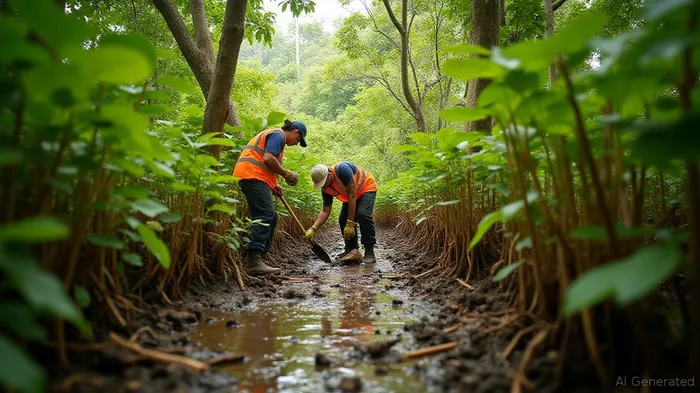
- Habitat Banks: Market-based systems where developers fund conservation projects to offset environmental damage elsewhere. In the Caribbean, mangrove restoration projects funded by CAF's Green Funds ($25.7 million allocated since 2022) exemplify this model, creating carbon sinks and coastal buffers against storms.
- De-Risking Mechanisms: Instruments like the Nautilus Blue Guarantee Company reduce investor uncertainty by underwriting projects against climate or market volatility.
Sectors with Dual Environmental and Economic Impact
CAF's investment priorities highlight sectors where environmental protection directly enhances economic stability:
1. Coral Restoration
The Caribbean's coral reefs, vital for fisheries and tourism, face existential threats from warming seas. CAF's $125,000 coral nursery projects in the Mesoamerican Reef System aim to restore 1,200 hectares of reef by 2030. These efforts not only bolster marine biodiversity but also protect coastal economies: reefs reduce up to 90% of wave energy, shielding communities from storm damage.
2. Sustainable Fisheries
Overfishing threatens food security and livelihoods in Latin America. CAF's $17 million allocation to combat illegal fishing and support artisanal fisheries in the Southwest Atlantic aims to recover 225,000 metric tons of overexploited stocks by 2030. Sustainable fishing certifications, such as the Marine Stewardship Council (MSC), can command premium prices, offering investors exposure to growing demand for traceable seafood.
3. Mangrove Conservation
Mangroves sequester four times more carbon per hectare than tropical forests, yet they are vanishing at 1% annually. CAF's $25.7 million mangrove restoration projects in Brazil and Colombia aim to restore 10,000 hectares by /2025, creating “natural infrastructure” that safeguards coastal cities and supports eco-tourism.
Risk-Adjusted Returns: How Investors Can Participate
The blue economy's growth hinges on closing a $500 billion annual financing gap for ocean-related projects. CAF's initiatives offer pathways to mitigate risks while capturing emerging opportunities:
- Blue Bonds: Investors can access these via CAF's syndicated deals or ETFs like the iShares Global Clean Energy ETF (ICLN), which increasingly includes marine energy projects.
- Private Equity Partnerships: Funds focused on biodiversity credits, such as Conservation International's debt-for-nature swaps, align with CAF's $100 billion coalition goal.
- Equity Plays: Companies like Ecocean (ECOC), which develops sustainable aquaculture solutions, or Aqua-Spark, an aquaculture impact fund, benefit from CAF's push to scale climate-resilient fisheries.
Conclusion: A Tide That Lifts All Boats
CAF's $2.5 billion commitment is not merely an environmental initiative but a blueprint for regenerative capitalism. By channeling capital into sectors like coral restoration and sustainable fisheries, investors can support ecological recovery while profiting from rising demand for ESG-aligned assets. As the bank's SCIFF framework matures, the focus on de-risking mechanisms and policy integration ensures these investments are as viable as they are visionary.
For investors seeking to capitalize on this transition, the path is clear: allocate to blue bonds and habitat banks through CAF-backed instruments or regional ETFs. The ocean's health—and the wealth it sustains—depends on it.
Disclosure: This analysis does not constitute financial advice. Consult a licensed advisor before making investment decisions.







Comentarios
Aún no hay comentarios