
Cadre Holdings: Strategic Positioning and Capital Efficiency in Commercial Real Estate
In the evolving commercial real estate landscape, Cadre Holdings has positioned itself as a disruptor by leveraging technology, strategic partnerships, and a focus on alternative investments. According to a SwotAnalysis report, the company aims to expand its secondary market by 150% in trailing twelve months while reducing transaction times from 30 to 15 days through AI-driven underwriting and predictive modeling. This focus on efficiency aligns with broader industry trends, as institutional investors increasingly seek diversification in niche sectors like data centers and life sciences, as noted in a Cohen & Steers insight.
Strategic Catalysts for Growth
Cadre's 2025 strategic plan emphasizes democratizing real estate investing by lowering barriers to entry. A pilot fund with a $10,000 minimum is designed to attract 1,000 new investors, broadening its total addressable market, according to the SwotAnalysis report. Simultaneously, the company is deepening partnerships with registered investment advisors (RIAs), a move that could drive significant asset growth. For instance, Q2 2025 results showed net sales of $157.1 million, with adjusted EBITDA margins rising to 17.2%-a 140-basis-point improvement from Q1, as reported in Cadre's Q2 release. These metrics underscore the effectiveness of Cadre's middle-market focus and disciplined capital deployment.
Capital Allocation Efficiency
While specific ROI and expense ratios for the commercial real estate segment remain undisclosed, Cadre's financial performance highlights operational efficiency. For the first half of 2025, the company generated $287.2 million in net sales with a 41.9% gross margin and 16.5% adjusted EBITDA margin, as detailed in Cadre's Q2 release. Capital expenditures were modest at $2.7 million, reflecting a measured approach to reinvestment. By comparison, Q1 2025 adjusted EBITDA of $20.5 million (15.8% margin) improved to $27.0 million in Q2, driven by recent acquisitions and demand for nuclear safety products, per the figures in Cadre's Q2 release.
The company's balance sheet further supports its capital efficiency. As of June 30, 2025, Cadre held $137.5 million in cash and cash equivalents, despite increased debt to $315.2 million (net debt of $177.7 million), according to Cadre's Q2 release. This liquidity positions Cadre to pursue strategic acquisitions, such as the Carr's Engineering division, which enhances its nuclear safety capabilities and diversifies revenue streams, a point highlighted in the SwotAnalysis report. Analysts note that such disciplined capital allocation-prioritizing high-growth, underserved markets-could drive long-term value creation, according to a Property Chronicle analysis.
Risks and Market Dynamics
Despite these strengths, challenges persist. Rising interest expenses, up $1.6 million year-over-year in Q2 2025, highlight the cost of debt-fueled growth, as the SwotAnalysis report observes. Additionally, macroeconomic uncertainties, including tariffs and geopolitical risks, could impact demand for Cadre's products, a risk discussed in the Property Chronicle analysis. However, the company's focus on the middle market-a segment less sensitive to macroeconomic swings-provides a buffer, as noted in the Cohen & Steers insight.
Conclusion
Cadre Holdings' strategic initiatives and financial discipline position it as a compelling player in the commercial real estate sector. By combining technological innovation, strategic partnerships, and a focus on alternative assets, the company is well-placed to capitalize on industry tailwinds. While specific ROI metrics for real estate remain opaque, its improving EBITDA margins and robust liquidity suggest efficient capital allocation. Investors should monitor Cadre's ability to execute its secondary market expansion and manage debt costs amid evolving market conditions.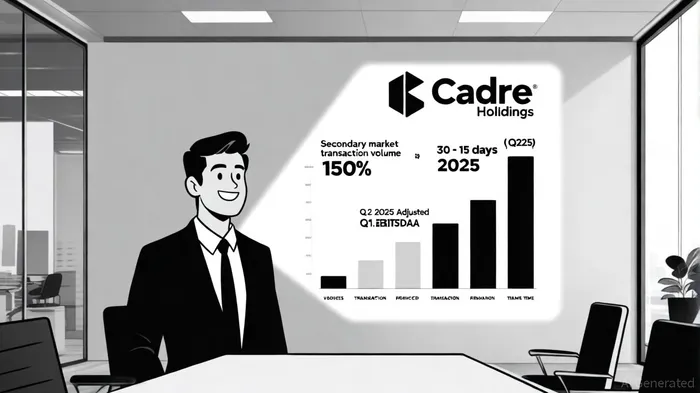







Comentarios
Aún no hay comentarios