
CABGY's Dividend Sustainability: Assessing Financial Resilience and Strategic Risk Management for Income Investors
Cabot Microelectronics (CABGY) has long been a staple for income-focused investors, offering a blend of stable cash flows and disciplined capital returns. As of October 2025, the company's dividend payout ratio stands at 22.68%, significantly below the Basic Materials sector average of 35.6%, according to financecharts' payout data. This conservative approach, coupled with robust operating cash flow and a measured debt profile, suggests a resilient foundation for sustaining payouts. However, for income investors, the critical question remains: How does CABGYCBT-- balance its dividend commitments with strategic risk management in an era of macroeconomic uncertainty and industry-specific vulnerabilities?
Financial Resilience: Cash Flow and Leverage
CABGY's fiscal 2025 results underscore its financial strength. In its Q3 2025 results, the company generated $249 million in operating cash flow, with discretionary free cash flow of $114 million after $61 million in capital expenditures. Annual cash flow from operations for 2024 totaled $692 million, supporting $241 million in capital investments and $93 million in dividend payments, as reported in Cabot's 10-K filings. This allocation reflects a disciplined approach to capital deployment, prioritizing reinvestment while maintaining shareholder returns.
Debt levels remain manageable, with a debt-to-equity ratio of 0.76 as of September 2024, per stock-data's debt-to-equity page. This marks a significant improvement from 1.21 in 2022, indicating a strategic shift toward equity financing and reduced leverage. Such a capital structure enhances flexibility, allowing CABGY to navigate downturns without compromising its ability to fund operations or sustain dividends.
Strategic Risk Management: Beyond the Balance Sheet
While CABGY's financials appear sturdy, its strategic risk management practices are equally vital for dividend sustainability. The company's 2024 10-K highlights a robust incentive compensation recoupment policy, which allows for the recovery of executive bonuses if financial restatements occur due to material noncompliance. This policy, effective October 2023, aligns leadership incentives with long-term financial integrity, reducing the risk of short-term mismanagement that could destabilize earnings.
Cybersecurity also features prominently in CABGY's risk framework, as outlined in its cybersecurity 10-K. The company employs a NIST-aligned program, including quarterly Board-level updates and simulation exercises to mitigate cyber threats. Given the increasing frequency of cyberattacks in industrial sectors, this proactive stance minimizes operational disruptions that could otherwise pressure cash flows and dividend capacity.
However, CABGY's 10-K does not explicitly outline a formal dividend policy or detailed risk management strategies for sustaining payouts. This absence, while not uncommon, leaves some ambiguity for income investors. The company's actions-such as maintaining a payout ratio well below 100% and returning $93 million in dividends during 2024-suggest a de facto conservative approach, as shown by CCMP's 10-K. Management's reaffirmation of fiscal 2025 adjusted EPS guidance ($7.15–$7.50) further signals confidence in sustaining earnings despite macroeconomic headwinds.
Industry-Specific Vulnerabilities and Mitigation
CABGY operates in cyclical markets, with its Reinforcement Materials and Performance Chemicals segments exposed to fluctuations in construction, automotive, and energy demand. In 2024, the company mitigated volume declines (down 8%) through cost optimization programs like "Future Forward" and strategic price increases, according to its 2024 10-Q filings. These initiatives preserved margin resilience, a critical factor for sustaining dividends during downturns.
Yet, rising raw material and logistics costs remain persistent risks. While CABGY has offset some pressures via pricing power, prolonged inflation could erode margins. Additionally, the company's exposure to interest rate sensitivity-evidenced by reduced interest income in 2024-highlights another vulnerability, as noted in the November 2024 10-K. For now, CABGY's strong cash flow generation and low leverage provide a buffer, but investors should monitor how management navigates these challenges.
Dividend Policy in Practice
Though CABGY's 10-K lacks a formal dividend policy, its track record offers clarity. The company has consistently increased dividends, with the most recent hike to $0.45 per share in Q3 2025, per the company's investor page. This aligns with a historical pattern of annualized payouts around $1.76 per share, supported by a payout ratio that has averaged 24.25% over three years, according to financecharts' payout data. By retaining a significant portion of earnings, CABGY maintains flexibility to adjust distributions in response to economic shifts-a key trait for dividend sustainability.
Conclusion: A Prudent but Cautious Outlook
Cabot Microelectronics' dividend appears well-supported by its financial metrics and strategic risk management practices. A low payout ratio, strong cash flow, and conservative leverage position the company to withstand near-term volatility. However, the lack of explicit dividend policy details in its 10-K and exposure to cyclical industry risks warrant caution. For income investors, CABGY offers a compelling but not foolproof proposition. Continued monitoring of macroeconomic trends, cost management efficacy, and management's commitment to shareholder returns will be essential in assessing long-term sustainability. 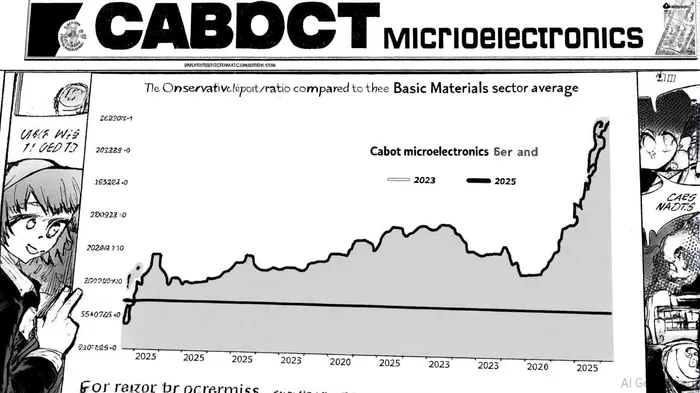





Comentarios
Aún no hay comentarios