
C3.ai's Strategic AI Ecosystem Expansion: Partnership-Driven Growth and Enterprise AI Scalability
Microsoft Partnership: A Cornerstone of Enterprise AI Integration
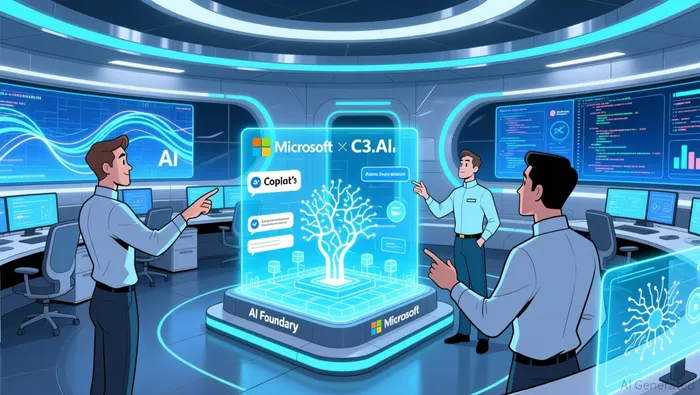
C3.ai's most significant development in 2025 has been its expanded collaboration with Microsoft, which now includes native integrations across Microsoft Copilot, Microsoft Fabric, and Azure AI Foundry. This partnership enables enterprises to unify reasoning, data, and model operations within a single system on the Microsoft Cloud, streamlining AI deployment and management. For instance, C3.ai's applications are now accessible via the Microsoft Commercial Cloud Portal and Azure Marketplace, with joint go-to-market strategies accelerating adoption in sectors like energy and manufacturing.
The integration with Microsoft Copilot allows users to interact with C3.ai's domain-specific applications through a conversational interface, enabling tasks such as invoking agentic workflows and accessing enterprise ontologies without data duplication. Meanwhile, Azure AI Foundry simplifies the deployment and fine-tuning of foundation models, addressing a critical barrier to enterprise AI scalability. According to C3.ai CEO , these advancements make enterprise AI "practical, trusted, and scalable", particularly in high-stakes sectors like defense and government.
 ### Expanding Cloud Alliances and Industry-Specific Solutions
Beyond Microsoft, C3.ai has strengthened ties with AWS and Google Cloud, leveraging their global infrastructure to broaden its market reach. The company's Strategic Integrator Program further amplifies this strategy by licensing its Agentic AI Platform to partners for industry-specific solutions. This initiative has already attracted interest from defense, intelligence, and government clients, reflecting C3.ai's focus on vertical markets where AI adoption is mission-critical.
. Air Force, which underscores the demand for C3.ai's solutions in national security applications. Such contracts not only validate the company's technical capabilities but also provide a stable revenue stream in a sector less susceptible to market volatility.
Enterprise AI Adoption: Case Studies and Scalability Metrics
The impact of C3.ai's partnerships on enterprise AI adoption is evident in case studies involving companies like Dow, Shell, and Nucor. These organizations have deployed C3 AI Energy Management and C3 AI ESG solutions to enhance operational efficiency and sustainability metrics. For example, Nucor's enterprise-wide rollout of C3.ai's AI tools has reportedly reduced maintenance costs and improved predictive analytics for steel production.
Scalability metrics further highlight the effectiveness of C3.ai's ecosystem. In fiscal 2025, were executed through partnerships, demonstrating the growing reliance on collaborative models to accelerate AI deployment. This trend aligns with broader industry analyst insights, such as Trend Micro's introduction of the Trend Vision One™ AI Security Package, which supports multi-cloud environments and addresses risks like data poisoning and prompt injection.
Challenges and Market Realities
Despite these advancements, C3.ai faces significant headwinds. The company in 2025, leading to a retracted annual outlook and speculation about potential acquisition. This financial strain reflects broader market concerns about the sustainability of AI valuations, particularly for pure-play software firms. As noted in a report by Decrypt, investor skepticism has caused sharp volatility in AI stocks, with critics questioning whether current valuations justify long-term profitability.
Moreover, while C3.ai's government contracts provide stability, they also expose the company to regulatory and geopolitical risks. For instance, shifts in defense spending or procurement policies could impact future revenue streams. Similarly, the reliance on cloud partners like Microsoft and AWS means C3.ai's growth is partially contingent on the success of its ecosystem collaborators.
Conclusion: Balancing Growth and Caution
C3.ai's strategic expansion of its AI ecosystem has undeniably advanced enterprise AI adoption, particularly through its Microsoft integrations and government contracts. The company's focus on industry-specific solutions and agentic AI platforms positions it to capitalize on the by 2034. However, investors must weigh these opportunities against financial challenges and market-wide valuation concerns.
For C3.ai to sustain its growth trajectory, it will need to demonstrate consistent revenue performance and address investor skepticism through tangible results. In the short term, the company's partnerships and government contracts offer a buffer against market volatility, but long-term success will depend on its ability to innovate and adapt in a rapidly evolving AI landscape.







Comentarios
Aún no hay comentarios