
C3.ai and Microsoft's Deepened Collaboration: A Catalyst for Enterprise AI Adoption in 2025
Streamlining AI Operations Through Microsoft Integrations
C3.ai's deepened partnerships with Microsoft have enabled enterprises to unify reasoning, data, and model operations within a single AI system on the Microsoft Cloud. By integrating with Microsoft Copilot, C3.ai allows users to invoke domain-specific applications and agents via a conversational interface, streamlining complex workflows such as generating RFPs or analyzing weather impacts on logistics. This integration reduces friction in AI adoption, enabling non-technical users to leverage advanced analytics without requiring data movement or duplication according to C3.ai's integration report.
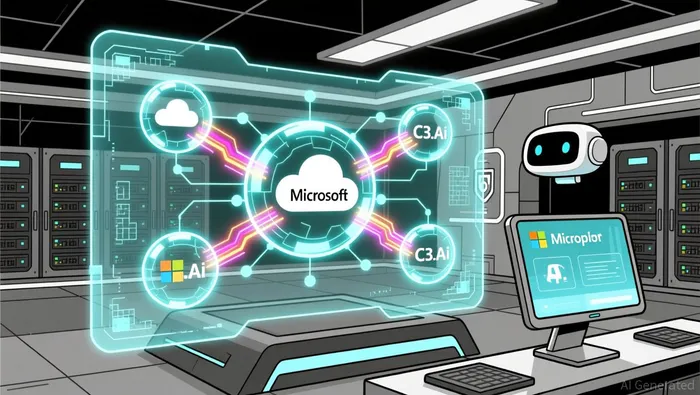 The collaboration with Microsoft Fabric and OneLake further enhances C3.ai's value proposition. By leveraging Fabric's data orchestration capabilities, C3.ai powers enterprise ontologies that function as an intelligence layer atop trusted data workflows. This eliminates the need for redundant data storage while ensuring compliance with enterprise governance standards. Meanwhile, Azure AI Foundry provides a seamless ecosystem for deploying, fine-tuning, and serving foundation models, allowing C3.ai to deliver scalable AI solutions tailored to industries like energy, defense, and healthcare.
According to a report by Stock Titan, these integrations reflect a broader industry trend toward embedded, enterprise-ready AI platforms that prioritize scalability and trust as research shows. Microsoft's cloud infrastructure, combined with C3.ai's domain expertise, is addressing critical pain points in enterprise AI adoption, such as interoperability and operational complexity.
Financial Performance and Stock Volatility
While C3.ai's technical capabilities are robust, its financials tell a mixed story. For Q3 and Q4 2025, the company reported revenue growth of 26% year-over-year, with total revenue reaching $98.8 million and $108.7 million, respectively. Subscription revenue, which constitutes 87% of total revenue, grew by 22% in Q3 and 22% in Q4, underscoring demand for its AI-as-a-service model. However, profitability remains elusive, with GAAP net losses of $(0.62) per share in Q3 and $(0.60) per share in Q4 according to financial reports.
The stock has faced significant headwinds, dropping over 60% in the past year. As of November 2025, C3.ai's market capitalization stood at $1.886 billion, with a price target of $14.67 set by analysts according to market data. This underperformance has been attributed to structural challenges, including a reliance on non-recurring revenue and leadership uncertainty following founder Thomas Siebel's resignation in September 2025. DA Davidson downgraded the stock to "Underperform," citing concerns over growth durability.
Despite these challenges, C3.ai's strategic partnerships have driven meaningful revenue diversification. In 2025, 73% of its agreements were executed through collaborations with hyperscalers like Microsoft and AWS. A $450 million contract with the U.S. Air Force to scale its predictive maintenance platform, PANDA, further highlights the company's ability to secure high-impact enterprise contracts.
A Long-Term Investment Thesis Built on Strategic Alliances
C3.ai's collaboration with Microsoft is not merely a technical integration but a strategic alignment with the dominant cloud ecosystem. By embedding its AI applications into Microsoft's Copilot interface, C3.ai is democratizing access to enterprise-grade AI tools, a critical factor in accelerating adoption. The company's ability to leverage Microsoft Fabric and OneLake for data orchestration also addresses a key barrier to AI deployment: the need for siloed data integration.
Moreover, C3.ai's focus on industry-specific solutions-such as its energy sector platform for Baker Hughes and defense applications for the U.S. military-positions it to capture niche markets where generic AI tools fall short. This specialization, combined with Microsoft's cloud infrastructure, creates a defensible moat in a competitive AI landscape.
While short-term financial metrics remain a concern, the company's guidance for FY2026 revenue of $447.5–$484.5 million suggests confidence in scaling its business. Management has also outlined a path to non-GAAP profitability by mid-2027 and free cash flow positivity by late 2026 according to earnings call statements. These milestones, if achieved, could catalyze a re-rating of the stock.
Conclusion
C3.ai's partnership with Microsoft represents a strategic inflection point for enterprise AI adoption. By integrating its domain-specific applications into Microsoft's cloud ecosystem, the company is addressing critical operational and technical barriers that have historically hindered AI deployment. While recent stock volatility and financial losses pose risks, the underlying business fundamentals-robust revenue growth, strategic alliances, and a clear path to profitability-suggest that C3.ai is well-positioned to capitalize on the long-term AI megatrend. For investors with a multi-year horizon, the company's challenges appear to be temporary hurdles in a broader narrative of enterprise AI transformation.





Comentarios
Aún no hay comentarios