
C3.ai and the Future of Enterprise AI: Strategic Partnerships as a Catalyst for Growth or a Distraction in a Crowded Market?
The Financial Reality: Growth Amid Losses
C3.ai's Q3 2025 results showed total revenue of $98.8 million, a 26% year-over-year increase, driven by subscription revenue of $85.7 million (87% of total revenue) according to financial results. However, the company reported a non-GAAP net loss per share of $0.12 and a full-year operating loss guidance of $87–$97 million according to financial results. While hyperscaler partnerships contributed to a 68% year-over-year rise in agreements (193 in FY2025) and 73% of deals executed through partners according to market analysis, the broader financial picture remains bleak. A $116.8 million net loss in Q1 2025 and a 33% revenue outlook cut in early 2026 underscore operational fragility according to restructuring reports.
Strategic Partnerships: A Double-Edged Sword
C3.ai's deepening integrations with Microsoft Copilot, Microsoft Fabric, and Azure AI Foundry aim to create a unified enterprise AI system, streamlining AI operations for large organizations according to company announcements. These partnerships have driven a 140% year-over-year increase in Microsoft's joint pipeline and 90% of C3.ai's business now flows through hyperscalers according to market analysis. The Strategic Integrator Program, which licenses its Agentic AI Platform to partners for industry-specific solutions, has also shown promise, particularly in defense and government sectors according to company updates.
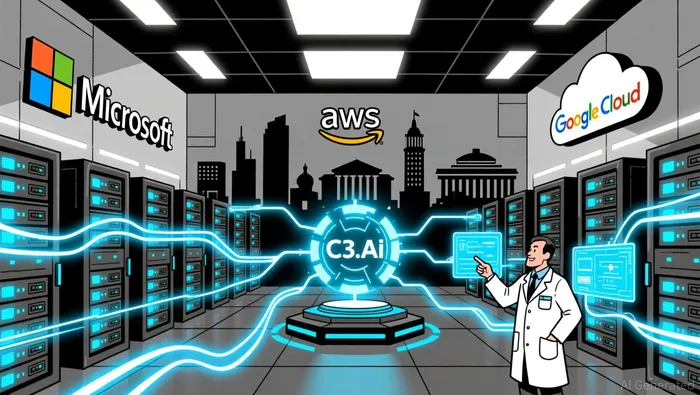
Yet, these alliances come with risks. The AI sector is experiencing a valuation correction, with investors rotating out of high-growth tech stocks. C3.ai's stock surged 6% on news of potential sale discussions, reflecting speculative optimism, but broader market skepticism persists according to market reports. Analysts note that while hyperscaler partnerships expand market reach, they also expose C3.ai to competition from the hyperscalers themselves, which are developing their own AI solutions according to industry analysis.
Leadership and Restructuring: A Rocky Transition
The departure of founder Thomas Siebel in July 2025 due to health concerns and the appointment of Stephen Ehikian as CEO marked a pivotal shift. Siebel attributed Q1 2026's weak sales to the sales restructuring and his own absence, while Ehikian faces the challenge of stabilizing operations according to company updates. The restructuring, including new leadership for global sales and services, initially disrupted performance but aims to enhance go-to-market efficiency according to financial results.
However, the transition has eroded investor confidence. C3.ai withdrew its full-year guidance, citing leadership changes and operational reorganization according to financial reports. Cost-cutting measures and disciplined spending are prioritized, but with a projected $30–$40 million Q4 non-GAAP operating loss, the path to profitability remains unclear according to financial results.
The Potential Sale: A Lifeline or a Last Resort?
Exploring a potential sale has injected short-term volatility into C3.ai's stock, with shares rising 6% on the news according to market reports. While this signals investor hope for a strategic buyer, it also reflects desperation. The company's $724.3 million cash reserves provide some flexibility, but without a sale or private funding, sustaining operations amid losses could prove challenging according to financial results. Analysts are divided: some view the new leadership and strong partner ecosystem as a foundation for recovery, while others label the stock a "Strong Sell" due to declining revenue and high-risk execution according to market analysis.
Conclusion: Partnerships as a Catalyst-With Caveats
C3.ai's hyperscaler partnerships are undeniably a growth catalyst, driving customer adoption and expanding its market footprint. The Strategic Integrator Program and deepened integrations with Microsoft, AWS, and Google Cloud position the company to capitalize on enterprise AI demand. However, these alliances are not a panacea. The company's financial instability, leadership transition, and a broader market correction in AI valuations create significant headwinds.
For long-term investors, the key question is whether C3.ai can execute its restructuring and leverage partnerships to achieve profitability. If Ehikian's leadership stabilizes operations and the hyperscaler ecosystem continues to drive revenue, the company could yet turn around. But without a clear path to profitability or a successful sale, C3.ai risks becoming a distraction in an already crowded market.





Comentarios
Aún no hay comentarios