
BYND Stock Volatility: Assessing the Impact of Debt Exchange on Shareholder Value
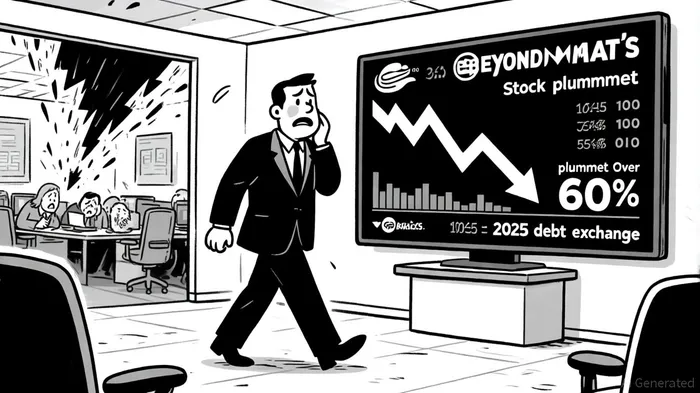
Beyond Meat's (BYND) recent debt restructuring has ignited a firestorm of volatility in its stock price, with shares plummeting over 60% in the wake of its September 2025 exchange offer, according to Investing.com. At the heart of this turmoil lies a high-stakes trade-off: reducing immediate default risk by extending debt maturity while inflicting severe dilution on existing shareholders. This analysis unpacks the mechanics of the exchange, quantifies the dilution risk, and evaluates whether the capital structure strategy is a lifeline or a death spiral.
The Debt Exchange: A High-Cost Lifeline
Beyond Meat's debt exchange involved swapping $1.11 billion of 0% convertible notes due in 2027 for new 7% Convertible Senior Secured Second Lien PIK Toggle Notes maturing in 2030 and 326 million new shares of common stock, per Beyond Meat's press release. The new notes feature a payment-in-kind (PIK) toggle, allowing the company to compound interest at 9.5% annually under certain conditions, as described in the exchange offer. This structure extends maturity by three years but locks in higher interest costs and introduces a compounding debt risk.
The exchange also eliminated restrictive covenants in the original indenture, providing operational flexibility, according to Quiver Quant. However, the cost of this flexibility is staggering: the issuance of 326 million new shares, which represents a 427% increase relative to the 76.5 million shares outstanding as of Q2 2025, per CompaniesMarketCap. For context, this dilution exceeds the total shares issued in the company's entire history, effectively resetting the ownership stakes of existing shareholders.
Dilution Risk: A Shareholder Value Black Hole
Dilution is rarely a secret in distressed companies, but Beyond Meat's scale is unprecedented. The 326 million new shares will increase total shares outstanding from ~76 million to approximately 402 million post-exchange, according to MarketWatch. This means existing shareholders' ownership will be diluted by roughly 81% (calculated as 76.5 / (76.5 + 326)). Such a move is akin to handing over 80% of the company to new investors in exchange for temporary debt relief.
The dilution is compounded by additional equity-linked components. For instance, the $40 million draw from a secured term loan facility included warrants exercisable at $3.26, a price far above the post-exchange stock price of ~$0.60, as disclosed in an 8-K filing. These warrants, if exercised, could further erode shareholder value. Meanwhile, the PIK toggle on the new notes could force the company to issue even more shares in the future if cash flow remains constrained.
Capital Structure Strategy: A Bridge to Nowhere?
The exchange's primary goal is to reduce leverage and avoid default. By swapping short-term zero-coupon debt for longer-term 7% notes, Beyond MeatBYND-- buys time to stabilize its cash flow. However, the strategy's long-term viability is questionable. The new debt's 7% interest rate is steep for a company that reported a net loss of $128 million in Q2 2025, according to its 10-Q, and the PIK feature could accelerate debt growth if cash flow doesn't improve.
Moreover, the exchange ignores the root issue: weak revenue growth. Beyond Meat's revenue declined 18% year-over-year in Q2 2025, to $142 million, as reported by Reuters. Without a clear path to profitability, the extended maturity of 2030 may only delay a reckoning. The company's focus on "aggressive cost reductions" and margin expansion is noted in coverage on BeyondSPX, but such measures are a necessary but insufficient fix.
Market Reaction: A Vote of No Confidence
The market's response has been brutal. Shares fell from ~$1.50 pre-announcement to ~$0.60 post-exchange, erasing $1.2 billion in market capitalization, according to Reuters. This sell-off reflects investor skepticism about the company's ability to execute its transformation strategy and the sheer magnitude of dilution. The 96.92% participation rate in the exchange offer, as reported by Markets Insider, suggests bondholders see this as the only viable path forward, but it also underscores the lack of alternative solutions.
Conclusion: A Pyrrhic Victory?
Beyond Meat's debt exchange is a textbook example of a high-risk, high-cost restructuring. While it extends the company's runway and removes immediate default risk, the dilution and compounding debt obligations create a precarious balance sheet. For shareholders, the exchange is a Pyrrhic victory: a temporary reprieve at the expense of long-term value. The coming months will test whether the company can reverse its revenue decline and generate the cash flow needed to service its new debt. Until then, BYNDBYND-- remains a stock for the bold-or the desperate.





Comentarios
Aún no hay comentarios