
BYD's Strategic Shift to Global Markets: A New Growth Engine Amid Domestic Slowdown?
BYD's meteoric rise in the global electric vehicle (EV) market has positioned it as a formidable challenger to traditional automakers and TeslaTSLA--. Yet, as domestic growth in China slows and competition intensifies, the company's aggressive pivot to international markets has become a critical test of its long-term viability. With exports accounting for 11.9% of total sales in the first seven months of 2024-nearly double the 2023 figure-BYD's export-led strategy is no longer a side bet but a central pillar of its growth narrative. The question now is whether this global expansion can sustainably offset domestic headwinds and cement BYD's status as a global EV leader.
Export Volume Trends and Market Diversification
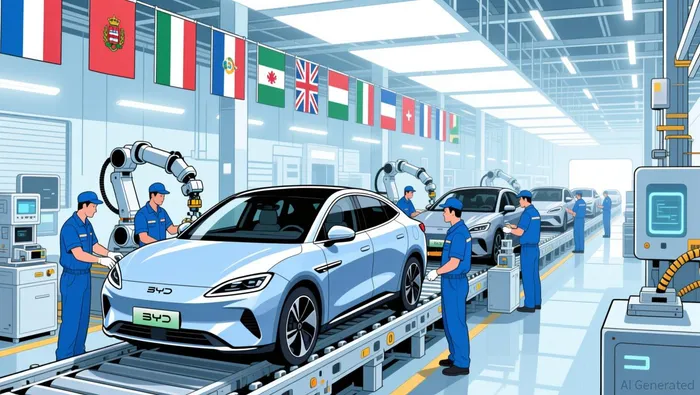
BYD's export volumes have surged, with 190,000 units sold internationally in 2024, nearly matching its 2023 total. The company's global sales are now split roughly equally among Europe, North America, and Southeast Asia, reflecting a deliberate diversification strategy. In Latin America, Brazil has emerged as a key hub, with new vehicle registrations rising 74% year-on-year in 2025. This growth is underpinned by localized production facilities in Hungary, Brazil, and Thailand, which reduce costs and insulate the company from tariffs. For instance, BYD's Hungarian plant aims to bypass EU levies on Chinese-made EVs, a critical advantage as trade tensions escalate.
However, the sustainability of this expansion hinges on regional dynamics. In Europe, BYD faces regulatory scrutiny and competition from established players, while Southeast Asia offers favorable policies like Argentina's tariff-free EV imports. The company's ability to adapt to these varying environments will determine whether its global footprint translates into lasting profitability.
Financial Performance and Premiumization Strategy
BYD's financials underscore its aggressive global ambitions. In 2024, the company reported revenue of 777.1 billion yuan, a 29% year-on-year increase, with a 23.9% net profit margin for automotive products in the first half of the year. This margin improvement reflects cost discipline and operational efficiency, but the company's premiumization strategy is equally vital. BYD has launched three high-end brands-Denza, Fangchengbao, and Yangwang-to capture higher-margin segments. These brands accounted for 5% of total sales in H1 2024, signaling a shift toward differentiation.
Chairman Wang Chuanfu has emphasized "premiumization and intelligence" as core priorities, with over 100 billion yuan allocated to R&D for intelligent driving and smart cockpit technologies. This focus on innovation is evident in localized marketing campaigns, such as Denza's Milan launch in Europe, which positions the brand as a global contender. Yet, challenges remain: perceptions of Chinese-made vehicles as lower-quality persist in markets like Europe, complicating BYD's premium positioning.
Risks and Opportunities in Localized Manufacturing
BYD's localized manufacturing strategy is a double-edged sword. While plants in Hungary and Brazil reduce logistics costs and tariffs, they also expose the company to regional risks. In Brazil, labor scrutiny and political instability could disrupt operations, while EU regulatory shifts threaten the viability of its European investments. Additionally, the company's reliance on aggressive pricing-such as discounts to boost market share in China-risks eroding margins in international markets.
Conversely, BYD's technological edge, including its Blade Battery and fast-charging capabilities, provides a competitive moat. In emerging markets, where affordability is key, BYD's cost-effective models outperform pricier rivals like Tesla. The company's investment in a fleet of car-carrier ships further insulates it from supply chain bottlenecks, ensuring consistent global delivery.
Sustainability of Export Growth
The long-term sustainability of BYD's export growth depends on three factors: infrastructure support, regulatory environments, and brand perception. In Southeast Asia and Latin America, favorable policies and renewable energy incentives bolster demand. However, trade tensions-such as the EU's 35% tariff on Chinese EVs-could force BYD to scale back its European ambitions unless local production scales rapidly.
Moreover, BYD must balance its premiumization goals with its reputation for affordability. While high-end brands like Yangwang target luxury segments, the company's core strength lies in accessible EVs. Striking this balance will require nuanced marketing and product segmentation, as seen in its tailored strategies for urban sustainability in Europe versus affordability in North America.
Conclusion
BYD's global expansion is a high-stakes gamble with the potential to redefine the EV landscape. Its localized manufacturing, premiumization efforts, and technological innovation position it to capitalize on international demand, particularly in emerging markets. However, risks such as trade barriers, brand perception, and operational complexity in new regions could temper its growth. For investors, the key question is whether BYD can maintain its domestic momentum while scaling globally-a challenge that will test the company's adaptability and resilience in the years ahead.







Comentarios
Aún no hay comentarios