
BYD's Strategic Expansion into South America: Assessing Argentina's EV Market Potential and Geopolitical Advantages
China's BYD has positioned itself at the forefront of the global electric vehicle (EV) revolution, and its recent foray into Argentina's market underscores a calculated move to capitalize on South America's rapidly evolving automotive landscape. With Argentina's EV market projected to grow at a staggering compound annual growth rate (CAGR) of 30.25% from 2025 to 2033, reaching USD 130.65 billion by 2033, according to an IMARC Group report, the country represents a critical battleground for automakers seeking to dominate the region's green energy transition. For BYD, the strategic alignment of Argentina's policy reforms, geopolitical dynamics, and consumer demand creates a compelling case for long-term investment.
Argentina's EV Market: A Policy-Driven Boom
Argentina's government has implemented a suite of incentives to accelerate EV adoption, including tax exemptions, reduced import tariffs, and subsidies for electrified vehicles. A pivotal policy shift in January 2025 eliminated tariffs on up to 50,000 hybrid and electric vehicles annually, a move that has already triggered a 70% surge in import applications compared to the same period in 2024, according to a Mobility Portal report. This policy not only lowers the cost of EVs for consumers but also opens the door for foreign automakers to compete in a previously protectionist market.
BYD's entry in August 2025 with the Dolphin Mini, Yuan Pro, and Song Pro DM-i models-priced below $16,000 before taxes-has been met with strong pre-order demand, as reported by CnEVPost. The company's strategy extends beyond sales: it has registered a local manufacturing unit and pledged to expand Argentina's charging infrastructure, Reuters reports in its coverage of BYD's launch in the country (Reuters). While Argentina's current EV charging network remains sparse-364 public chargers for 14,175 electrified vehicles sold in 2024, according to a Mobility Portal analysis-private-sector investments by Shell and YPF to double charging points in 2025 signal growing confidence in the sector's viability.
Geopolitical Leverage: China's South American Ambitions
Argentina's strategic importance for BYD is amplified by its role in China's broader geopolitical and economic strategy in South America. A $5 billion currency swap agreement between Argentina and China in April 2025 helped solidify bilateral ties, according to a CFR article, with China positioning itself as a key partner in Argentina's economic stabilization and infrastructure development. This relationship is part of a larger pattern: Chinese investments in South American ports, mines, and agricultural projects are designed to secure supply chains for critical resources like lithium and soybeans while reducing regional dependence on U.S. or European markets, as noted by Geopolitical Monitor.
BYD's expansion into Argentina aligns with this vision. By establishing a foothold in the second-largest car market in South America, the company is not only tapping into a growing consumer base but also reinforcing China's influence in the region's green energy transition. Argentina's policy of tariff-free EV imports directly benefits Chinese automakers, who offer cost-competitive models compared to European or domestic competitors, according to a Rest of World piece. This dynamic is further bolstered by Argentina's economic reforms under President Javier Milei, which prioritize foreign investment and market liberalization, as observed by Verified Market Reports.
Long-Term Growth: Infrastructure, Demand, and Regional Spillovers
The long-term success of BYD's Argentina venture hinges on three factors: infrastructure development, consumer adoption, and regional scalability. While Argentina's current charging network lags behind demand, the government's collaboration with private firms to establish ultra-fast charger corridors along key routes (e.g., Buenos Aires-Chile, Argentina-Brazil) could catalyze cross-border EV travel and regional integration, according to LATAM Mobility.
Consumer demand is also on an upward trajectory. Argentina's EV sales are expected to grow at a CAGR of 100.7% from 2025 to 2029, reaching 95,985 units by 2029, per a Fitch Solutions forecast. This growth is driven by falling EV prices, environmental awareness, and the economic advantages of lower fuel and maintenance costs. For BYD, the affordability of its models-priced to compete with both internal combustion vehicles and rival EVs-positions the company to capture a significant market share.
Regionally, Argentina's policy reforms could serve as a blueprint for neighboring countries. As South America's largest car market, Argentina's success in electrifying its fleet may encourage Brazil, Chile, and Uruguay to adopt similar incentives, creating a domino effect that expands BYD's addressable market.
Risks and Mitigations
Despite the optimism, challenges persist. Argentina's economic volatility, including inflation and currency fluctuations, could impact consumer purchasing power. Additionally, the lack of a coordinated public infrastructure strategy may slow charging network expansion. However, BYD's dual focus on local manufacturing and infrastructure partnerships-such as its collaboration with Argentine firms to build charging stations-mitigates these risks by aligning its growth with the country's long-term energy transition goals, according to GBEJ.
Conclusion: A Win-Win for BYD and Argentina
BYD's entry into Argentina's EV market is a masterstroke of strategic alignment. By leveraging Argentina's policy reforms, geopolitical ties with China, and the region's untapped demand for affordable EVs, the company is poised to dominate a market on the cusp of exponential growth. For investors, this move represents not just a bet on Argentina's EV boom but also a stake in China's broader economic and technological ascendancy in South America. As the continent's green energy transition accelerates, BYD's early-mover advantage in Argentina could prove to be a cornerstone of its global expansion.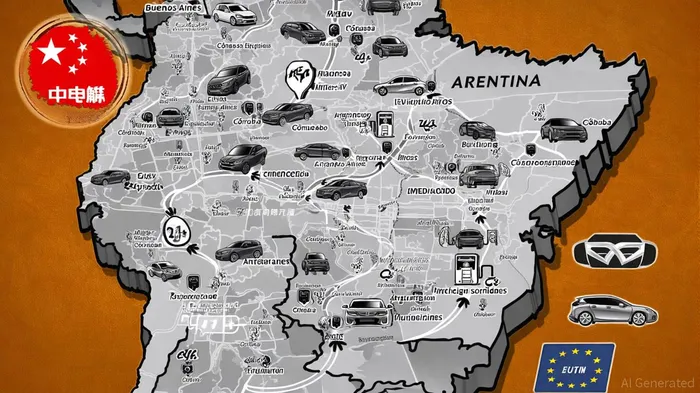







Comentarios
Aún no hay comentarios