
BYD's Strategic Expansion into Argentina's EV Market: Assessing Long-Term Growth and Regional Readiness
The electric vehicle (EV) market in Argentina is undergoing a seismic shift, driven by a confluence of policy reforms, infrastructure investments, and the country's vast lithium reserves. For Chinese automaker BYD, the timing of its entry into this market could not be more strategic. As Argentina's EV sales surged by 210% year-on-year in 2025, with 2,020 units sold, the stage is set for a transformative era in South American mobility, according to a Fitch Solutions report. BYD's recent launch of three models-the Dolphin Mini, Yuan Pro, and Song Pro DM-i-positions the company to capitalize on this momentum, but the question remains: Does its strategy align with Argentina's long-term readiness for EV adoption?
Argentina's EV Market: A Policy-Driven Boom
Argentina's government has removed a 35% import tariff on up to 50,000 electric and hybrid vehicles annually through 2026, a move that has already spurred a 70% increase in EV imports in early 2025 compared to 2024, as a Mobility Portal analysis reports. This policy, coupled with tax exemptions and streamlined regulations for charging infrastructure, has created a fertile ground for growth. By 2033, the market is projected to reach $15 billion, with a compound annual growth rate (CAGR) of 25%, according to a Verified Market Reports forecast. Urban centers like Buenos Aires are leading the charge, with public charging networks expanding to address range anxiety-a critical barrier to adoption.
However, challenges persist. Economic instability, including high inflation and currency volatility, could deter consumer spending. Additionally, while hybrids are dominating initial imports due to limited charging infrastructure, the government's push to install more stations by 2026 suggests a long-term commitment to electrification, as Mobility Portal notes.
BYD's Strategy: Diversification and Infrastructure Investment
BYD's entry into Argentina is marked by a nuanced approach. The company has introduced a mix of fully electric and plug-in hybrid models, catering to both urban commuters and families. This strategy acknowledges Argentina's current infrastructure limitations while positioning the brand for future growth. As Stephen Deng, BYD's country manager, noted, the company is importing 7,800 vehicles under the tariff waiver and plans to expand its dealership network to over 20 locations nationwide, according to EVMagz.
Crucially, BYD is not just selling cars-it is investing in the ecosystem. A partnership with local infrastructure firm Chargebox to expand EV charging stations underscores its commitment to overcoming the "chicken-and-egg" dilemma of EV adoption, as GBEJ reported. This infrastructure play aligns with Argentina's own goals, as the World Bank and DNV have emphasized the need for city-wide charging networks to sustain growth.
Lithium Abundance: A Strategic Advantage
Argentina's lithium reserves-part of the lithium-rich "Lithium Triangle" with Bolivia and Chile-offer a unique advantage for EV manufacturers. The country aims to boost lithium production by 75% in 2025, reaching 130,800 tonnes of lithium carbonate equivalent (LCE), driven by projects in Salta, Catamarca, and Jujuy, according to Discovery Alert. BYD, as part of China's broader push to dominate the global EV supply chain, is poised to benefit from this resource. Chinese firms like Ganfeng Lithium and CATL have already secured significant stakes in Argentina's lithium projects, and BYD's expansion into the region aligns with these strategic investments, as Undisciplined Environments notes.
While BYD has not yet announced battery production facilities in Argentina, its vertically integrated supply chain-spanning lithium mining to EV assembly-suggests a long-term vision to leverage regional resources. The company's development of all-solid-state batteries, slated for mass production by 2027, could further cement its role in Argentina's EV ecosystem, according to Electrek.
Risks and Realities
Despite the optimism, risks loom. Environmental and social concerns surrounding lithium extraction-particularly water usage in salt flats-have sparked protests from indigenous communities, as the BISI report documents. Additionally, Argentina's automotive industry has shrunk by 30% since 2012, and its reliance on exports to Brazil-a market slow to adopt EVs-could limit domestic production synergies, according to a FUND analysis.
For BYD, the path forward depends on navigating these challenges while maintaining its focus on infrastructure and consumer education. The company's decision to bypass local distributors and establish direct sales channels, as seen in Colombia and Peru, indicates a prioritization of market share over immediate profitability-a risky but potentially rewarding strategy in a nascent market, as HGBr noted.
Conclusion: A Calculated Bet on the Future
BYD's expansion into Argentina is a calculated bet on a market at the intersection of policy tailwinds, resource abundance, and strategic timing. While infrastructure gaps and economic volatility pose risks, the company's investments in charging networks and its alignment with Argentina's lithium boom suggest a long-term commitment. For investors, the key takeaway is clear: BYD is not just selling cars in Argentina-it is building an ecosystem. Whether this ecosystem thrives will depend on the government's ability to sustain policy momentum and BYD's agility in addressing local challenges. 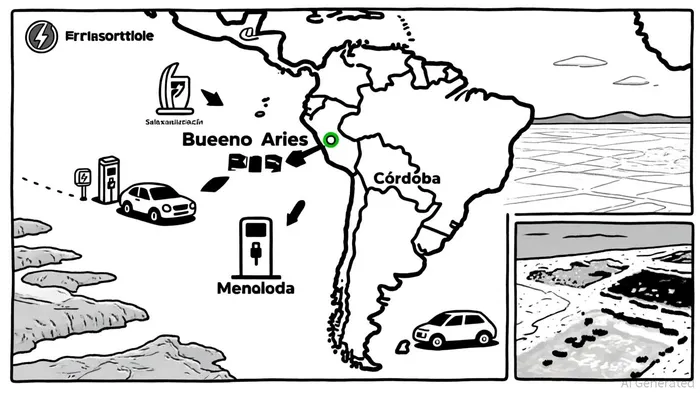







Comentarios
Aún no hay comentarios