
BYD's Long-Term Investment Potential Post-Berkshire Exit: Navigating Re-Rating and Institutional Shifts
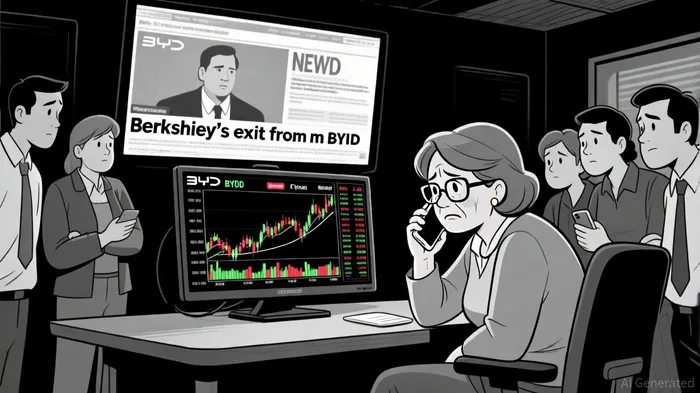
The recent full exit of Berkshire Hathaway from its 17-year stake in BYD marks a pivotal moment for the Chinese electric vehicle (EV) giant. Warren Buffett's decision to divest a position that grew from $230 million in 2008 to a peak valuation of $9 billion by 2022[1] has sent ripples through the EV sector. While the move reflects strategic recalibration by Berkshire, it also raises critical questions about BYD's long-term value creation potential and its ability to navigate a re-rating in the EV industry.
Strategic Implications of Reduced Institutional Ownership
Berkshire's exit, confirmed in March 2025, followed a gradual reduction of its stake since August 2022[2]. The sale triggered an immediate 3% drop in BYD's shares[3], underscoring the symbolic weight of Buffett's endorsement. Institutional ownership shifts have since accelerated: Vanguard, BlackRock, and Fidelity collectively sold $3.3 billion worth of BYD shares in Q2 2025[4]. This exodus reflects broader investor caution toward Chinese equities amid geopolitical tensions and regulatory scrutiny of aggressive discounting in the EV sector[5].
However, institutional skepticism does not equate to a lack of fundamentals. BYD's financials remain robust, with a net cash position of 13.57 billion yuan and a debt-to-equity ratio of 0.21[6]. The company's vertical integration—controlling battery production, electronics, and software—grants it a 25% cost advantage over legacy automakers[7]. UBS analysis emphasizes that this structural edge positions BYD to maintain profitability even amid price wars[8].
Re-Rating Potential in the EV Sector
The EV sector's re-rating in 2025 has been shaped by divergent trajectories. Tesla, with its 35% production capacity increase in 2023 and IRA credits, retains dominance in the U.S. market[9]. NIO, meanwhile, staged a 40% stock rebound in July 2025 on cost-cutting optimism[10], though it remains unprofitable. BYD, by contrast, faces a more complex landscape:
- Profitability Pressures: BYD's Q2 2025 net income fell 30% year-on-year due to domestic price wars[11].
- Sales Revisions: The company cut its 2025 target to 4.6 million vehicles from 5.5 million, reflecting slowing domestic demand[12].
- Valuation Metrics: BYD's trailing P/E ratio of 22.71 and EV/EBITDA of 7.50[13] suggest moderate valuations compared to historical peaks (e.g., 116x in 2025)[14]. Analysts like UBS argue the stock is undervalued relative to its cost leadership and global expansion plans[15].
Long-Term Value Creation: Challenges and Opportunities
BYD's ability to sustain long-term value creation hinges on three factors:
- Global Expansion: The company is targeting 40% of its 2025 sales from overseas markets, leveraging cost-effective models and Blade battery technology[16]. Success in Europe and Southeast Asia could offset domestic headwinds.
- Technological Innovation: BYD's investment in sodium-ion and solid-state batteries[17] aligns with global electrification trends, offering a potential moat against competitors.
- Margin Resilience: While price wars have eroded short-term profits, BYD's vertical integration and scale could enable margin recovery as demand stabilizes[18].
Conclusion: A Cautious Bull Case
Berkshire's exit signals a recalibration of risk in the EV sector but does not invalidate BYD's long-term potential. The company's cost leadership, technological depth, and global ambitions provide a foundation for value creation. However, investors must weigh near-term challenges—such as regulatory pressures and profit erosion—against its structural advantages. For those with a multi-year horizon, BYD's current valuation and strategic pivot to international markets may present an attractive entry point, albeit with a higher risk profile than Tesla's entrenched dominance.







Comentarios
Aún no hay comentarios