
BYD's Global Expansion: Can Europe Become Its Next Growth Engine?
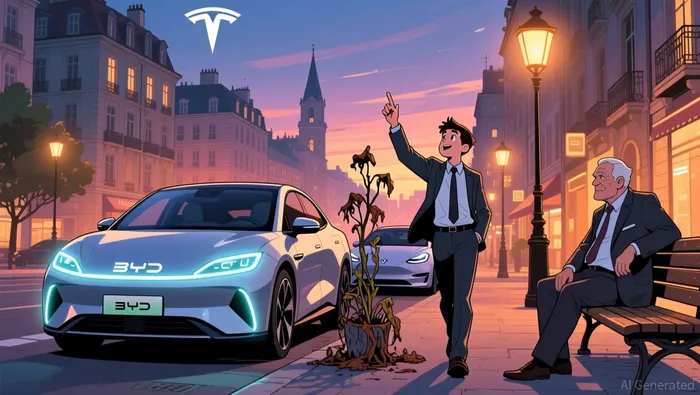
China's BYD has emerged as a formidable force in the global electric vehicle (EV) market, with Europe now serving as a critical battleground for its ambitions. In 2025, the company's overseas sales surged by 276.0% year-on-year in the European Union alone, with total registrations reaching 159,869 units from January to November according to data. This meteoric rise-outpacing Tesla's European sales decline by 10.5% in the same period-positions BYD as a disruptor in a market already grappling with shifting dynamics. As the company aims to sell 1.6 million vehicles abroad in 2026, with Europe, North America, and ASEAN each accounting for a third of its overseas sales, the question arises: Can Europe become BYD's next long-term growth engine, or will domestic headwinds and European competition temper its ambitions?
Strategic Market Diversification: Pricing, Localization, and Product Proliferation
BYD's success in Europe hinges on a trifecta of strategies: aggressive pricing, localized production, and a diverse product lineup. The company's vertical integration model allows it to undercut competitors on price while maintaining profitability. For instance, the BYD Dolphin Surf starts at £18,650 in the UK, less than half the price of a Tesla Model 3. This pricing advantage is amplified by BYD's pivot to plug-in hybrid electric vehicles (PHEVs), which account for 40.1% of its European sales. PHEVs help BYD navigate EU import tariffs on battery-electric vehicles (BEVs) while catering to European consumers' lingering concerns about charging infrastructure.
Localization is another cornerstone of BYD's strategy. A new plant in Hungary, with an annual capacity of 800,000 units, is set to reduce reliance on Chinese imports and mitigate the impact of EU anti-dumping tariffs. The company is also evaluating additional production sites in Turkey and Spain, with plans to localize 100% of European production by 2028. This approach not only lowers costs but also aligns with the EU's push for supply chain resilience.
Case Study: Germany and Spain-Growth Hubs or High-Risk Markets?
Germany, Europe's largest automotive market, has become a focal point for BYD's expansion. By September 2025, the company had captured a 4.4% market share in the EU, surpassing TeslaTSLA-- in cumulative registrations. The Seal U PHEV, a spacious SUV, led the European PHEV market in September 2025 with 45,837 units sold, marking the first time a Chinese brand dominated a European EV category. BYD's plans to build a third European plant in Germany signal its intent to deepen its footprint in the region. However, the company faces stiff competition from established automakers like Volkswagen and BMW, as well as regulatory scrutiny over its supply chain practices.
Spain offers a contrasting but equally promising opportunity. BYD's EV sales in Spain grew by 738.7% year-to-date in July 2025, driven by government incentives like the MOVES III package and a rapidly expanding dealer network. The company's sales points in Spain multiplied from 25 to nearly 100 in 2025, enabling it to outpace local brands and Tesla. Spain's EV adoption rate, up 150.8% through July 2025, underscores the market's potential for BYD's affordable PHEVs and BEVs. Yet, the company must contend with Spain's fragmented market and the risk of retaliatory tariffs if its localization efforts fall short.
Challenges: Domestic Headwinds and European Competition
Despite its European success, BYD faces weakening domestic sales in China, where growth slowed to its weakest in five years in 2026 due to intensifying competition and diminishing technological leadership according to reports. This domestic strain could divert resources from international expansion. Additionally, the EU's 27% import duty on Chinese-made BEVs forces BYD to rely heavily on PHEVs-a segment that may face regulatory headwinds as the bloc phases out internal combustion engines.
European competitors are also adapting. Tesla, despite its sales slump, is rumored to be developing a cheaper Model 3 variant to counter BYD's pricing edge. Meanwhile, Volkswagen and Stellantis are accelerating their EV production timelines, potentially eroding BYD's market share in the coming years.
The 2026 Outlook: A Make-or-Break Year
BYD's 2026 success in Europe will depend on its ability to scale localized production, navigate regulatory hurdles, and differentiate its offerings. The company's target of 2,000 European sales points by 2026-double its 2025 count-will be critical to maintaining momentum. However, achieving this requires seamless integration into local supply chains and partnerships with European component manufacturers according to analysis.
For investors, the stakes are high. Europe's EV market, projected to grow by 21% in 2025, represents a $500 billion opportunity. BYD's aggressive expansion, if executed effectively, could secure a 10-15% market share in the region by 2026. Yet, the company's domestic challenges and the EU's evolving regulatory landscape mean that this growth is far from guaranteed.
Conclusion
BYD's European expansion is a masterclass in strategic market diversification, leveraging pricing, localization, and product innovation to outmaneuver rivals. While the company's 276% YoY growth in the EU and dominance in PHEV segments according to market data are impressive, the path to long-term success remains fraught with risks. For Europe to become BYD's next growth engine, the company must balance its global ambitions with the realities of local competition and regulatory complexity. If it succeeds, Europe could become the cornerstone of BYD's transformation into a truly global automaker.





Comentarios
Aún no hay comentarios