
BYD's Export Surge and Its Implications for China's EV Sector
The Chinese electric vehicle (EV) market has become a battleground for survival, with price wars squeezing profit margins and reshaping competitive dynamics. At the center of this turmoil is BYD, the world's largest new energy vehicle (NEV) manufacturer, which has navigated domestic headwinds through a dual strategy of aggressive price cuts and rapid international expansion. While its domestic net income plummeted by 30% in Q2 2025 compared to the prior year, BYD's overseas exports surged 326% year-over-year in November 2025, reaching 131,935 units. This duality-domestic contraction paired with global expansion-raises critical questions about the sustainability of BYD's model and its broader implications for China's EV sector.
Strategic Resilience: Pricing as a Double-Edged Sword
BYD's response to the domestic price war has been nothing short of radical. Between 2023 and 2024, the company slashed prices on 22 models by up to 34%, including a 34% reduction on the Seal and a 20% cut on the Seagull. These markdowns, while boosting sales to 4.27 million units in 2024, have come at a cost. Profit margins, already lower than Tesla's USD 10,000–15,000 per vehicle in 2022–2023 compared to BYD's USD 6,000, have further compressed. Analysts warn that such tactics risk eroding brand equity, particularly for premium sub-brands like Denza and Fangchengbao, where models like the Denza N7 and Leopard 5 were slashed by RMB 60,000 and RMB 50,000, respectively.
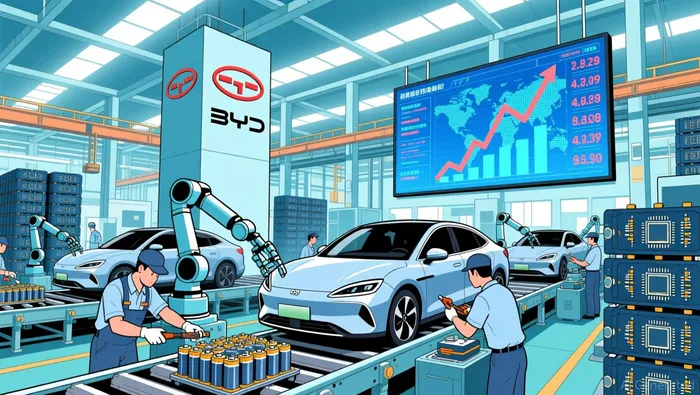 Yet, BYD's vertical integration in battery and semiconductor production has provided a buffer. This cost-control advantage has enabled the company to undercut competitors like TeslaTSLA-- in international markets, where the Dolphin Surf (€23,000) undercuts the cheapest Tesla model by €19,000. Such pricing power has fueled BYD's global dominance, with a 22.2% market share in 2024, and underscores its ability to leverage domestic cost efficiencies for overseas gains.
Export-Driven Diversification: A Lifeline or a Mirage?
BYD's export surge is not merely a byproduct of low prices but a calculated strategy to offset domestic risks. The company is building factories in Hungary, Turkey, and potentially Spain to circumvent EU tariffs, which threaten its European export potential. This move mirrors broader industry trends, as Chinese EV makers seek to localize production to avoid geopolitical and trade barriers. However, the long-term viability of these investments remains uncertain. High capital expenditures and the need to adapt to foreign regulatory environments could strain BYD's resources, particularly if global demand for EVs softens.
Domestically, BYD's product mix is also shifting. While plug-in hybrid electric vehicle (PHEV) sales have declined for eight consecutive months, battery-electric vehicle (BEV) sales rose 19.9% year-over-year in November 2025. This reflects a broader industry pivot toward BEVs in China, driven by policy incentives and consumer preferences. Yet, BYD's reliance on BEVs could expose it to supply chain vulnerabilities, particularly in critical minerals and battery technology.
The Price War's Ripple Effects: A Sector-Wide Reckoning
BYD's aggressive pricing has triggered a sector-wide arms race. Competitors like Geely and NIO have followed suit with their own discounts, intensifying margin compression. Volkswagen's China CEO has labeled such tactics "destructive and unsustainable," while Xpeng executives warn that most Chinese EV brands may not survive the next decade. These concerns are not unfounded: the price war has already led to a 30–40% increase in dealership footfall for BYD, but at the expense of brand perception and financial stability.
For investors, the key question is whether BYD's export-driven model can offset domestic losses. While its 2025 sales target of 5.5 million units suggests confidence, the company's net income decline highlights the fragility of its current approach. The EU's looming tariffs and the risk of margin erosion in both domestic and international markets could force BYD to pivot toward higher-margin segments or innovate beyond pricing.
Conclusion: A Test of Long-Term Resilience
BYD's export surge exemplifies strategic resilience in a market defined by volatility. By leveraging cost advantages and aggressive pricing, the company has secured a dominant global position while mitigating domestic risks. However, the sustainability of this model hinges on its ability to balance short-term gains with long-term brand value and margin preservation. As the EV sector grapples with trade barriers, supply chain challenges, and intensifying competition, BYD's path forward will serve as a bellwether for China's broader EV industry. For now, its success underscores a critical truth: in a price-war-driven market, resilience is not just about surviving-it's about redefining the rules of the game.





Comentarios
Aún no hay comentarios