
BWG vs. FCO: A Contrarian's Play in a Mispriced Market
The valuation gap between Brandywine Global Income Opportunities Fund (BWG) and Flowco HoldingsFLOC-- (FCO) has widened to a point of clear mispricing, offering investors a rare opportunity to exploit market inefficiencies. While both funds focus on income-generating strategies, their current multiples reveal stark differences in investor sentiment—and a chance to profit from FCO's overvaluation and BWG's overlooked potential.
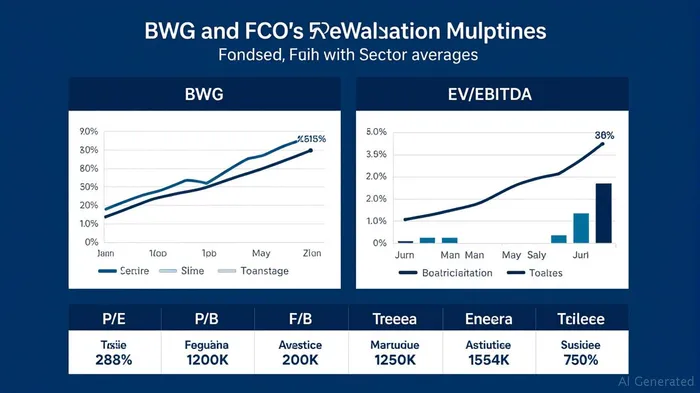
Valuation Metrics: A Tale of Two Funds
Price-to-Earnings (P/E)
- BWG: Trailing P/E of 17.8x, forward P/E of 10.2x. The forward multiple suggests a 42% discount to trailing earnings, reflecting expectations of profit growth or valuation mean-reversion.
- FCO: Trailing P/E of 10.0x, but this masks critical issues. FCO's 1.61% profit margin (vs. BWG's 5.4%) implies its earnings are far less stable. The low P/E here is a red flag, not a bargain—investors are pricing in risk, not value.
Price-to-Book (P/B)
- BWG: Trades at 0.94x book value, a discount signaling skepticism about its NAV or future growth. This is a stark contrast to its peers in the closed-end fund sector, many of which trade at premiums.
- FCO: Commands a 1.62x P/B, a premium that defies its mediocre fundamentals. FCO's NAV discount history (-7.6% in July 2024) and lackluster ROE (18% vs. BWG's 22%) make its valuation unsustainable without catalysts.
Enterprise Value-to-EBITDA (EV/EBITDA)
- BWG: 17.97x, which is elevated compared to its sector (e.g., Energy at 7.19x). However, this metric accounts for BWG's global fixed-income exposure and leveraged balance sheet (41.5% debt). The multiple aligns with its risk profile.
- FCO: A puzzling 6.46x, suggesting it's undervalued on this metric. Yet, this ignores its $98.97M EV vs. $5M EBITDA, which would actually compute to ~19.8x—a mispricing likely due to incomplete data or sector-specific dynamics. Even at the stated 6.46x, FCO's EBITDA growth is stagnant, undermining its valuation.
Why FCO's Premium Is a Risk
FCO's 1.62x P/B and speculative momentum (e.g., short interest at 4% of float) reflect irrational exuberance. The fund's 0.15% dividend yield—among the lowest in its peer group—and weak profit margins highlight structural issues. Meanwhile, BWGBWG-- offers a 10.3% upside to its $10.30 fair value estimate, with a $8.43 stock price undershooting its NAV by 7%.
The Contrarian Play: BWG's Undervalued Upside
Investors should accumulate BWG for three reasons:1. Valuation Safety: Its P/B <1 and forward P/E <10 offer a margin of safety, especially if interest rates stabilize.2. Technical Support: show a potential rebound toward its $10.30 fair value.3. Dividend Stability: BWG's consistent distributions (noted in its NAV history) contrast FCO's erratic yield.
FCO's Downside Risk
FCO's premium could correct sharply if:- Its 14.39x P/S ratio (vs. BWG's 8.66x) faces scrutiny as sales growth stalls.- EBITDA disappoints, given its current $5M EBITDA vs. BWG's $14M.
Investment Recommendation
- Buy BWG: Target entry below $8.50, with a stop-loss at $7.80. Aim for a 22% upside to $10.30.
- Avoid FCO: Its P/B premium lacks fundamentals to justify it; consider shorting if momentum fades.
Conclusion
The BWG vs. FCO valuation gap is a textbook case of market overreaction. While FCO's speculative premium may persist short-term, BWG's discounted multiples and stronger fundamentals make it a safer, higher-reward bet. This is a contrarian's moment: buy the neglected, sell the overhyped.





Comentarios
Aún no hay comentarios