
U.S. Business Sentiment and the Fed's Rate Cut Calculus: A Delicate Balancing Act
The Federal Reserve's September 2025 rate cut-its first reduction since December 2024-has sparked intense debate about the interplay between U.S. business sentiment and monetary policy. While the central bank officially cited a "risk management" approach to address a cooling labor market and elevated inflation, improving business sentiment surveys suggest a broader narrative is at play. These surveys, including the Third Quarter 2025 Survey of Professional Forecasters (SPF) and a small business optimism index from Constant Contact, indicate a resilient corporate sector that may indirectly influence the Fed's path forward.
The Optimism Gap: Business Confidence vs. Macroeconomic Realities
According to the SPF, real GDP growth expectations improved to 1.3% annualized for Q3 2025, up from 1.0% in Q1 2025. Simultaneously, small business owners reported a surge in optimism, with 86.3% expressing confidence in their firms' prospects for the next quarter. This optimism, despite persistent inflation and political uncertainty, highlights a disconnect between corporate confidence and broader economic vulnerabilities.
The SPF also noted downward revisions to inflation expectations, with core PCE forecasts dropping to 3.1% for 2025. Such data suggests businesses are adapting to a lower-inflation environment, potentially reducing the urgency for aggressive monetary tightening. However, the Fed's September 2025 decision to cut rates by 25 basis points was not explicitly tied to these sentiment metrics. As stated in the FOMC minutes, the move was driven by "moderated job gains" and "rising downside risks to employment," with the unemployment rate projected to rise to 4.5% by year-end (reported by CBS News).
The Fed's Dual Mandate Dilemma
The Federal Reserve's dual mandate-stable prices and maximum employment-has created a policy tightrope. While inflation remains "somewhat elevated" at 3.1% for core PCE, the labor market's fragility has shifted the central bank's focus. Fed Chair Jerome Powell emphasized the need to "support the labor market" during his post-meeting press conference, framing the rate cut as a hedge against potential downturns.
Critically, business sentiment surveys may indirectly inform this calculus. For instance, the SPF's improved growth forecasts and the resilience of small businesses-key drivers of U.S. economic dynamism-suggest that a modest rate cut could amplify confidence without reigniting inflationary pressures. Yet, the Fed's internal dissent, with one FOMC member advocating for a 50-basis-point cut, underscores the lack of consensus on how much weight to assign to sentiment data.
Implications for Investors: Navigating a Fragmented Outlook
For investors, the Fed's cautious approach to rate cuts highlights the importance of monitoring both macroeconomic indicators and business sentiment. The FOMC's projection of two additional 25-basis-point cuts in 2025 implies a gradual easing cycle, which could buoy risk assets like equities and corporate bonds. However, the political pressures on the Fed-exemplified by President Trump's public advocacy for faster cuts-add an unpredictable layer to policy expectations (coverage by CNBC).
Businesses, particularly small enterprises, may benefit from lower borrowing costs, as evidenced by the Constant Contact survey showing stronger-than-expected sales in H1 2025. Yet, the persistence of inflation and a fragile labor market means the Fed is unlikely to pivot aggressively. As one FOMC participant noted in the September minutes, "policy remains data-dependent, and the path forward will hinge on incoming information about inflation and employment."
Conclusion: Sentiment as a Signal, Not a Directive
While the Federal Reserve did not explicitly reference business sentiment surveys in its September 2025 decision, the broader economic context suggests these metrics are shaping the central bank's risk assessment. Improved sentiment among businesses-particularly small enterprises-provides a buffer against recessionary fears, but the Fed's primary focus remains on stabilizing prices and employment. For investors, the key takeaway is that the Fed's rate-cut trajectory will likely remain tethered to labor market data and inflation trends, with business sentiment serving as a supplementary signal rather than a primary driver.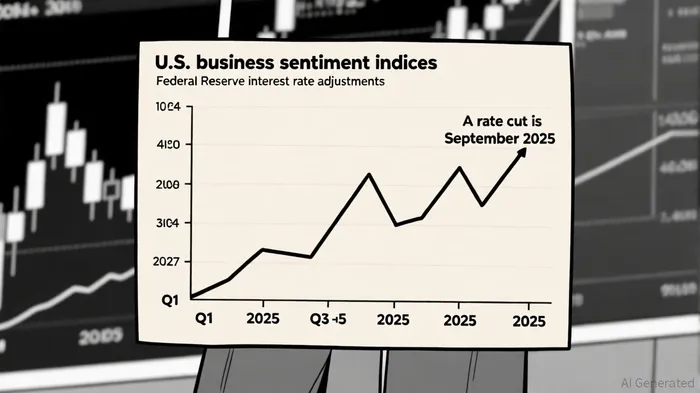







Comentarios
Aún no hay comentarios