
The Business Cost of Overstaying Your Welcome: Evaluating Content Longevity in Streaming and Network TV
The television industry has long grappled with the paradox of longevity: while extended runs of popular series can generate immense revenue, they often come at the cost of eroding audience loyalty, diluting brand value, and diminishing returns on investment. This tension is evident in the trajectories of three iconic series-The Walking Dead, Grey's Anatomy, and Suits-which exemplify the financial and cultural risks of stretching content beyond its prime. As streaming platforms and networks increasingly rely on long-running hits to fill programming gaps, the question arises: does longevity sustain profitability, or does it become a liability?
The Walking Dead: A Franchise That Outgrew Its Welcome
The Walking Dead (2010–2022) epitomizes the double-edged sword of extended storytelling. Initially a cultural phenomenon, the show's first five seasons averaged over 15 million viewers per episode, cementing AMC's dominance in the post-network TV era. However, as the series progressed, its production costs and creative risks escalated. By season 7, per-episode budgets had stabilized at around $2.75 million after early cost-cutting measures, but narrative coherence and audience engagement began to falter. Critics noted a decline in quality, with later seasons prioritizing spectacle over character depth. Viewership plummeted from 15 million to 2–3 million by the 11th season, reflecting a stark disconnect between the show's original rural, survivalist ethos and its later urban, cosmopolitan shifts.
Financially, The Walking Dead initially boosted AMC's revenue, generating over $2 billion by 2017 through spin-offs like Fear the Walking Dead. Yet, by 2023, AMC Networks reported declining licensing revenues from the franchise, signaling that even a behemoth can lose its luster. The show's final season, while a ratings disappointment, briefly spiked AMC's ad sales in 2021, but this proved unsustainable as streaming platforms began favoring shorter, serialized formats.
Grey's Anatomy: The Paradox of Perpetual Renewal
Grey's Anatomy (2005–present) has defied conventional wisdom by maintaining a consistent viewership across 21 seasons. Despite a general decline in broadcast TV ratings, the show remains the highest-rated drama in the 18–49 demographic, averaging 15 million viewers per episode. Its endurance is attributed to a formulaic blend of medical drama, character-driven storytelling, and strategic casting changes. However, this longevity has not been without cost.
Production expenses for Grey's Anatomy have risen steadily, reflecting the challenges of sustaining a live-action series for over two decades. While specific per-episode costs remain undisclosed, the show's reliance on frequent recasting (e.g., after the departure of Sandra Oh in 2015) has added to its financial burden. Streaming data further complicates the picture: generated 3.5 billion viewing hours across 432 episodes, but this pales in comparison to the subscriber retention power of newer, niche hits like Stranger Things. For platforms like Netflix and Max, which depend on older broadcast shows to fill content gaps, Grey's Anatomy remains a cash cow-but one that increasingly struggles to compete with the novelty of original programming.
Suits: When Core Characters Exit, Does the Franchise Follow?
Suits (2011–2019) offers a cautionary tale about the fragility of brand value in long-running series. The show's first seven seasons centered on the dynamic between Mike Ross (Patrick J. Adams) and Harvey Specter (Gabriel Macht), a relationship that defined its appeal. However, when Adams left the series in 2016 due to scheduling conflicts, the show's brand value took a hit. Seasons 8–9, which replaced Mike with a new character, failed to recapture the original magic, leading to a 20% drop in viewership.
Financially, Suits found a second life on streaming platforms. From 2020 to 2024, it generated $356 million in subscriber revenue across Netflix, Peacock, and Amazon Prime Video, with Netflix alone earning $53 million in Q4 2023. Licensing fees for the first eight seasons ranged between $25M and $50M, with residuals paid to writers and actors at 1.2% and 3.6% of those fees, respectively. While the show's post-network success on streaming platforms offset some of its linear TV declines, its brand value never fully recovered. The spin-off Suits: LA (2021–2022), which cost $12 million in tax credits to produce, struggled to replicate the original's success, underscoring the difficulty of sustaining a franchise after its core identity has shifted.
The Broader Industry Implications
The cases of The Walking Dead, Grey's Anatomy, and Suits highlight systemic challenges in the TV industry. First, is inevitable: viewers grow disillusioned with formulaic storytelling or repetitive character arcs, leading to declining ratings and engagement. Second, production costs rise exponentially with longevity, particularly for live-action series that require frequent recasting, location changes, and special effects. Third, streaming platforms face a paradox: while they rely on long-running shows to retain subscribers, they also prioritize shorter, serialized content that aligns with binge-watching habits. 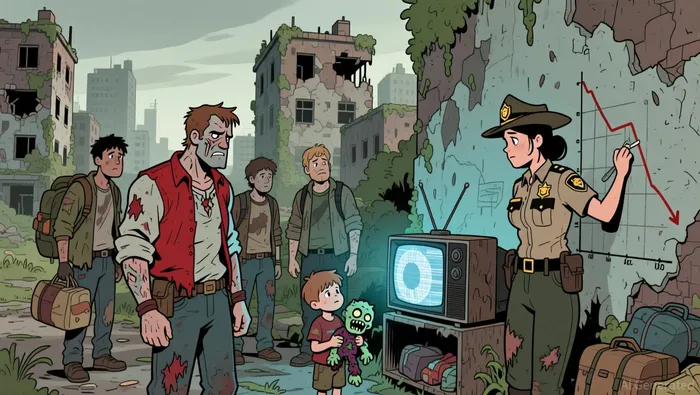
Financial data further complicates the picture. AMC NetworksAMCX--, for instance, saw a 23% drop in U.S. ad revenue by 2023 despite The Walking Dead's initial boost. Similarly, Suits' streaming success masked its declining linear TV performance, with platforms like Netflix strategically withholding its final season to drive subscriptions on Peacock. These examples suggest that while long-running series can generate short-term revenue, their long-term profitability is increasingly uncertain in a fragmented, streaming-dominated market.
Conclusion: The Cost of Staying Too Long
For investors and studios, the lesson is clear: content longevity is a high-stakes gamble. While extended runs can lock in revenue and brand recognition, they also risk alienating audiences, inflating costs, and cannibalizing future opportunities. The industry's shift toward shorter, serialized formats-exemplified by shows like Stranger Things and The Mandalorian-reflects a growing recognition that quality and innovation often trump quantity. As production budgets rise and viewer attention spans shrink, the era of 10-season marathons may be waning. The true ROI of a show, it seems, lies not in how long it runs, but in how well it knows when to end.





Comentarios
Aún no hay comentarios