
Bunge's Post-Merger Strategic Position and Path to Shareholder Value Recovery in 2025
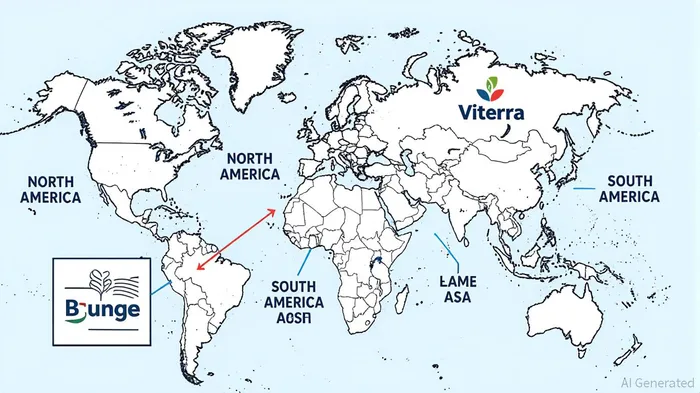
Bunge Limited’s (BG) acquisition of Viterra in July 2025 marked a transformative step in its evolution as a global agribusiness leader. The merger, valued at $7.7 billion in acquisition financing and $300 million in delayed draw term loans [1], has positioned BungeBG-- to leverage operational synergies and navigate industry headwinds. Despite challenges such as volatile commodity prices and geopolitical tensions, the company’s strategic integration efforts and financial discipline are laying the groundwork for shareholder value recovery in 2025.
Operational Synergy Realization: A Foundation for Resilience
Bunge’s integration of Viterra has already yielded early gains in cost and commercial synergies. Management highlighted logistical and transportation efficiencies as key drivers of durable cost savings, with teams actively streamlining processing networks and optimizing supply chains [2]. While specific figures for 2025 remain undisclosed, the company’s Q2 2025 adjusted EPS of $1.31—exceeding estimates by $0.22—reflects the initial benefits of these efforts [3]. CEO Greg Heckman emphasized that the combined entity’s expanded global footprint enhances its ability to serve food, feed, and fuel markets, creating a more resilient value chain [4].
The merger also enabled Bunge to simplify its portfolio through strategic divestitures. The sale of its U.S. corn milling business generated $776 million in cash proceeds, aligning the company with global value chains and reducing operational complexity [5]. These moves underscore Bunge’s focus on capital allocation and portfolio optimization, which are critical for sustaining long-term profitability.
Navigating Industry Headwinds: Innovation and Diversification
Bunge faces significant industry challenges, including volatile commodity prices and a contracting global grain trade. For instance, soy, corn, and wheat prices swung sharply in Q1 2024, directly impacting earnings per share [6]. Additionally, the FAO projects a 5.6% contraction in global grain trade for 2024/25, driven by reduced Chinese demand and export restrictions in major producing countries [7].
To counter these risks, Bunge is investing in advanced processing technologies and market diversification. Innovations such as soybean dehulling and toasting techniques improve feed conversion efficiency by up to 15%, opening new revenue streams in plant-based protein and nutritional supplements [8]. The company is also expanding regional production facilities in Southeast Asia and the Middle East, reducing logistics costs and import dependencies [9]. These strategies position Bunge to adapt to shifting demand patterns and mitigate supply chain disruptions.
Financial Resilience and Shareholder Value Recovery
Bunge’s financial health remains robust despite the debt burden from the Viterra merger. As of Q2 2025, the company reported a leverage ratio of 1.1x and $8.7 billion in committed credit facilities, with $7.6 billion unused [10]. Discretionary cash flow of $560 million year-to-date further supports its liquidity position [11]. The company has also implemented a share buyback program, signaling confidence in its ability to deliver returns to shareholders.
While Bunge reaffirmed its full-year 2025 adjusted EPS guidance of $7.75 [12], the path to achieving this target hinges on the successful realization of synergies. Management acknowledged execution risks, including operational alignment challenges, but expressed optimism about the long-term value of the merger [13].
Conclusion: A Strategic Pivot Amid Uncertainty
Bunge’s post-merger integration with Viterra has strengthened its global scale and operational efficiency, but the company must continue to execute on synergy realization to offset industry headwinds. By leveraging technological innovation, regional expansion, and disciplined capital allocation, Bunge is positioning itself to recover shareholder value in 2025. Investors should monitor the company’s progress in reducing Viterra’s $9.8 billion debt burden and its ability to capitalize on durable cost savings. While risks persist, Bunge’s strategic pivot underscores its resilience in a volatile agribusiness landscape.
Source:
[1] unaudited pro forma condensed combined financial ... [https://www.sec.gov/Archives/edgar/data/1996862/000110465925065405/tm2518720d1_ex99-4.htm]
[2] Earnings call transcript: Bunge Q2 2025 sees EPS beat ... [https://www.investing.com/news/transcripts/earnings-call-transcript-bunge-q2-2025-sees-eps-beat-despite-revenue-miss-93CH-4160296]
[3] Bunge (BG) Q2 EPS Beats by 20% [https://www.nasdaq.com/articles/bunge-bg-q2-eps-beats-20]
[4] Bunge LimitedBG-- (BG) Q2 FY2025 earnings call transcript [https://finance.yahoo.com/quote/BG/earnings/BG-Q2-2025-earnings_call-343293.html]
[5] Bunge Reports Second Quarter 2025 Results [https://investors.bunge.com/news-and-events/press-releases/2025/07-30-2025-110055436]
[6] PESTEL Analysis of Bunge – SWOTAnalysisExample.com [https://swotanalysisexample.com/products/bunge-pestle-analysis]
[7] FAO forecasts lower grain trade and stocks for 2025 [https://millermagazine.com/blog/fao-forecasts-lower-grain-trade-and-stocks-for-2025-6054]
[8] Edible Soybean Meal Market Analysis, Dynamics [https://www.intelmarketresearch.com/edible-soybean-meal-2025-2032-301-4883]
[9] Bunge Global S.A. (BG) Stock Price, ... [https://www.datainsightsmarket.com/companies/BG]
[10] Bunge Global S.A. (BG) Stock Price, ... [https://www.datainsightsmarket.com/companies/BG]
[11] Bunge (BG) Q2 EPS Beats by 20% [https://www.aol.com/finance/bunge-bg-q2-eps-beats-110545437.html]
[12] Bunge Limited (BG) Q2 FY2025 earnings call transcript [https://finance.yahoo.com/quote/BG/earnings/BG-Q2-2025-earnings_call-343293.html]
[13] Earnings call transcript: Bunge Q2 2025 sees EPS beat ... [https://www.investing.com/news/transcripts/earnings-call-transcript-bunge-q2-2025-sees-eps-beat-despite-revenue-miss-93CH-4160296]







Comentarios
Aún no hay comentarios