
Why Bund Center Investment (SGX:BTE) Is a Dividend Stock to Avoid in 2025
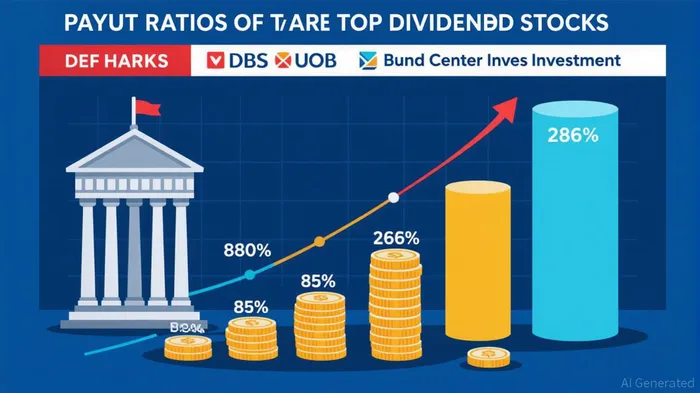
Investors seeking dividend income often prioritize yield, but true sustainability hinges on a company's ability to fund payouts from earnings and cash flow. Bund Center Investment (SGX:BTE) has long been a subject of scrutiny due to its aggressive payout ratios and opaque financials. While recent data on BTEBTE-- remains elusive[1], historical trends and the robust performance of Singapore's top dividend stocks underscore why BTE should be avoided in 2025.
The Payout Ratio: A Recipe for Disaster
BTE's payout ratio—historically reported at 286% of net profit[2]—is a glaring red flag. Such a ratio implies the company distributes more in dividends than it earns, a practice that relies on debt or asset sales to sustain. This contrasts sharply with Singapore's leading dividend stocks, which balance generosity with prudence. For instance, DBS Group Holdings (D05) reported a net profit of S$11.4 billion in 2024, with a final dividend of S$0.60 per share, translating to a payout ratio well within sustainable limits[3]. Similarly, OCBC Bank (O39) maintained a 50% payout ratio for the first half of 2025, supported by its S$7.59 billion net profit[4]. These banks prioritize long-term stability, whereas BTE's approach risks a sudden dividend cut or suspension if cash flow tightens.
Earnings and Cash Flow: A Mismatch
BTE's financial health is further clouded by declining earnings and mismatched cash flow. While the company's 2024/2025 earnings per share (EPS) trends are unavailable[5], its historical reliance on non-operating income and volatile revenue streams raises concerns. In contrast, United Overseas Bank (UOB) reported a S$6 billion net profit in 2024, bolstered by strategic acquisitions and a diversified business model. UOB's operating cash flow comfortably covers its dividend commitments, a metric BTE lacks.
A Benchmark of Excellence: Singapore's Dividend Leaders
Singapore's top dividend stocks exemplify how strong fundamentals underpin sustainable payouts. DBS's 2024 performance, for example, was driven by broad-based growth across its business segments, enabling it to introduce a quarterly capital return dividend. OCBC's S$2.5 billion shareholder return plan over two years reflects confidence in its cash reserves. Even non-financials like ST Engineering and Singtel demonstrate disciplined reinvestment and cash flow management, ensuring dividends are backed by earnings.
The Perils of Yield Chasing
Prioritizing yield over fundamentals can lead to costly mistakes. BTE's high yield may appear attractive, but it masks the risks of a payout ratio that exceeds profitability. As the Syfe report notes, “Dividend sustainability requires a company to generate consistent cash flow and maintain a payout ratio below 100%”. BTE's historical metrics fail this test, while Singapore's top performers—DBS, OCBC, and UOB—offer both yield and security.
Conclusion
In an era of falling yields, investors must focus on quality over quantity. Bund Center Investment's opaque financials, unsustainable payout ratio, and lack of operating cash flow make it a poor choice for 2025. By contrast, Singapore's leading dividend stocks—backed by robust earnings, disciplined payout ratios, and strong cash flow—provide a blueprint for sustainable income investing. For those seeking reliable dividends, the path forward is clear: prioritize transparency and financial health over fleeting yields.







Comentarios
Aún no hay comentarios