
BullZilla's Presale Potential as a High-Yield Altcoin Play: A Comparative Analysis Against Litecoin and BCH
In the rapidly evolving 2025 cryptocurrency landscape, investors are increasingly drawn to projects that balance innovation with tangible growth mechanisms. Among the most talked-about opportunities is BullZilla (BZIL), a memeMEME-- coin leveraging a structured presale model, deflationary tokenomics, and community-driven incentives. This article evaluates BullZilla's presale potential as a high-yield altcoin play, comparing its value proposition against established alternatives like Litecoin (LTC) and Bitcoin Cash (BCH).
BullZilla's Presale Mechanics: A Structured Growth Engine
BullZilla's presale is engineered to maximize scarcity and investor participation through a 24-stage, time-based pricing model. As of September 2025, the project has raised over $730,000 in its 4th stage, with a token price of $0.00009241, set to increase by 7.20% in the next phase, according to a BullZilla presale explainer. This staged approach-where prices rise either upon hitting $100,000 funding milestones or every 48 hours-creates urgency for early buyers while ensuring gradual value appreciation.
The tokenomics further reinforce this strategy:
- 50% of the 160 billion supply is allocated to the presale, with 20% reserved for staking (offering up to 70% APY via the HODL Furnace), per BullZilla research.
- A Roar Burn mechanism permanently removes tokens at each stage, reducing supply and enhancing scarcity, as highlighted in a BullZilla price prediction.
- Referral incentives (10% bonuses for both parties) drive organic community growth, noted in a CoinCentral roundup.
These features position BullZilla as a speculative yet structured play, contrasting sharply with the passive utility of older altcoins.
Litecoin: Stability Over Exponential Growth
Litecoin, a 15-year-old cryptocurrency, remains a cornerstone of the altcoin market. Priced at $111.90 as of Q3 2025, it offers fast transaction speeds (2.5 minutes) and low fees, making it a preferred settlement layer for newer projects, according to a Coindoo analysis. Analysts project a modest 13–15% price increase by Q4 2025, with a $130–$150 range expected, per a Crypto-Economy forecast.
While Litecoin's MWEB privacy upgrades and $7.94 billion market cap underscore its reliability, it lacks the speculative upside of presale projects. Its value proposition is rooted in utility and adoption, notNOT-- structured scarcity or yield incentives. For investors seeking long-term stability, LitecoinLTC-- remains a solid choice-but it's not a 100x play.
Bitcoin Cash: Utility Meets Scalability
Bitcoin Cash (BCH), with a $11.64 billion market cap and a price of $584.45, has reemerged as a scalable digital cash system. Its block size limit of 32MB enables low-cost, high-speed transactions, appealing to emerging markets and merchants, as noted in a Gate.io analysis. Despite a 91.42% annual gain, BCH's growth is tied to broader market dynamics rather than a designed scarcity model, according to a Changelly forecast.
Unlike BullZilla, BCHBCH-- does not feature a presale or token burn mechanisms. Its appeal lies in real-world adoption and decentralized ownership (top 5 addresses hold just 12.88% of the supply), per Currency Analytics. However, its neutral market sentiment (Fear and Greed Index at 48) suggests limited speculative momentum compared to BullZilla's hype-driven model.
Comparative Analysis: Growth Mechanisms and Risk Profiles
| Metric | BullZilla | Litecoin | Bitcoin Cash |
|---|---|---|---|
| Tokenomics | 24-stage presale, Roar Burn, 70% APY | Fixed supply, no burn | Fixed supply, no burn |
| Price Projections | $0.000466 by 2025 (27,527% ROI; per Coindoo) - Coindoo report | $130–$150 by Q4 2025 (Blockonomi analysis) | $701–$2,675 by 2030 (CoinPedia projection) |
| Market Position | High-growth meme coin | Stable utility asset | Scalable digital cash |
| Risk Level | High (presale volatility) | Low (established project) | Moderate (market-dependent) |
BullZilla's structured scarcity and community incentives create a compelling narrative for exponential returns, but its presale model carries inherent risks-liquidity constraints, regulatory uncertainty, and reliance on market sentiment, as discussed in an Analytics Insight piece. Litecoin and BCH, while less volatile, offer predictable utility and lower entry barriers for conservative investors.
Investment Considerations: Balancing Speculation and Stability
For a diversified portfolio, BullZilla serves as a high-risk, high-reward speculative bet, ideal for investors comfortable with presale volatility. Its Roar Burn events and HODL Furnace staking could drive significant value if adoption accelerates. However, Litecoin and BCH provide counterbalance, offering liquidity and real-world utility in a market prone to corrections.
A strategic approach might allocate 10–15% to BullZilla's presale while holding Litecoin as a bridge asset and BCH for transactional use cases. This balances the potential for outsized gains with the stability of established protocols.
Conclusion
BullZilla's presale represents a novel experiment in tokenomics, blending meme-driven hype with structured scarcity and yield incentives. While its 27,527% ROI projection is enticing, investors must weigh this against the high-risk nature of presales. Litecoin and Bitcoin CashBCH--, by contrast, offer proven utility and lower volatility, making them complementary assets in a 2025 crypto portfolio.
As the market evolves, the key will be monitoring BullZilla's adoption, Litecoin's network upgrades, and BCH's merchant adoption. For now, the data suggests a multi-asset strategy is optimal-leveraging BullZilla's potential while hedging with the stability of older altcoins. 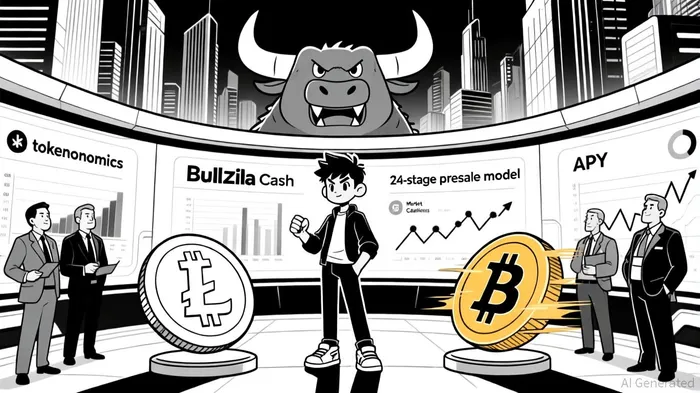






Comentarios
Aún no hay comentarios