
Why BullZilla Outperforms Chainlink in 2025: A Strategic Shift in DeFi Exposure
Market Positioning: Presale Momentum vs. Institutional Stability
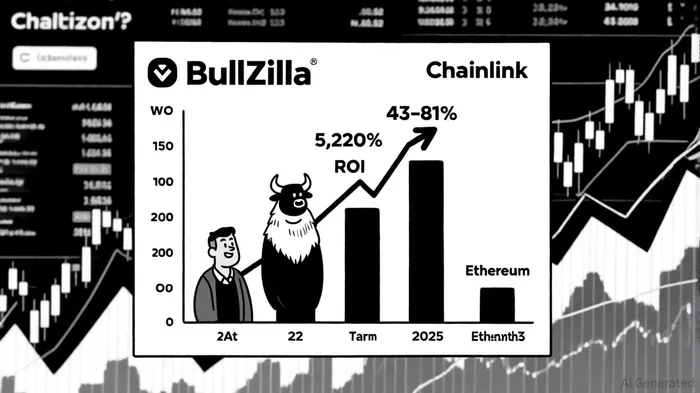
BullZilla has emerged as a dominant force in the presale arena, having sold over 30 billion tokens and raised $680,000 as of September 2025, according to Live Coin Watch. Its 24-stage presale model, which advances either when $100,000 is raised or after 48 hours, creates urgency and liquidity for early investors. With a projected 5,220% ROI by listing at $0.00527 per token, BullZilla's aggressive pricing strategy-coupled with a deflationary burn mechanism and 70% APY staking rewards-has attracted over 2,100 holders and $35.43M in 24-hour trading volume, per Live Coin Watch data.
In contrast, Chainlink's $16.41 billion market cap and $24.20 price point reflect its role as a stable infrastructure asset. While LINK's institutional adoption and partnerships with entities like SWIFT and the German stock exchange underscore its reliability, its growth trajectory is more conservative. Analysts project an 18-month target range of $35–$55, a 43–81% increase from current levels, according to Coinlaw. However, this pales in comparison to BullZilla's speculative ROI potential, which leverages memeMEME-- coin energy and DeFi mechanics to target exponential returns.
Technological Innovation: Meme-Driven DeFi vs. Oracle Infrastructure
BullZilla's success lies in its fusion of meme coin virality with DeFi tools. Its Progressive Price Engine ensures token value appreciation through staged price increases, while Roar Burn events reduce supply to create scarcity. The HODL Furnace staking mechanism rewards long-term holders with 70% APY, incentivizing retention and compounding value, as noted by Live Coin Watch. These features align with Ethereum's robust infrastructure, leveraging its security and liquidity to scale rapidly.
Chainlink, meanwhile, remains indispensable as a decentralized oracle network. By connecting smart contracts to real-world data, it enables DeFi platforms, stablecoins, and insurance protocols to operate with trustless accuracy. Its 67% market share in oracle services and $93 billion in on-chain value highlight its critical role in bridging blockchain and traditional finance, according to Coinlaw's analysis. However, its utility is inherently reactive-it powers DeFi but does not generate speculative growth.
Tokenomics and Community Dynamics
BullZilla's tokenomics are engineered for hypergrowth. The project's 1.32K holders benefit from a HODL system that rewards long-term retention and referral bonuses, creating a self-sustaining ecosystem. With a fixed supply of 1 billion tokens and a circulating market cap of $547K, BullZilla's scarcity model amplifies demand, per Live Coin Watch.
Chainlink's tokenomics, by contrast, prioritize stability. Its $16.41 billion market cap and institutional-grade oracle services cater to a different investor base-those seeking foundational infrastructure rather than speculative gains. While LINK's recent 95% year-to-date growth is impressive, it lacks the viral, community-driven momentum that fuels BullZilla's rapid adoption, as Coinlaw observes.
Future Projections: A DeFi Ecosystem in Transition
The broader DeFi landscape in 2025 reflects a duality: investors are increasingly splitting their exposure between high-risk, high-reward presales like BullZilla and established infrastructure assets like Chainlink. BullZilla's roadmap-focusing on Q4 2025 staking activation and burn events-positions it to capitalize on Ethereum's dominance while appealing to meme-driven retail investors, according to Live Coin Watch.
Chainlink, however, faces challenges in maintaining relevance amid rising competition from cross-chain oracles and enterprise-focused solutions. While its CCIP expansion to 60+ blockchains and SmartNAV API innovations are promising, they cater to a niche audience. BullZilla's ability to blend meme culture with DeFi mechanics represents a more scalable model for mass adoption.
Conclusion
BullZilla's outperformance in 2025 is not a fluke but a reflection of DeFi's evolving priorities. By combining meme-driven virality, deflationary tokenomics, and Ethereum's infrastructure, it has created a model that outpaces Chainlink's infrastructure-centric approach. For investors seeking explosive ROI and strategic exposure to the next phase of DeFi, BullZilla represents a paradigm shift-one where community engagement and speculative mechanics outweigh traditional utility.






Comentarios
Aún no hay comentarios