
BullZilla's Disruptive Presale and Its Implications for Crypto Market Dynamics
The Altcoin Season 2.0 Narrative: BullZilla's Presale as a Case Study
The 2025 crypto market has been defined by two opposing forces: the sharp corrections in blue-chip assets like BitcoinBTC-- (BTC) and EthereumETH-- (ETH) and the explosive growth of niche altcoins capitalizing on fragmented narratives. As Bitcoin fell below $112,667 and Ethereum dropped to $4,187 in September 2025, the total crypto market cap contracted to $3.89 trillion, wiping out $1.6 billion in leveraged positions[5]. Yet, amid this turmoil, projects like BullZilla have emerged as disruptors, leveraging structured tokenomics and community-driven incentives to capture capital flows traditionally reserved for blue-chips.
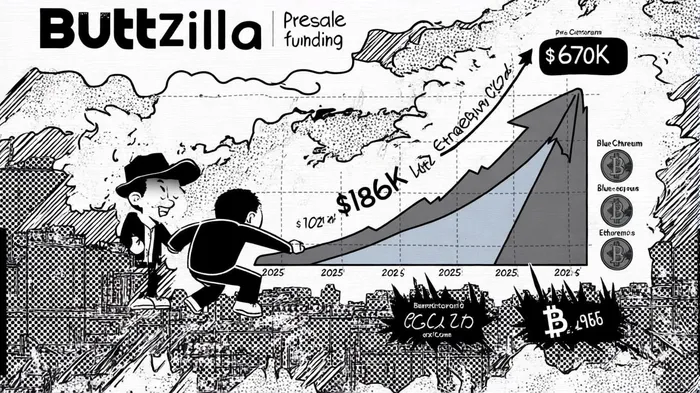
BullZilla's presale, now in its 4th Stage (Red Candle Buffet), has raised over $670,000 by late September 2025, with 29 billion tokens sold at a price of $0.00009241[1]. This performance contrasts sharply with the broader market's “Red September” downturn, where even resilient altcoins like SolanaSOL-- (SOL) and XRPXRP-- faced double-digit declines[5]. The project's tokenomics—allocating 50% of its 160 billion supply to presale, 20% each to staking, treasury, and burn pool, and 5% to the team (locked for two years)—has created a scarcity-driven model that appeals to investors seeking yield in a volatile environment[2].
The Roar Burn mechanism, which reduces token supply at key milestones, further differentiates BullZilla from traditional memeMEME-- coins. By burning tokens as the presale progresses, the project artificially inflates demand, a strategy that mirrors Ethereum's post-merge scarcity narrative but with a more aggressive burn rate[3]. Meanwhile, the HODL Furnace staking program offers up to 70% APY, dwarfing Ethereum's 3-5% staking yields and attracting capital from risk-tolerant investors seeking high returns[4].
Capital Rotation and the Altcoin Season 2.0 Framework
The Altcoin Season Index, which hit 76 in mid-2025, confirms a structural shift in capital flows[1]. Institutional investors, once fixated on Bitcoin, are now rotating into Ethereum and DeFi protocols, with Ethereum ETFs attracting $3.3 billion in inflows during August 2025 while Bitcoin ETFs faced outflows[4]. This trend has created a vacuum in retail investor strategies, where projects like BullZilla—offering both speculative upside and utility-driven mechanics—are thriving.
BullZilla's referral system, which rewards investors with a 10% bonus on transactions for both referrer and referee (minimum $50 purchase), has accelerated its adoption curve[4]. With over 1,700 token holders in Stage 3 alone, the project's community-driven growth model mirrors the viral dynamics of early-stage meme coins but with a more structured economic foundation[3]. This hybrid approach—combining the FOMO of meme coins with the rigor of DeFi tokenomics—positions BullZilla as a potential leader in the 2025 altcoin season.
However, the risks are undeniable. The presale's incremental price increases—triggered either by $100,000 funding milestones or every 48 hours—create urgency but also volatility[4]. Moreover, the broader market's dependence on macroeconomic factors, such as the Federal Reserve's hawkish stance and U.S. dollar strength, means BullZilla's success is contingent on a broader recovery in risk-on sentiment[5].
Strategic Implications for Investors
For investors navigating the 2025 market, BullZilla represents a high-risk, high-reward opportunity. Its presale model is designed to capitalize on the “altcoin rotation” narrative, where capital flows from overcorrected blue-chips into projects with innovative tokenomics and strong community engagement. The project's alignment with Ethereum's post-merge ecosystem—particularly its focus on staking and Layer 2 scalability—further enhances its appeal in a market increasingly dominated by institutional-grade DeFi protocols[4].
Yet, caution is warranted. The Fear & Greed Index averaged 50 in August 2025, signaling a neutral market with occasional dips into fear levels[2]. This volatility underscores the importance of diversification and risk management, particularly for projects like BullZilla, which lack the liquidity and regulatory clarity of blue-chips.
Conclusion
BullZilla's presale is more than a speculative play—it's a microcosm of the 2025 crypto market's evolving dynamics. As blue-chips face corrections and institutional capital reallocates toward Ethereum and DeFi, projects with structured tokenomics and community-driven incentives are filling the void. While the risks of presale participation remain high, BullZilla's hybrid model—blending meme coin virality with DeFi utility—positions it as a compelling case study in the next phase of altcoin innovation.
For investors willing to navigate the volatility, the key lies in balancing exposure to blue-chip recoveries with strategic bets on projects like BullZilla, which are redefining the boundaries of crypto's new frontier.






Comentarios
Aún no hay comentarios