
BullZilla: The Next Chainlink-Level Disruptor in DeFi?
On-Chain Utility: Engineered Scarcity vs. Infrastructure Dominance
BullZilla ($BZIL) has redefined memeMEME-- coin mechanics with its Mutation Engine, a presale mechanism that increases token prices every 48 hours or upon hitting $100,000 funding milestones. This creates artificial scarcity, incentivizing early participation and driving demand. By September 2025, the project had raised over $670,000, with 1,700+ holders, signaling strong community adoption [2]. Complementing this is the Roar Burn Mechanism, which permanently reduces token supply at each presale stage, enhancing scarcity further [3].
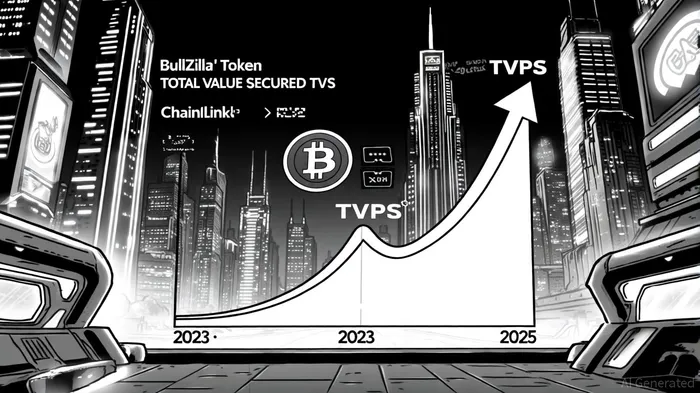
In contrast, ChainlinkLINK-- (LINK) has solidified its role as a foundational infrastructure layer for DeFi, securing $89 billion in Total Value Secured (TVS) by Q2 2025—68% of all oracle-secured value in DeFi [1]. Its Chainlink Reserve locks revenue into LINK tokens, reducing circulating supply and aligning incentives with holders [4]. While BullZilla's utility is speculative and community-driven, Chainlink's value lies in its irreplaceable role as a data oracleADA-- for smart contracts, underpinning protocols like AaveAAVE-- and UniswapUNI--.
Market Capture: Viral Growth vs. Institutional Trust
BullZilla's market capture strategy hinges on viral community engagement and high-yield staking. The HODL Furnace offers up to 70% APY for token holders, locking liquidity and fostering long-term participation [3]. Its referral system (Roar-to-Earn) rewards users with 10% of tokens purchased via their links, accelerating organic growth [5]. As of Stage 4C in September 2025, the project had sold 29 billion tokens, with a projected 6,565% ROI if the token lists at $0.00527 [6].
Chainlink, however, has captured market share through institutional partnerships and regulatory alignment. By Q2 2025, it had secured collaborations with Mastercard, J.P. Morgan, and the U.S. Department of Commerce, publishing macroeconomic data onchain [1]. Its TVS growth—from $20 billion in 2023 to $89 billion in 2025—reflects its dominance in securing DeFi protocols and real-world assets (RWAs) [1]. Unlike BullZilla's retail-driven model, Chainlink's value proposition is rooted in enterprise-grade reliability.
Disruption Potential: Meme Mechanics or Infrastructure Legacy?
To assess whether BullZilla could replicate Chainlink's disruption, one must consider their divergent value propositions. Chainlink's disruption stemmed from solving a critical infrastructure gap—connecting blockchains to real-world data—while BullZilla leverages meme culture and engineered scarcity.
BullZilla's tokenomics—50% presale, 20% staking, 5% burn—create a self-sustaining ecosystem where price appreciation is algorithmically enforced [2]. This contrasts with Chainlink's utility-driven model, where demand is tied to the growth of DeFi and RWAs. Analysts argue that BullZilla's structured burn and staking mechanisms could drive token value, but its success hinges on sustained community participation and favorable market conditions [6].
However, BullZilla lacks Chainlink's institutional credibility and real-world use cases. While it offers speculative appeal, its disruption potential is confined to the meme coin niche, whereas Chainlink's infrastructure role ensures long-term relevance.
Conclusion: A High-Risk, High-Reward Proposition
BullZilla's on-chain utilities—Mutation Engine, Roar Burn, and HODL Furnace—position it as a compelling presale opportunity, particularly for risk-tolerant investors seeking exponential returns. Its market capture strategy, driven by viral growth and high APY incentives, mirrors the dynamics of past meme coin frenzies. Yet, it lacks the institutional adoption and infrastructure depth that underpin Chainlink's dominance.
For BullZilla to achieve Chainlink-level disruption, it would need to transition from speculative hype to functional utility—perhaps by expanding into DeFi staking or NFT integrations. Until then, it remains a high-risk, high-reward project, best suited for investors who prioritize short-term gains over long-term infrastructure bets.






Comentarios
Aún no hay comentarios