
BullZilla vs. ChainLink: A New Era in DeFi Infrastructure?
In the rapidly evolving DeFi landscape of 2025, two projects-BullZilla and ChainLink-stand out as emblematic of divergent investment narratives. While ChainLinkLINK-- (LINK) solidifies its role as the backbone of blockchain infrastructure, BullZilla ($BZIL) emerges as a speculative presale phenomenon with engineered scarcity and community-driven momentum. This analysis explores whether BullZilla's presale mechanics and tokenomics could position it as a ChainLink alternative, particularly for investors prioritizing high-growth opportunities in the DeFi oracleADA-- space.
BullZilla: The Presale Powerhouse with DeFi Ambitions
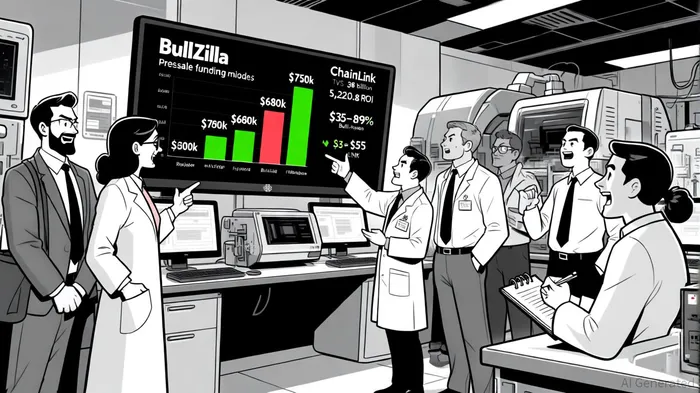
BullZilla's presale has captured attention through its Progressive Price Engine, which automatically increases the token price every 48 hours or upon raising $100,000, whichever occurs first. This mechanism has driven urgency among investors, with the project raising over $750,000 by Stage 5C and attracting 2,400+ holders, according to a Coindoo report. The Roar Burn Mechanism further enhances scarcity by permanently removing tokens from circulation at each funding milestone, creating upward pressure on value, as discussed in a CoinCentral analysis.
Critically, BullZilla's HODL Furnace offers staking rewards of up to 70% APY, aligning long-term loyalty with token appreciation, according to an Intellectia article. These features, combined with a capped supply of 159,999,999,910 tokens and a referral system (Roarblood Vault), position BullZilla as a hybrid of meme coin virality and structured financial incentives, as noted in a Crypto-Reporter piece. While it lacks direct oracle functionality like ChainLink, its Ethereum-based infrastructure and partnerships with decentralized exchanges suggest potential for future integration into DeFi ecosystems, a point covered by LiveBitcoinNews in their roundup.
ChainLink: The Bedrock of Oracle Infrastructure
ChainLink remains the gold standard for decentralized oracle networks, securing $38 billion in Total Value Secured (TVS) and powering over 1,300 projects across DeFi, gaming, and enterprise solutions, according to a Medium analysis. Its Cross-Chain Interoperability Protocol (CCIP) enables seamless data and asset transfers across blockchains, addressing a critical pain point in Web3 adoption, as described in a Blockonomi piece. Institutional adoption, including integrations with BNBBNB-- Chain and government data on-chain, underscores its role as a reliable infrastructure provider, a trend covered by Coindoo.
However, ChainLink's utility is inherently stable and less speculative. Analysts project a conservative price range of $35–$55 for LINK over 18 months, contingent on U.S. regulatory clarity, according to a CryptoBrowser analysis. This contrasts sharply with BullZilla's projected ROI of 5,220.89% if the token reaches $0.00527 at listing, a projection previously highlighted by Intellectia.
Market Timing and Investor Sentiment
The 2025 crypto market is defined by two forces: infrastructure reliability and presale frenzy. ChainLink's role in providing verifiable data feeds for smart contracts remains irreplaceable, particularly as regulators demand transparency, as Blockonomi has observed. Yet, BullZilla's presale model-blending meme culture with deflationary mechanics-has resonated with a new generation of investors seeking exponential returns.
Data from Coindoo highlights BullZilla's presale as one of the "best 1000x crypto presales" in 2025, driven by its 70% APY staking rewards and token burn schedule, a narrative echoed in a LiveBitcoinNews roundup. Meanwhile, ChainLink's institutional partnerships and CCIP advancements position it as a long-term play for enterprises and DeFi protocols requiring robust oracle networks, a trend also documented by Coindoo.
Risks and Considerations
BullZilla's speculative nature carries inherent risks. Its success hinges on market sentiment, regulatory shifts, and the sustainability of its tokenomics. In contrast, ChainLink's established infrastructure and institutional backing offer more predictable value, albeit with lower growth potential. Investors must weigh these factors against their risk tolerance and time horizon.
Conclusion: Divergent Paths, Shared Potential
BullZilla and ChainLink represent two sides of the DeFi coin. ChainLink is the bedrock of blockchain infrastructure, while BullZilla embodies the speculative energy of presales with engineered scarcity and community incentives. For investors seeking high-growth opportunities in 2025, BullZilla's presale mechanics and ROI projections make it a compelling alternative to traditional oracle projects. However, its lack of direct oracle functionality means it cannot fully replace ChainLink's foundational role.
As the DeFi ecosystem matures, projects like BullZilla and ChainLink will coexist, catering to distinct investor preferences. The key lies in understanding market timing: BullZilla for those chasing exponential returns, and ChainLink for those prioritizing long-term infrastructure stability.






Comentarios
Aún no hay comentarios