
Bullfrog AI's Shareholder Offering and Its Implications for Investor Value
In the high-stakes arena of AI startups, capital structure strategy is both a lifeline and a litmus test for investor confidence. Bullfrog AI HoldingsBFRG--, Inc. (BFRG) has navigated this terrain with a series of equity-driven fundraisers in 2024–2025, but the results raise critical questions about alignment with industry norms and long-term value creation.
Equity Financing: A Double-Edged Sword
Bullfrog AI's October 2024 registered direct offering and concurrent private placement raised $3.13 million, selling 1.565 million shares at $2.00 apiece, alongside warrants exercisable at the same price after six months, as noted in AI startup valuations AI startup valuations. This followed a February 2024 public offering targeting $5.7 million, with shares priced at $3.782, per its MarketBeat listing MarketBeat listing. Both rounds were underwritten by WallachBeth Capital, LLC, underscoring the company's reliance on a single placement agent-a strategy that may limit negotiation leverage but ensures continuity in execution.
While these efforts generated net proceeds of $2.7 million (post-offering costs), they occurred against a backdrop of escalating losses. For the nine months ending September 30, 2024, Bullfrog AI reported a net loss of $5.28 million, a 31.6% increase year-over-year, driven by rising operating expenses, according to the company press release. This pattern mirrors broader trends in AI startups, where early-stage firms often prioritize growth over profitability. The finrofca report shows that AI startups in categories like Large Language Models (LLMs) and Search Engines command valuation multiples of 44.1x and 30.9x revenue, respectively, reflecting investor bets on long-term potential over current performance. However, Bullfrog AI's offerings-raising less than $6 million combined-fall far short of the $13–40 billion rounds secured by category leaders like Anthropic and OpenAI, suggesting a stark gap in perceived defensibility and scalability (per the company press release).
Capital Structure: Equity-Heavy, Debt-Light
Bullfrog AI's debt-to-equity ratio of 0.31 as of June 2025, cited in the company press release, contrasts sharply with industry benchmarks. The Technology Sector's trailing twelve months (TTM) debt-to-equity ratio reached 3.02 in Q3 2025, while the Diversified Commercial Services sector averaged 0.94 in 2024, per industry debt-to-equity ratios industry debt-to-equity ratios. AI startups, particularly those in infrastructure, have increasingly tapped venture debt-accounting for 38.4% of the $30 billion in U.S. and European venture debt in 2025, according to the company press release. By contrast, Bullfrog AI's strategy leans heavily on equity, a path that preserves financial flexibility but risks diluting shareholder value.
This approach aligns with the "Supernova" model described by Bessemer Venture Partners, where startups trade short-term profitability for aggressive scaling in the State of AI report State of AI report. Yet, the absence of debt raises questions about operational efficiency. For instance, while peers like Crusoe secured $750 million in credit facilities for GPU procurement (as noted in the company press release), Bullfrog AI has not disclosed similar infrastructure investments. Without evidence of capital-efficient growth, the company's reliance on equity may signal to investors that it lacks the technical or market differentiation to justify higher valuation multiples.
Market Impact: A Bearish Outlook Amid Volatility
The market's reaction to Bullfrog AI's offerings has been tepid. As of October 10, 2025, the stock closed at $1.32, down 47.83% year-to-date and trading below Nasdaq's $2.5 million stockholders' equity threshold, triggering delisting concerns, according to an Aventis valuation analysis Aventis valuation analysis. Technical analysis projects further declines, with a short-term range of $1.21–$1.30 and a bearish trend expected in the coming months, per the Aventis analysis. This contrasts with the broader AI sector, where generative AI and LLM firms trade at median revenue multiples of 45x-far exceeding traditional SaaS benchmarks of 8x, as highlighted in the Aventis analysis.
The disconnect highlights a critical challenge: Bullfrog AI's offerings have not translated into improved investor sentiment. While the company cites "working capital and general corporate purposes" as the use of proceeds in its filings, the finrofca report and the company's filings reveal no material progress in reducing losses or monetizing its AI platform. This opacity, combined with a debt-light structure, leaves the company vulnerable to market skepticism.
Investor Implications: A Cautionary Case Study
For investors, Bullfrog AI's trajectory underscores the risks of misaligned capital strategies. In a sector where valuation multiples are tied to technical defensibility and monetization clarity, as discussed in the Aventis analysis, the company's repeated equity raises without demonstrable ROI may erode trust. By comparison, "Shooting Star" startups-those prioritizing capital efficiency and sustainable growth-have attracted more stable investor backing, per Bessemer's State of AI report.
Moreover, Bullfrog AI's stock price volatility and delisting risk amplify downside exposure. While the recent 4.76% monthly gain offers a glimmer of hope (noted in the State of AI report), algorithmic forecasts remain bearish, according to Aventis. Investors must weigh these risks against the company's stated goals of R&D expansion and strategic partnerships, which remain unproven in terms of execution.
Conclusion: A Test of Resilience
Bullfrog AI's shareholder offerings reflect a classic AI startup dilemma: balancing the need for capital with the imperative to build sustainable value. While its equity-heavy approach aligns with early-stage norms, the absence of debt and lack of clear differentiation place it at odds with industry leaders securing multi-billion-dollar valuations. For the company to avoid delisting and regain investor confidence, it must demonstrate not only technical innovation but also a capital structure that balances growth with fiscal prudence-a tall order in an increasingly selective AI market.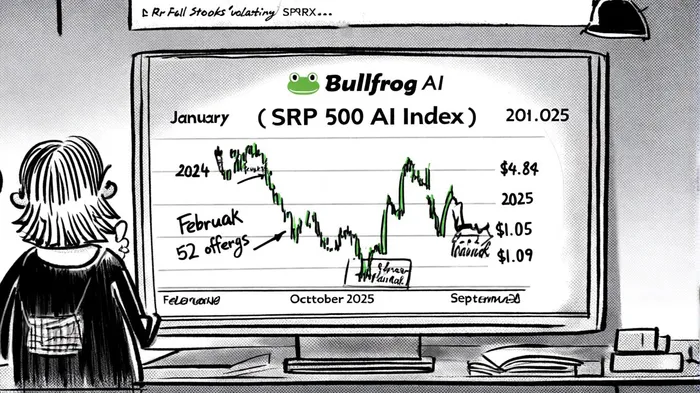





Comentarios
Aún no hay comentarios