
Building Tomorrow: Resilient Infrastructure Stocks and the Legacy of Adversity-Driven Leadership
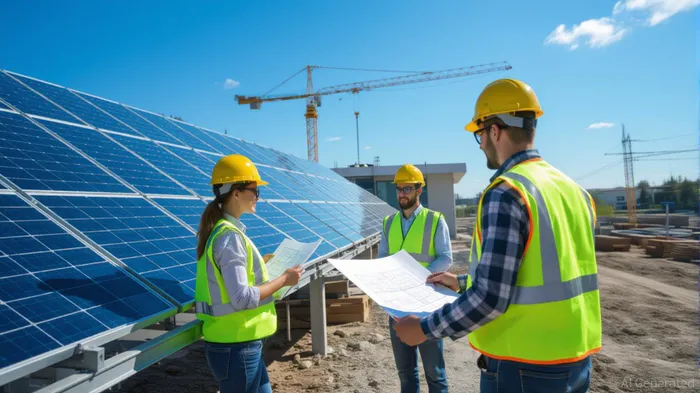
In a world still reeling from the aftershocks of the pandemic and grappling with inflationary pressures, the infrastructure sector has emerged as a beacon of stability and long-term value creation. Investors are increasingly turning to companies that not only weather economic storms but also build resilience through adversity-driven leadership, frugality, and a commitment to environmental, social, and governance (ESG) principles. These firms, much like the legendary Chung Ju-Yung of Hyundai, prioritize relentless execution and strategic reinvestment, transforming challenges into opportunities for growth.
The Chung Ju-Yung Blueprint: Frugality, Execution, and Vision
Chung Ju-Yung, the architect of Hyundai's rise from post-war South Korea, built his empire on a foundation of frugality, operational discipline, and a people-centric culture. His philosophy—turning adversity into innovation—resonates today in the strategies of modern infrastructure leaders. Consider AECOM (ACM), a global engineering and construction firm that reported a 17.1% adjusted operating margin in Q3 2025. With a net leverage ratio of 0.6x and $2.3 billion in buybacks since 2020, AECOMACM-- balances cost discipline with reinvestment. Its P/E ratio of 26.71, 64% below its 10-year average, suggests the market is underestimating its role in global infrastructure spending.
Similarly, Delta Air Lines (DAL) has turned crisis into opportunity. After the 2020 pandemic, DeltaDAL-- modernized its fleet and digital infrastructure while maintaining a conservative balance sheet. Its AI-driven fare pricing system and $1.64 billion in free cash flow reflect a leadership style that mirrors Chung's ability to adapt to adversity. Delta's P/E of 9.01 and EV/EBITDA of 9.11 underscore its undervaluation in a market that often overlooks industrials.
ESG and Public-Private Partnerships: The New Infrastructure Megatrends
The 2025 ESG landscape is dominated by companies that align with global sustainability goals and leverage public-private partnerships (PPPs) to scale impact. Microsoft (MSFT), for instance, partners with Black-owned solar firm Volt Energy to advance its net-zero emissions target by 2050. This collaboration is emblematic of the PPPs driving the energy transition. Microsoft's 100% renewable energy goal by 2025 and its $3,041 billion market cap position it as a linchpin in the AI and cloud infrastructure revolution.
Meanwhile, Waste Management (WM) has embraced the circular economy with a 28.9% EBITDA margin and $4.4 billion in EBIT. Its acquisition of Stericycle and expansion into renewable natural gas (RNG) reflect a strategic vision akin to Chung's global infrastructure ambitions. Despite a high debt-to-equity ratio of 247.2%, its 5.6x interest coverage ratio ensures stability, making it a compelling play in the waste-to-energy sector.
The Power of Adversity-Driven Innovation
Caterpillar (CAT) exemplifies frugal innovation, pivoting to hybrid and hydrogen-powered machinery while maintaining a 17.3% operating margin. Its $3.1 billion in operating cash flow and forward P/E of 22.35—below its historical average—highlight its undervaluation. Caterpillar's approach mirrors Chung's 1960s gamble on cutting-edge infrastructure, aligning with long-term sustainability trends.
Why These Stocks Matter in 2025
The post-pandemic economy demands infrastructure that is both resilient and adaptive. Companies like AECOM, Delta, CaterpillarCAT--, and Waste ManagementWM-- are not just surviving—they are redefining their industries. Their leadership philosophies, rooted in frugality and execution, position them to capitalize on government-supported domestic construction growth and ESG-driven capital flows.
For investors, the case is clear: these firms offer a blend of financial discipline, ESG alignment, and strategic reinvestment that is rare in today's market. As the world shifts toward decarbonization and digitalization, the infrastructure sector—led by adversity-driven leaders—will be the backbone of long-term value creation.
Conclusion: Building for the Future
The legacy of Chung Ju-Yung lives on in companies that prioritize execution, frugality, and resilience. In a market obsessed with short-term gains, these firms stand out for their commitment to long-term value creation. Whether through AI-driven infrastructure, renewable energy partnerships, or circular economy innovations, they are laying the groundwork for a sustainable future. For investors seeking stability and growth in an uncertain world, the message is simple: build with the builders.







Comentarios
Aún no hay comentarios