
Building the Rails: A Strategic $2,000 Play on AI Infrastructure's Exponential Growth
The AI investment story is hitting a critical inflection point. The era of speculative model development is giving way to a new paradigm: the urgent need for scalable, efficient infrastructure to run these models at production scale. This isn't a minor upgrade; it's a fundamental re-engineering of enterprise compute, driven by the harsh economics of real-world deployment. The result is a durable, multi-year capital expenditure cycle that favors the builders of the physical rails over the fleeting application-layer bets.
The shift is already underway. As AI moves from proof-of-concept to continuous, enterprise-wide workloads, companies are discovering their existing infrastructure is misaligned with the technology's unique demands. Recurring AI workloads mean near-constant inference, which is the act of using an AI model in real-world processes. This constant activity, especially with agentic AI, has led to monthly bills for AI use in the tens of millions of dollars, forcing a rethink of where and how compute is deployed. The problem extends beyond cost to data sovereignty, latency, and resilience, demanding a new architecture that leverages the right compute platform for each task.
This operational reality is creating a massive and underestimated capex cycle. While analyst consensus for 2026 capital spending by AI hyperscalers has risen to $527 billion, the historical pattern shows these estimates have consistently underestimated capex spending related to AI. The divergence in stock performance confirms the market's maturing view: investors are rotating away from infrastructure companies where growth is under pressure and capex is debt-funded, and toward those with a clear link between spending and revenue. This is a classic "war of attrition" in the software layer, where models and narratives change quarterly, while the underlying physical infrastructure remains a more stable, long-term investment.
The most compelling opportunities lie in the infrastructure layers that enable this next phase of adoption. Whether the algorithm is generating text or video, it still lives inside steel and concrete. The watchlist for this cycle skips the volatile "App Store" trade and focuses on the data center itself. This means companies building the bespoke engines-custom ASICs and advanced packaging-and the high-speed interconnects that bind them into clusters. For the infrastructure strategist, the paradigm has shifted. The exponential growth curve is no longer about the model on top; it's about the compute floor beneath it.
The Infrastructure Stack: Where the Exponential Growth Is
The exponential growth of AI is no longer a theoretical curve; it is being forced into physical reality by the demands of its own workloads. This is where the infrastructure stack becomes the battleground for the next decade. The shift from training to inference is not just a change in usage-it is a fundamental reordering of the compute landscape, creating massive, durable investment opportunities in networking, custom silicon, and power.
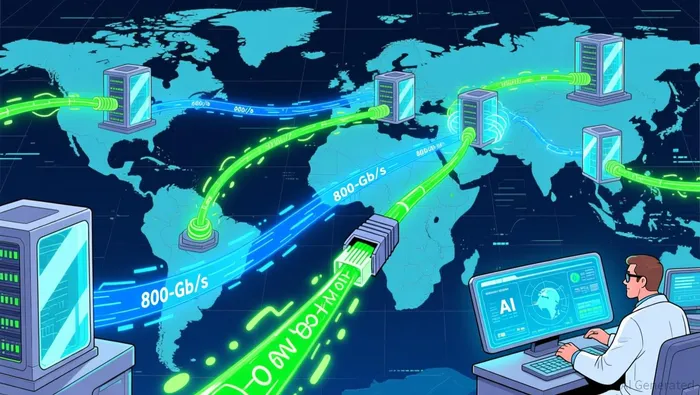
The first layer to undergo a paradigm shift is networking. For years, InfiniBand was the gold standard for high-performance AI clusters. But the economics and scalability of pure inference are changing the game. Ethernet is outpacing InfiniBand as the preferred fabric for scalable AI workloads. This isn't a minor preference; it's a strategic pivot. Driven by open standards from the Ultra Ethernet Consortium and the performance of new 800-Gb/s links, Ethernet is proving it can handle the massive data flows required for AI training and, more importantly, real-time inferencing. In fact, one provider claims Ethernet-based AI fabrics outperform InfiniBand by 30%. This move toward a more open, commodity-based fabric lowers barriers to entry and accelerates adoption, turning networking from a niche specialty into a foundational, high-volume market.
Simultaneously, the market for the chips that power this new workload is exploding. The focus is shifting from the expensive, power-hungry chips used for initial training to the inference-optimized engines that will run AI continuously. The market for inference-optimized chips will grow to over US$50 billion in 2026. This is the heart of the exponential adoption curve. While training demand may be maturing, the sheer volume of inference queries-driven by agentic AI and enterprise deployment-is creating a new, massive, and recurring revenue stream. This isn't about replacing data centers; it's about building a new layer of compute that runs on them, demanding specialized hardware designed for efficiency, not just raw power.
This leads directly to the third pillar: custom silicon and advanced packaging. As hyperscalers seek to control costs and improve efficiency, they are moving beyond off-the-shelf GPUs. They are designing their own purpose-built chips, or ASICs. Hyperscalers are no longer waiting for Intel or Nvidia to hand them a standard roadmap. They are designing their own purpose-built silicon. This creates a powerful ripple effect. The companies that provide the essential IP for these custom designs, like high-speed SerDes for interconnects, are positioned for significant growth. More broadly, the physical packaging required to stitch these advanced chips together-like 2.5D CoWoS-becomes a critical bottleneck. With TSMC's capacity sold out, independent players like AmkorAMKR-- are stepping in as the "China Hedge," building the essential rails for this new wave of custom silicon.
The bottom line is that exponential growth is converging at the infrastructure layer. It's not in the fleeting application layer, but in the physical stack that makes AI work. From the open Ethernet fabric to the inference-optimized chips and the custom ASICs being designed from the ground up, the investment thesis is clear. These are the durable, high-capex businesses that will be built to last the entire AI adoption cycle.
Financial Impact and Selective Capital Allocation
The capex surge is real, but the market is no longer rewarding all big spenders equally. Investors are rotating away from AI infrastructure companies where growth in operating earnings is under pressure and capex spending is debt-funded. This selectivity is a hallmark of a maturing cycle. The divergence in stock performance confirms the shift: the average correlation among large public AI hyperscalers has collapsed from 80% to just 20% since June. The new focus is on companies demonstrating a clear link between their spending and future revenue-a classic filter for durable infrastructure plays.
The 2026 catalyst for networking infrastructure is the volume shipment of switches compliant with the Ultra Ethernet Consortium's open standards. This is the moment Ethernet moves from promise to production, directly challenging InfiniBand's dominance in scalable AI workloads. The solution for enterprises is not a simple cloud vs. on-premises choice, but building AI-optimized data centers that leverage the right compute platform for each workload. This is the operational reality forcing the physical re-engineering of enterprise IT.
For the infrastructure strategist, this selectivity points to a few key beneficiaries. The first is the provider of the essential IP for custom silicon. As hyperscalers design their own purpose-built engines to cut costs and improve efficiency, companies like Marvell are positioned to capture the revenue. Marvell's high-speed SerDes IP is a critical building block for these custom chips, and its 2026 revenue stream from AWS and Microsoft is expected to hit volume production. The second beneficiary is the independent player in advanced packaging. With TSMC's capacity sold out, Amkor TechnologyAMKR-- is the primary alternative, acting as a "China Hedge" for the semiconductor supply chain. Its role in stitching together complex AI chips makes it a vital, non-discretionary part of the infrastructure stack.
The bottom line is that exponential growth is converging on these specific rails. The financial impact will be felt not in speculative model bets, but in the volume shipments of open networking gear and the ramp of custom silicon design wins. For investors, the playbook is clear: allocate capital to the companies building the physical floor of the new economy, where the capex cycle is durable and the revenue link is direct.
Catalysts, Risks, and What to Watch
The infrastructure thesis is now in its validation phase. The exponential adoption curve is being funded, but the market is demanding proof that this spending translates into durable revenue and returns. The near-term catalysts are clear, but they come with significant geopolitical and execution risks.
The most immediate test is the finalization and adoption of new networking standards. The 2026 catalyst for Ethernet-based AI fabrics is the volume shipment of switches compliant with the Ultra Ethernet Consortium's open standards. This is the moment the technology moves from promise to production, directly challenging InfiniBand's dominance in scalable AI workloads. The winner in this race will be the company that captures the essential IP for these new, high-speed interconnects. For Marvell, the 2026 milestone is the ramp of its custom ASIC revenue from AWS and Microsoft to volume production. This is the threshold where design wins must cross into cash flow, validating the company's position in the "Build Your Own Silicon" trend.
A more profound risk, however, is geopolitical. As AI computing power becomes a critical strategic asset, export controls and national security concerns are reshaping the entire supply chain. The U.S. and its partners are actively managing the spread of advanced AI capabilities, particularly to competitors like China. This creates friction for companies operating globally, as seen in the Council on Foreign Relations analysis. The risk is not just regulatory delay, but a potential bifurcation of the technology stack, forcing companies to build separate, less efficient supply chains for different regions. For an infrastructure play, this introduces cost and complexity that could pressure margins and slow adoption.
The primary catalyst, though, remains the continued, underestimated surge in AI capital expenditure. The consensus estimate for 2026 capex by AI hyperscalers is now $527 billion. The market's selectivity is a filter: investors are rotating away from infrastructure companies where capex is debt-funded and growth is under pressure. The beneficiaries are those with a clear link between spending and revenue. This creates a durable, multi-year investment cycle for the physical floor of the new economy. For the strategist, the forward view is one of validation. Watch for the volume shipments of open networking gear, the ramp of custom silicon design wins, and the steady, debt-light execution of capex by the hyperscalers. These are the signals that the exponential growth curve is being built, one steel-and-concrete layer at a time.





Comentarios
Aún no hay comentarios