
Building the Orbital Rails: A $2,000 Portfolio for the 2026 Space Inflection
The satellite industry is at a classic inflection point. It is moving from the early-adopter phase of a technological S-curve toward the steep, exponential growth of mainstream adoption. The numbers show a sector transitioning from niche to infrastructure. The global satellite mega constellations market is projected to grow from $5.55 billion in 2025 to $27.3 billion by 2032, a compound annual rate of 25.5%. This isn't just growth; it's the scaling of a new communications paradigm, from a few geostationary satellites to a dense network of hundreds or thousands in low Earth orbit, promising near-global, low-latency connectivity.
This shift is being fueled by a powerful convergence of capital and policy. Venture funding has poured into the hardware-led infrastructure, with trailing 12-month investment reaching $10.4 billion in 2025. This capital is not chasing hype; it's building the physical rails-the satellites, launch vehicles, and ground stations-that will carry the next wave of data. The stage is set for a generational catalyst: a reported $1.5 trillion IPO for SpaceX in 2026. Such an event would be a market validation, pulling generalist capital into the sector and re-rating the entire space economy, much like Tesla did for electric vehicles.
The policy tailwind is equally potent. The new White House Space Executive Order, signed in mid-December, is a concrete mandate for American space superiority that includes commercial-first procurement reforms and repeatable contract triggers. This isn't vague encouragement; it's a direct channel for government spending to flow to private companies, accelerating commercial expansion. When a $1.5 trillion valuation and a national policy directive align with a $10.4 billion capital wave, the setup for exponential growth becomes compelling. The orbital economy is no longer an experiment. It's the infrastructure layer for the next decade, and 2026 may be the year it crosses the chasm into mainstream adoption.
Infrastructure Layer: Launch and Compute
The exponential adoption of satellite mega constellations demands a new class of launch infrastructure. The market is shifting from small, dedicated rides on Electron rockets to the heavy lifting required for thousands of satellites. This is where companies like Rocket LabRKLB-- are positioned to capture the next phase of growth. Its reusable Neutron rocket is the linchpin. The vehicle is now in final development, with its launchpad arriving at the Virginia site in the first quarter of 2026, setting the stage for a debut flight later this year. Analysts see this as a potential inflection, projecting the company's sales to more than double to $1.2 billion by 2027. The math is straightforward: Neutron's capacity of 13,000 kilograms to low Earth orbit opens up larger payload markets, with individual contracts priced at $50 million to $55 million-far above the average Electron flight fee. If the launch cadence scales, this could drive a significant revenue ramp.
Yet the timeline is a high-stakes gamble. The debut has been pushed back multiple times, from an initial 2024 target to now a window that may not open until mid-2026. Further delays are possible, adding estimated costs of $15 million per quarter. Missing the first-quarter arrival could trigger a sharp stock decline, as the market prices in the risk of a late or failed debut. The competition is also fierce, with Neutron's capacity falling short of SpaceX's Falcon 9 and Starship. For now, Neutron's success is a binary bet on execution and timing.
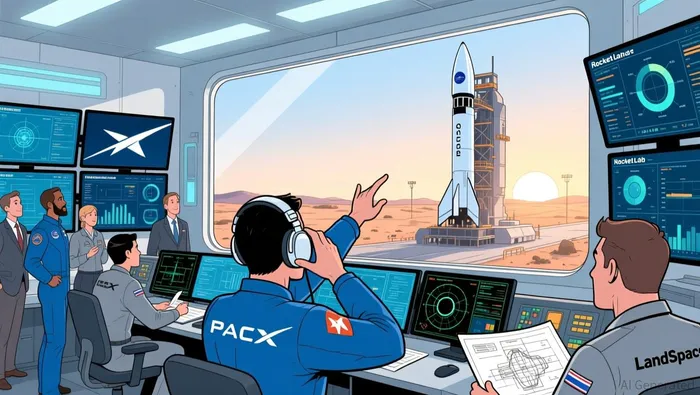
This launch narrative is being amplified by a more profound theme: orbital compute. The idea of "data centers in space" is moving from sci-fi to funded demos, creating a credible narrative that ties space investment directly to the AI infrastructure boom. As data generation explodes, the need for compute at the edge-closer to the user-becomes critical. Satellites in low Earth orbit are the natural platform for this. This transforms launch services from a mere transportation play into an essential stock for the AI infrastructure layer. Companies enabling this compute paradigm, through both launch and ground systems, become foundational rails for the next data economy.
The ultimate catalyst for this entire infrastructure layer could be the reported $1.5 trillion IPO for SpaceX in 2026. This event would be a market validation on a generational scale, re-rating the entire space sector much like Tesla's IPO did for electric vehicles. It would pull generalist capital into the category, set new benchmarks for valuation, and accelerate commercial expansion. For launch providers like Rocket Lab, a SpaceX IPO would validate the underlying demand for orbital capacity and likely increase competition for government and commercial contracts. The orbital economy is no longer an experiment. It is the infrastructure layer for the next decade, and 2026 may be the year it crosses the chasm into mainstream adoption.
Concrete Picks and a $2,000 Allocation Framework
With the orbital S-curve now in view, a $2,000 portfolio can be structured to capture the inflection. The strategy is a 50/30/20 split: $1,000 in a diversified space ETF for broad exposure, $600 in a high-growth launch play, and $400 in a rapidly scaling competitor. This balances core infrastructure, exponential potential, and defensive diversification.
The foundation is the space ETF ARKX. This provides instant, low-cost access to the entire sector's S-curve. It holds a basket of companies from launch providers to satellite operators, smoothing out the volatility of individual bets. For a $2,000 allocation, ARKX offers the most efficient way to own the paradigm shift itself. It's the portfolio's ballast, ensuring you benefit from the $1 trillion market trajectory even if specific picks stumble.
The second pillar is Rocket Lab (RKLB). This is a pure bet on the Neutron rocket's debut and the medium-lift market. The stock has already shown its volatility, climbing about 30% in one week in December on SpaceX IPO news. The rationale is clear: Neutron's 13,000-kilogram capacity opens contracts priced at $50 million to $55 million, a step up from the Electron's average $8.4 million. Analysts project sales could more than double to $1.2 billion by 2027 if the launch cadence scales. The risk is binary-delays to mid-2026 or later add costs and could trigger a sharp decline. But for a concentrated bet on the launch infrastructure layer, RKLBRKLB-- is the most direct play.
The third leg is a global competitor. LandSpace is the closest thing China has to its own SpaceX, and its growth trajectory is staggering. The company's revenue reportedly grew eightfold in the first half of 2025. Its Zhuque-3 rocket, modeled on the Falcon 9, reached orbit in December 2025 and aims for 12 launches and landing attempts in 2026. This rapid scaling is a key signal of the global race for orbital capacity. The $400 allocation here is a bet on the competitive intensity that will drive down costs and accelerate adoption worldwide. Note that LandSpace is a Chinese company, not directly tradable on U.S. exchanges. Investors can access it via American Depositary Receipts (ADRs) or through ETFs that hold Chinese space stocks.
This framework turns the 2026 inflection into a concrete plan. The ETF captures the broad S-curve, Rocket Lab targets the launch infrastructure breakthrough, and LandSpace provides a high-growth, global counterpoint. It's a portfolio built on exponential adoption, not just individual stock picks.
Monitoring the S-Curve: Key Metrics and Catalysts
The 2026 inflection is now a live trade. The setup is clear, but the path to exponential adoption will be marked by specific triggers and risks. For investors, the focus shifts from the broad thesis to the near-term catalysts that can accelerate or derail the S-curve, and the metrics that will signal progress.
The primary catalyst remains the reported $1.5 trillion IPO for SpaceX in 2026. This is not just a company event; it's a market validation that could re-rate the entire sector overnight. The mechanism is straightforward: a liquidity event of that magnitude would pull generalist capital into the space category, setting new benchmarks for valuation and accelerating commercial expansion. The sentiment effect is already visible, with Rocket Lab stock climbing about 30% in one week in December on the news. The key is timing. Any delay to the IPO window would remove a major positive catalyst, while a successful debut would provide a powerful tailwind for all infrastructure plays.
The major operational risk, however, is orbital congestion. As the mega constellation market grows from $5.55 billion in 2025 to $27.3 billion by 2032, the density of satellites in low Earth orbit will rise sharply. Collision rates are projected to increase 30-50% by 2030, a physical friction that raises insurance premiums and operational costs. This isn't a distant theoretical problem; it's a direct pressure on the economics of launch and satellite operations. Companies that can demonstrate superior collision avoidance systems or operate in less crowded orbital slots will have a material advantage.
For individual stocks, the milestones are binary. For Rocket Lab (RKLB), the critical path is the Neutron rocket. The arrival of its launchpad at the Virginia site in the first quarter of 2026 is a key logistical checkpoint. The subsequent debut flight, now expected no earlier than mid-2026, is the ultimate inflection point. Success here validates the medium-lift market and the $50 million to $55 million contract price point. Failure or further delay would likely trigger a sharp decline in the stock, as the binary bet on execution unravels.
For the global competitor, LandSpace, the metrics are about scaling. The company's revenue reportedly grew eightfold in the first half of 2025, a staggering growth rate that must be monitored quarter by quarter. Equally important is its progress on orbital launch capabilities. The successful reach of orbit by its Zhuque-3 rocket in December 2025 is a foundational step. The 2026 target of 12 launches and landing attempts will test its operational cadence and reliability. Consistent execution here signals a credible, high-growth challenger in the global race for orbital capacity.
The bottom line is that 2026 is a year of verification. The policy tailwinds and capital flows have created the runway. Now, the market will judge the sector on its ability to execute, manage physical risks, and deliver on the exponential adoption promised by the S-curve. Watch the IPO timeline, the collision rate data, and the launch cadence of the key players. These are the metrics that will separate the infrastructure builders from the hype.





Comentarios
Aún no hay comentarios