
Building the AI Infrastructure S-Curve: 10 Stocks for the Exponential Growth Phase
The AI adoption curve is now in its steepest, most explosive phase. Teams are moving decisively from isolated pilot projects to full-scale production deployments, triggering a massive infrastructure build-out. This isn't a gradual climb; it's a leap up the exponential part of the S-curve. The evidence is clear: AI infrastructure spending surged 166% year-over-year in 2025 as organizations scrambled to secure the compute and storage needed for heavier workloads. Yet even with this massive investment, the transition is revealing critical bottlenecks, with 82% of teams still facing performance slowdowns and bandwidth issues doubling in just a year. This friction underscores the urgency and the high stakes of getting the foundational layers right.
The market's trajectory confirms this is a paradigm shift, not a trend. The AI infrastructure sector is projected to grow from $87.6 billion in 2025 to $197.64 billion by 2030, following a steady 17.71% compound annual growth rate. This isn't speculative hype; it's the predictable expansion of a new technological paradigm as its core infrastructure scales to meet demand. The spending surge is concentrated in the hardware layer, where the need for specialized compute is most acute. Accelerated servers now account for 91.8% of all AI server spending, signaling a decisive, irreversible shift toward hardware optimized for machine learning tasks. This concentration means the companies building the fundamental rails for AI-those providing the GPUs, TPUs, and the networking that connects them-are at the epicenter of this exponential growth.
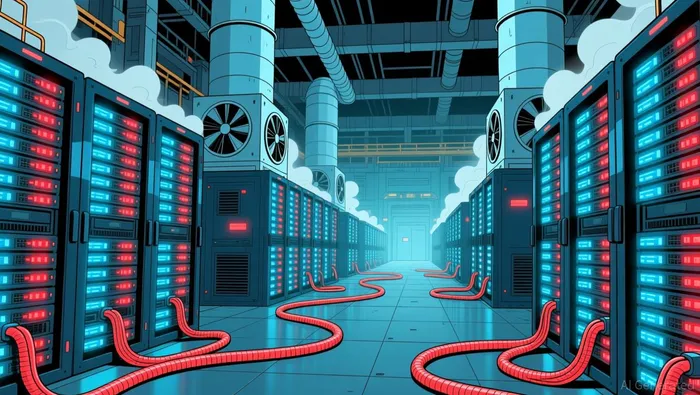
For investors, the thesis is straightforward. The phase of proving AI's value is over. The phase of scaling it is here. The infrastructure that enables this scaling is the new industrial base. Companies that are building the hardware and software layers that solve the performance bottlenecks and enable reliable, cost-efficient operations are positioned to capture the growth as the entire stack moves from pilot to production. The 166% spending surge is just the beginning of a decade-long expansion.
The Compute Bottleneck: Power, Bandwidth, and the New Infrastructure Layer
The explosive growth of AI is hitting a physical wall. As workloads scale from pilot to production, the infrastructure demands are creating data center "cities" with unprecedented and volatile power needs that strain aging electrical grids. This isn't a minor operational hiccup; it's a fundamental constraint that is redefining the competitive landscape. The grid, much of it built decades ago, is struggling to keep pace with the surge in electricity demand driven by AI. Experts note that approximately 70% of the U.S. grid is approaching the end of its life cycle, making it a central operational and strategic bottleneck. This forces data centers from passive energy consumers into active grid stakeholders, co-investing in upgrades and deploying on-site generation and storage to ensure reliability and manage costs.
Simultaneously, a parallel bottleneck is emerging in the network layer. Bandwidth issues have become a major performance drag, jumping from 32% to 53% in just one year. This surge in connectivity problems creates a critical chokepoint, making it harder to train models efficiently and scale experiments without delays. The result is a dual constraint: insufficient power to run the chips and inadequate bandwidth to move data between them. This friction is what separates companies that can scale reliably from those that hit a wall.
The response is a strategic pivot. Data centers are shifting from cost centers to revenue generators, with a new focus on metrics like 'tokens per watt per dollar'. This new priority drives a diversification of power strategies, blending renewables, natural gas, and battery storage to balance sustainability with performance. The bottom line is that the next frontier of infrastructure investment is not just about more compute, but about building the resilient, efficient, and grid-integrated systems that can power the exponential growth phase. Companies that master this new layer of infrastructure-solving for both power density and bandwidth-will own the rails for the AI paradigm.
Valuation and Competition: Selecting the Exponential Winners
The market is now sorting winners from the pack. After a massive rally, the easy money in AI infrastructure is being priced in, and investors are becoming ruthlessly selective. The divergence is clear: stocks are no longer moving together. The average correlation among major AI hyperscalers has collapsed from 80% to just 20% since June, as capital flows toward companies where AI spending demonstrably boosts revenue and away from those where it pressures earnings. This rotation is the hallmark of a market maturing from a speculative phase into a growth phase, where fundamentals matter more than hype.
Nvidia sits at the apex of this infrastructure layer, commanding an approximate 90% market share in the GPU space for training. Its CUDA software moat and first-mover advantage have fueled a nearly 1,200% share surge, making it the world's largest company. Yet even dominance has limits. The stock's massive run-up prices in perfection, and the company is now facing tangible pressure. Supply constraints are a persistent friction, while competition is intensifying. Broadcom is emerging as a major threat in the ASIC market, providing the IP and manufacturing backbone for custom AI chips that can be more efficient for inference. AMDAMD--, meanwhile, is making inroads in the inference segment, where Nvidia's lead is narrower. For investors, this suggests the high-growth phase may now belong to the challengers, with Broadcom and AMD potentially offering higher upside than NvidiaNVDA-- in the coming years.
The next phase of the AI trade, according to Goldman Sachs Research, will move beyond the hardware and data center operators. It will involve AI platform stocks and productivity beneficiaries. This shift reflects a natural progression: once the foundational compute and storage are in place, the focus turns to the software and services that unlock value. Platform providers-those offering databases, development tools, and integrated AI suites-are already showing strength, outperforming peers that lack a clear revenue link to AI adoption. The expectation is that this cohort will benefit as corporate AI use expands from infrastructure build-out to actual workflow transformation. The bottom line is that the exponential growth curve is broadening. The winners will be those building the next layer of the stack, not just the first.
Catalysts and Risks: The Path to Exponential Adoption
The path from today's massive infrastructure build-out to the next phase of exponential adoption is paved with clear catalysts and significant risks. The primary near-term catalyst is the continued execution of hyperscaler capital expenditure plans. These plans are consistently underestimated by consensus estimates, driving a steady upward revision in forecasts. The consensus for 2026 capital spending by AI hyperscalers has climbed to $527 billion, up from $465 billion just a few months ago. This relentless spending is the fuel for the S-curve. As long as these giants keep investing at this pace, the infrastructure growth thesis is validated. The market's recent rotation-rewarding companies with a clear revenue link to AI capex while shunning those with pressured earnings-shows investors are focused on this execution. The next phase, as Goldman Sachs Research notes, will involve platform stocks and productivity beneficiaries, but that shift depends entirely on the foundational capex spending holding firm.
Yet the most tangible risk is a physical one: power. The exponential growth of AI is hitting the limits of the existing grid. Experts predict that approximately 70% of the U.S. grid is approaching the end of its life cycle, creating a central operational and strategic bottleneck. If grid upgrades and data center co-investment in generation and storage lag, this power constraint could directly limit the scale and speed of AI deployment. It would force a painful deceleration, turning a software-driven paradigm shift into a hardware and utility planning problem. This isn't a distant theoretical risk; it's the defining operational challenge for 2026, redefining where and how data centers can be built.
A second, more subtle risk is the pace of efficiency gains. The entire infrastructure build-out assumes that AI models will continue to demand more compute. But if models become significantly more compute-efficient-through better algorithms, chiplet designs, or new accelerator architectures like ASICs-the hardware demand curve could decelerate. This is the "efficiency frontier" risk. As one expert noted, new agentic capabilities will give way to new possibilities, but the path to those possibilities may require less raw power. If the efficiency gains outpace the growth in model complexity, the need for the current wave of massive infrastructure spending could diminish faster than expected. This would challenge the growth trajectory of the hardware and construction layers that are currently priced for sustained expansion.
The bottom line is that the catalysts are strong and visible, but the risks are physical and technological. The path to exponential adoption depends on the hyperscalers' ability to spend, the grid's ability to deliver, and the models' ability to keep demanding more. Any friction in one of these three pillars could slow the S-curve.





Comentarios
Aún no hay comentarios