
Buffett's Bold Bet: Love at First Sight, or Fool's Gold?
Generado por agente de IAHarrison Brooks
lunes, 24 de marzo de 2025, 4:11 pm ET2 min de lectura
BRK.B--
Warren Buffett, the legendary investor known for his shrewd decisions and unyielding principles, once famously declared, "I love your business, I love you, I'll give you $4 billion." Yet, when it came to seeing the business before buying it, he refused to cross an ocean. This paradox encapsulates Buffett's unique approach to risk management and due diligence, a method that has made him one of the most successful investors of all time.
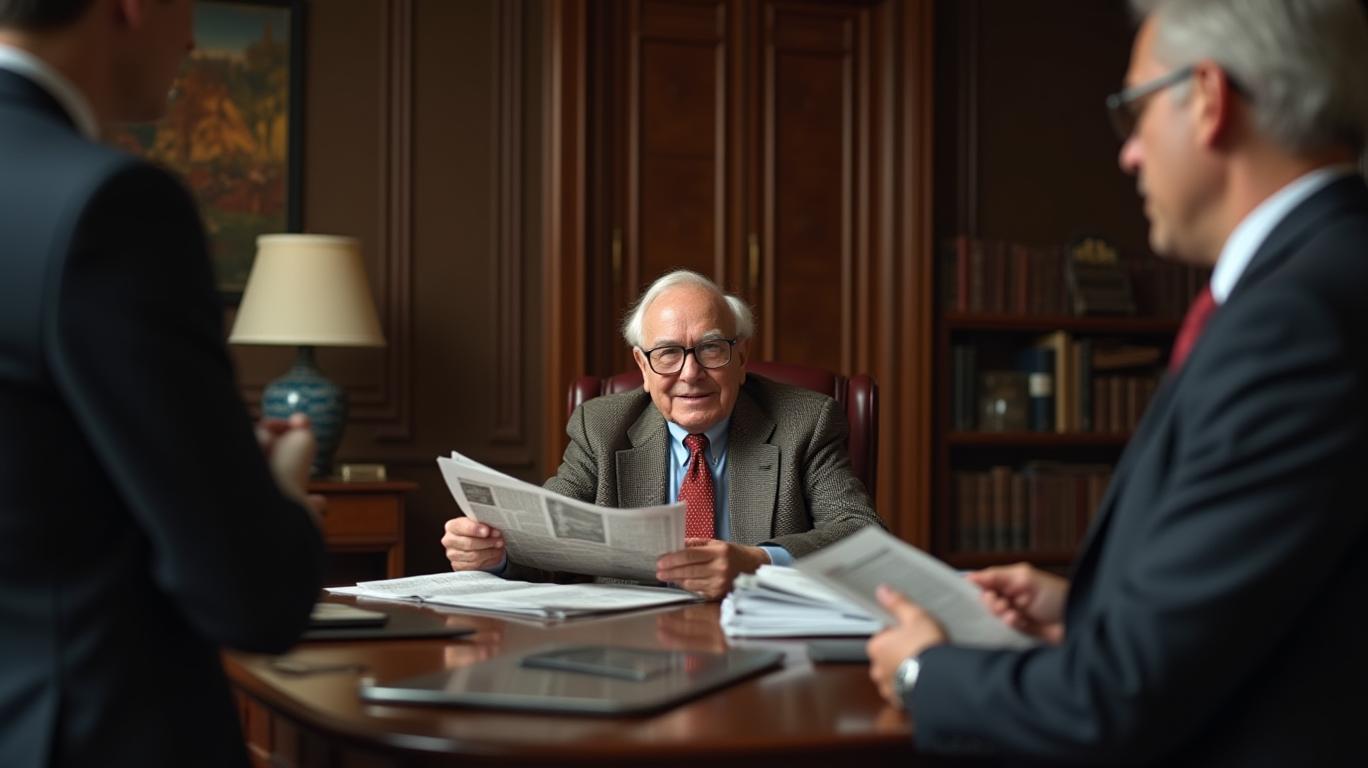
Buffett's decision to buy See's Candies without physically visiting the business is a testament to his confidence in his ability to assess a company's value based on financial data and qualitative factors. In 1972, when See's Candies was up for sale, Buffett was initially hesitant. "Gee, Bob, the candy business. I don’t think we want to be in the candy business," he said. However, after researching the company, he realized that the value of See's intangibles, such as its brand and customer loyalty, outweighed the need for a physical inspection. This approach to due diligence allowed Buffett to make a quick and decisive investment in a company that he believed had strong long-term prospects.
Buffett's decision to buy See's Candies at a price that was more than six times its earnings and three times its value demonstrates his willingness to take calculated risks in pursuit of long-term gains. He recognized that See's had a strong brand and loyal customer base, which would help the company weather economic downturns and maintain its competitive advantage. Additionally, Buffett's purchase of See's Candies allowed Berkshire HathawayBRK.B-- to invest in other businesses, further diversifying its portfolio and reducing its overall risk.
Buffett's approach to risk management and due diligence is not without its critics. Some argue that his decision to buy See's Candies without visiting the business was reckless and that he was lucky to have made a profitable investment. However, Buffett's track record speaks for itself. He has consistently made profitable investments by focusing on the long-term economic value of a business, rather than short-term gains or market trends. As he stated in his 2007 Berkshire Hathaway annual letter, "Our criterion of 'enduring' causes us to rule out companies in industries prone to rapid and continuous change. Though capitalism's 'creative destruction' is highly beneficial for society, it precludes investment certainty. A moat that must be continuously rebuilt will eventually be no moat at all."
In conclusion, Warren Buffett's decision to refuse to cross an ocean to see the business before buying it reflects his approach to risk management and due diligence in investment decisions. By focusing on the company's financial data and qualitative factors, Buffett was able to identify potential risks and opportunities associated with the investment. His willingness to take calculated risks in pursuit of long-term gains has made him one of the most successful investors of all time. As he once said, "Someone's sitting in the shade today because someone planted a tree a long time ago." Buffett's approach to investment is a testament to the power of patience, due diligence, and a long-term perspective.
Warren Buffett, the legendary investor known for his shrewd decisions and unyielding principles, once famously declared, "I love your business, I love you, I'll give you $4 billion." Yet, when it came to seeing the business before buying it, he refused to cross an ocean. This paradox encapsulates Buffett's unique approach to risk management and due diligence, a method that has made him one of the most successful investors of all time.
Buffett's decision to buy See's Candies without physically visiting the business is a testament to his confidence in his ability to assess a company's value based on financial data and qualitative factors. In 1972, when See's Candies was up for sale, Buffett was initially hesitant. "Gee, Bob, the candy business. I don’t think we want to be in the candy business," he said. However, after researching the company, he realized that the value of See's intangibles, such as its brand and customer loyalty, outweighed the need for a physical inspection. This approach to due diligence allowed Buffett to make a quick and decisive investment in a company that he believed had strong long-term prospects.
Buffett's decision to buy See's Candies at a price that was more than six times its earnings and three times its value demonstrates his willingness to take calculated risks in pursuit of long-term gains. He recognized that See's had a strong brand and loyal customer base, which would help the company weather economic downturns and maintain its competitive advantage. Additionally, Buffett's purchase of See's Candies allowed Berkshire HathawayBRK.B-- to invest in other businesses, further diversifying its portfolio and reducing its overall risk.
Buffett's approach to risk management and due diligence is not without its critics. Some argue that his decision to buy See's Candies without visiting the business was reckless and that he was lucky to have made a profitable investment. However, Buffett's track record speaks for itself. He has consistently made profitable investments by focusing on the long-term economic value of a business, rather than short-term gains or market trends. As he stated in his 2007 Berkshire Hathaway annual letter, "Our criterion of 'enduring' causes us to rule out companies in industries prone to rapid and continuous change. Though capitalism's 'creative destruction' is highly beneficial for society, it precludes investment certainty. A moat that must be continuously rebuilt will eventually be no moat at all."
In conclusion, Warren Buffett's decision to refuse to cross an ocean to see the business before buying it reflects his approach to risk management and due diligence in investment decisions. By focusing on the company's financial data and qualitative factors, Buffett was able to identify potential risks and opportunities associated with the investment. His willingness to take calculated risks in pursuit of long-term gains has made him one of the most successful investors of all time. As he once said, "Someone's sitting in the shade today because someone planted a tree a long time ago." Buffett's approach to investment is a testament to the power of patience, due diligence, and a long-term perspective.

Divulgación editorial y transparencia de la IA: Ainvest News utiliza tecnología avanzada de Modelos de Lenguaje Largo (LLM) para sintetizar y analizar datos de mercado en tiempo real. Para garantizar los más altos estándares de integridad, cada artículo se somete a un riguroso proceso de verificación con participación humana.
Mientras la IA asiste en el procesamiento de datos y la redacción inicial, un miembro editorial profesional de Ainvest revisa, verifica y aprueba de forma independiente todo el contenido para garantizar su precisión y cumplimiento con los estándares editoriales de Ainvest Fintech Inc. Esta supervisión humana está diseñada para mitigar las alucinaciones de la IA y garantizar el contexto financiero.
Advertencia sobre inversiones: Este contenido se proporciona únicamente con fines informativos y no constituye asesoramiento profesional de inversión, legal o financiero. Los mercados conllevan riesgos inherentes. Se recomienda a los usuarios que realicen una investigación independiente o consulten a un asesor financiero certificado antes de tomar cualquier decisión. Ainvest Fintech Inc. se exime de toda responsabilidad por las acciones tomadas con base en esta información. ¿Encontró un error? Reportar un problema


SOBRE NOSOTROS
Nuestra historiaAutores de noticiasBase de conocimientosPolítica de privacidadTérmino de usoDescargo de responsabilidad de corretaje de tercerosTérminos de uso de AIMEDivulgaciones de riesgos de AInvest AICarrerasCONTÁCTENOS
Email: support@ainvest.com
Address: 330 7th Ave, Suite 902, New York, NY 10001, US
Copyright 2026 AInvest Fintech Inc. All rights reserved.


Comentarios
Aún no hay comentarios