
Btq Technologies' $100M Mixed Shelf Filing: A Strategic Move for Flexibility and Quantum-Driven Growth
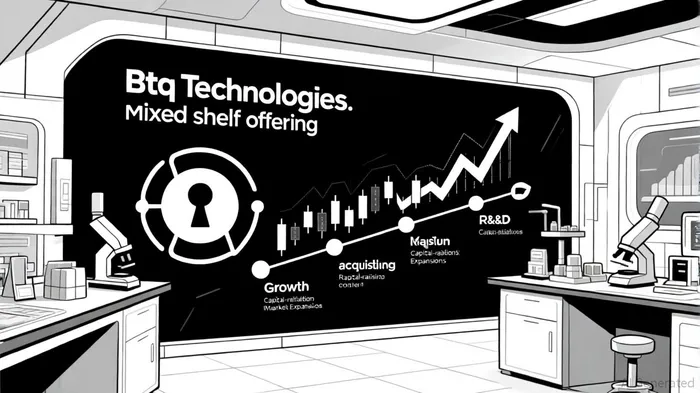
Btq Technologies' recent $100 million mixed shelf filing[1] is a masterstroke in capital-raising strategy, offering the company unprecedented flexibility to navigate the volatile post-quantum encryption market. By registering a diverse array of securities—including Class A common stock, preferred stock, warrants, and units—the firm can now tap into favorable market conditions without the administrative drag of repeated filings[2]. This approach not only minimizes costs but also allows Btq to act swiftly on growth opportunities, a critical edge in a sector where timing is everything.
Capital-Raising Flexibility: A Hedge Against Market Volatility
Mixed shelf offerings are a hallmark of companies with ambitious growth trajectories. For Btq, this $100M lifeline means it can issue securities tailored to specific needs, whether it's raising equity during a bull market or securing debt when rates are low[3]. According to a report by Investopedia, such offerings reduce the risk of market over-saturation by enabling staggered releases of securities[4]. This is particularly vital for Btq, given the speculative nature of its post-quantum computing (PQC) applications. With 22.5 million Class A shares outstanding and 41 million Class M shares controlled by its CEO as of March 2025[5], the company must balance innovation with shareholder dilution—a challenge the mixed shelf structure is designed to mitigate.
Growth Levers: R&D, Acquisitions, and Quantum-Resistant Infrastructure
The proceeds from this offering are earmarked for “general corporate purposes,” but the July 2025 announcement clarifies their intent: accelerating hardware/software development, funding strategic acquisitions, and bolstering working capital[6]. This aligns with Btq's push to commercialize its Quantum Secure Stablecoin Network (QSSN), a platform endorsed by U.S. regulators and international standards bodies[7]. By integrating dual classical and post-quantum signatures, QSSN ensures compliance with NIST and NSA guidelines, positioning Btq as a leader in quantum-resistant financial infrastructure[8].
What's more, the company's collaboration with the Quantum Industrial Standard Association (QuINSA) to standardize QSSN globally[9] underscores its potential to dominate a market projected to grow exponentially as quantum threats loom. With planned pilots in Q4 2025 alongside top stablecoin issuers[10], Btq is not just future-proofing its technology—it's actively shaping the industry's roadmap.
Competitive Positioning: A Quantum Leap Over Peers
Btq's mixed shelf filing isn't just about liquidity—it's a strategic move to outmaneuver rivals in a race against time. While competitors like Bitcoin Depot (BTM) and CCSC Technology also pursue mixed shelf offerings[11], Btq's focus on post-quantum encryption gives it a unique value proposition. Its ability to issue warrants or units could attract institutional investors seeking exposure to the PQC sector, a niche still in its infancy.
However, risks remain. The lack of detailed earnings reports for 2023–2025[12] and the speculative nature of PQC adoption could deter risk-averse investors. Yet, with the U.S. Post-Quantum Financial Infrastructure Framework (PQFIF) spotlighting QSSN as a blueprint for secure tokenized deposits[13], Btq's regulatory tailwinds are hard to ignore.
Conclusion: A Calculated Bet on the Future
Btq Technologies' $100M mixed shelf filing is more than a financial maneuver—it's a calculated bet on the future of secure digital finance. By leveraging its flexibility to raise capital and its first-mover advantage in quantum-resistant solutions, the company is poised to capitalize on a market that's still in its early innings. For investors willing to stomach the volatility, this offering represents a compelling opportunity to ride the quantum wave before it crashes.





Comentarios
Aún no hay comentarios