
BTCC's $10M New Year Trading Festival: A Strategic Play for Market Share and User Growth in 2026
In the fiercely competitive landscape of centralized cryptocurrency exchanges (CEXs), BTCC has positioned itself as a formidable contender by leveraging aggressive user incentives and innovative product offerings. As the global CEX market remains dominated by a handful of giants-Binance with a 38% market share, CoinbaseCOIN-- at 15%, and others-BTCC's 2026 New Year Trading Festival, a $10 million incentive-driven campaign, underscores its ambition to capture a larger slice of the pie. This analysis evaluates how BTCC's strategic use of financial rewards and community engagement aligns with broader industry trends and its own unique value proposition.
BTCC's 2025 Performance: A Foundation for 2026 Ambitions
BTCC closed 2025 with 11 million registered users and $775 billion in total trading volume, including $53.1 billion in tokenized real-world asset (RWA) futures-a niche product line that distinguished the exchange during a volatile market according to its 2025 performance report. This resilience, coupled with its recognition as the "Best Centralized Exchange (Community Choice)" at the BeInCrypto 100 Awards 2025, highlights BTCC's ability to retain users through diversified offerings and institutional-grade tools like its Q4 2025 integration with TradingView as reported in industry coverage.
However, the CEX sector remains highly concentrated, with the top 10 exchanges accounting for 69% of total revenue in 2024. For BTCC to scale further, it must not only compete on product innovation but also on user acquisition and retention-a challenge it addresses head-on with its 2026 New Year Trading Festival.
The $10M Festival: A Dual-Pronged Strategy
BTCC's 2026 New Year Trading Festival is structured around two phases, each designed to incentivize trading activity and foster community loyalty.
Phase 1 (Jan 4–30, 2026):
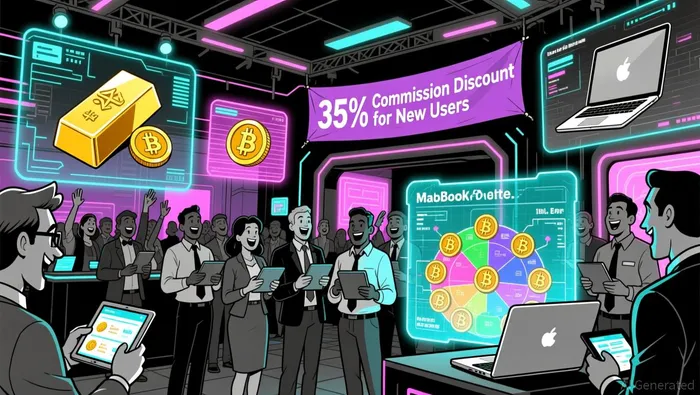
The first phase allocated $1.9 million in USDTUSDT-- to a Futures Trading Competition and $100,000 in USDT to a Profit Rate Competition. Top performers received premium rewards, including a 100-gram gold bar, 2 ETH, and a MacBook Pro. Additionally, new users were offered a 35% commission discount, a critical incentive to attract first-time traders in a market where fee competition is paramount.
Phase 2:
While details for Phase 2 remain unannounced, the staggered approach suggests BTCC aims to sustain user engagement beyond the initial post-holiday surge. This strategy mirrors industry best practices, where prolonged campaigns are used to maintain momentum in user activity.
Competitive Positioning: Incentives as a Differentiator
BTCC's $10 million prize pool is not merely a numbers game-it reflects a calculated response to the broader CEX sector's reliance on user acquisition costs. Binance, for instance, has historically used token airdrops and staking rewards to retain its user base, while Coinbase has focused on fiat on-ramping and institutional partnerships according to industry analysis. BTCC, however, is doubling down on community-driven incentives and product diversification.
The 35% commission discount for new users is particularly noteworthy. In a market where trading fees can account for 10–20% of an exchange's revenue, such discounts risk short-term profitability. Yet, BTCC's Q4 2025 performance-$22.7 billion in RWA futures trading volume-demonstrates that its diversified product suite can offset fee-based losses by capturing long-term user value as highlighted in its 2025 results.
Community Engagement: Beyond Financial Incentives
While BTCC's festival emphasizes monetary rewards, its broader community engagement strategy remains underdeveloped. As of late 2025, the exchange has not publicly announced initiatives beyond commission discounts to deepen user interaction. This gap presents an opportunity for competitors like Hyperliquid, which has leveraged decentralized governance and social token incentives to build a loyal user base according to market analysis.
However, BTCC's integration of RWA futures-allowing users to trade tokenized commodities and equities-creates a unique hook. By combining these products with the festival's incentives, BTCC can attract both retail and institutional traders seeking exposure to traditional assets in a crypto-native environment as reported in industry coverage.
Industry Trends and Regulatory Tailwinds
BTCC's strategy also benefits from favorable macroeconomic and regulatory trends. The passage of the GENIUS Act in 2025, which provided regulatory clarity for stablecoins, has spurred a 16% increase in stablecoin supply to $290 billion by Q3 2025 according to market analysis. This growth has indirectly boosted CEX trading volumes, as stablecoins serve as a liquidity bridge between traditional and crypto markets.
Moreover, the rise of digital asset treasuries (DATs) has expanded institutional participation in crypto, a trend BTCC is well-positioned to capitalize on through its RWA offerings as detailed in industry reports.
Conclusion: A Calculated Bet on 2026 Growth
BTCC's $10M New Year Trading Festival is a bold but strategic move to solidify its position in the CEX sector. By combining aggressive financial incentives with a diversified product portfolio, the exchange is addressing two critical pain points: user acquisition and retention. While its community engagement tactics remain less defined compared to peers, the festival's phased structure and focus on RWA futures suggest a long-term vision to outmaneuver competitors in a market where innovation and user experience are king.
As the CEX sector evolves, BTCC's ability to balance short-term incentives with sustainable product development will determine whether this $10 million investment translates into a lasting market share gain.





Comentarios
Aún no hay comentarios