
BTB REIT's Revised Offer to Purchase Units by Ewing Morris: Strategic and Financial Implications for Unitholders
Ewing Morris & Co. Investment Partners has launched a revised all-cash offer to acquire up to 8,000,000 units of BTB Real Estate Investment Trust (BTB) at $4.10 per unit, a 12% premium to the unaffected unit price, according to an Ewing Morris press release. This move, described as the firm's "best and final offer," extends the tender deadline to October 15, 2025, and positions unitholders with a liquidity opportunity amid BTB's historically low trading volume. For unitholders, the decision to tender units requires a nuanced evaluation of both the immediate financial benefits and the broader strategic implications for the REIT's future.
Financial Implications: Premium Liquidity vs. Yield Trade-offs
The $4.10 offer price represents a significant premium to BTB's recent trading performance. Data from StockAnalysis show that BTB units have not traded above $4.00 in over three years. At this price, the yield on BTB units would fall to 7.3%, calculated using the Trust's current annualized dividend per the Ewing Morris announcement. This yield is notably lower than the average yields of other Canadian REITs, such as Minto Apartment REIT (8.2%) and Agree Real Estate Investment Trust (7.8%), which Ewing Morris has highlighted as higher-yielding alternatives in its announcement.
For unitholders seeking liquidity, the offer provides immediate value. The total value of the tender, if fully subscribed, would reach $32.8 million per the Ewing Morris announcement, offering a substantial cash infusion for those holding large blocks of units. However, the yield reduction raises questions about the long-term appeal of BTB units post-tender. If a significant portion of the 8 million units is accepted, the remaining unitholders could face a smaller, potentially less diversified portfolio, which might impact future dividend stability.
Strategic Considerations: Board Neutrality and Ewing Morris's Motives
BTB's Board of Trustees has explicitly declined to recommend acceptance or rejection of the offer, according to BTB's update. This neutrality reflects the board's acknowledgment of the offer's fairness but also underscores the lack of a clear strategic vision for the REIT's future. In contrast, Ewing Morris's broader strategy reveals a focus on value-driven opportunities in the REIT sector. For instance, the firm recently advocated for a strategic review of Stoneridge Inc., emphasizing cost synergies and asset optimization, as noted in BTB highlights. While Ewing Morris has not explicitly outlined its plans for BTB post-tender, its emphasis on liquidity and yield efficiency suggests a preference for consolidating or repositioning underperforming assets.
The offer also highlights structural challenges in BTB's market dynamics. With limited trading volume, large unitholders have historically struggled to exit positions without depressing the price, an issue Ewing Morris's announcement seeks to address by providing a guaranteed buyer at a premium, albeit at the cost of reducing the REIT's capital base.
BTB's Financial Performance: Growth Amid Constraints
BTB's recent financial results present a mixed picture. In Q3 2024, the Trust reported a 92.3% occupancy rate, with rental income and net operating income rising by 1.5% and 4.8%, respectively, compared to the same period in 2023, as highlighted by BTB. These figures reflect organic growth in its industrial and commercial portfolio. However, Q2 2025 revenue declined by 5.29% year-over-year to $30.51 million per StockAnalysis, signaling short-term volatility.
The Trust's debt management remains prudent, with a total debt ratio of 58.3% and a mortgage debt ratio of 52.5% according to BTB highlights. These metrics suggest BTB has sufficient leverage to fund operations without overexposure. Yet, the revenue decline and yield compression from the Ewing Morris offer raise concerns about the REIT's ability to sustain growth in a competitive market.
Conclusion: A Calculated Decision for Unitholders
Unitholders must weigh the immediate benefits of the $4.10 offer against the long-term implications for BTB's value. For those prioritizing liquidity and seeking to capitalize on a premium price, the tender represents a compelling opportunity. However, unitholders who believe in BTB's growth potential-backed by its stable debt ratios and organic income growth-may prefer to hold units, especially if the tender reduces the REIT's scale and diversification.
Ewing Morris's strategic focus on yield optimization and its history of advocating for asset reviews at other companies suggest that the firm may not pursue further value-creation initiatives for BTB post-tender. Unitholders are advised to consult financial advisors and review the detailed offer documents on BTB's SEDAR+ profile per the Ewing Morris press release before making decisions. 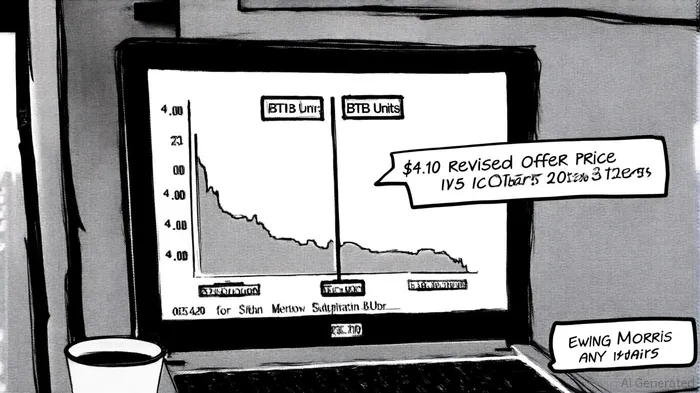







Comentarios
Aún no hay comentarios